
Caw
Open source web terminal multiplexer for AI agents
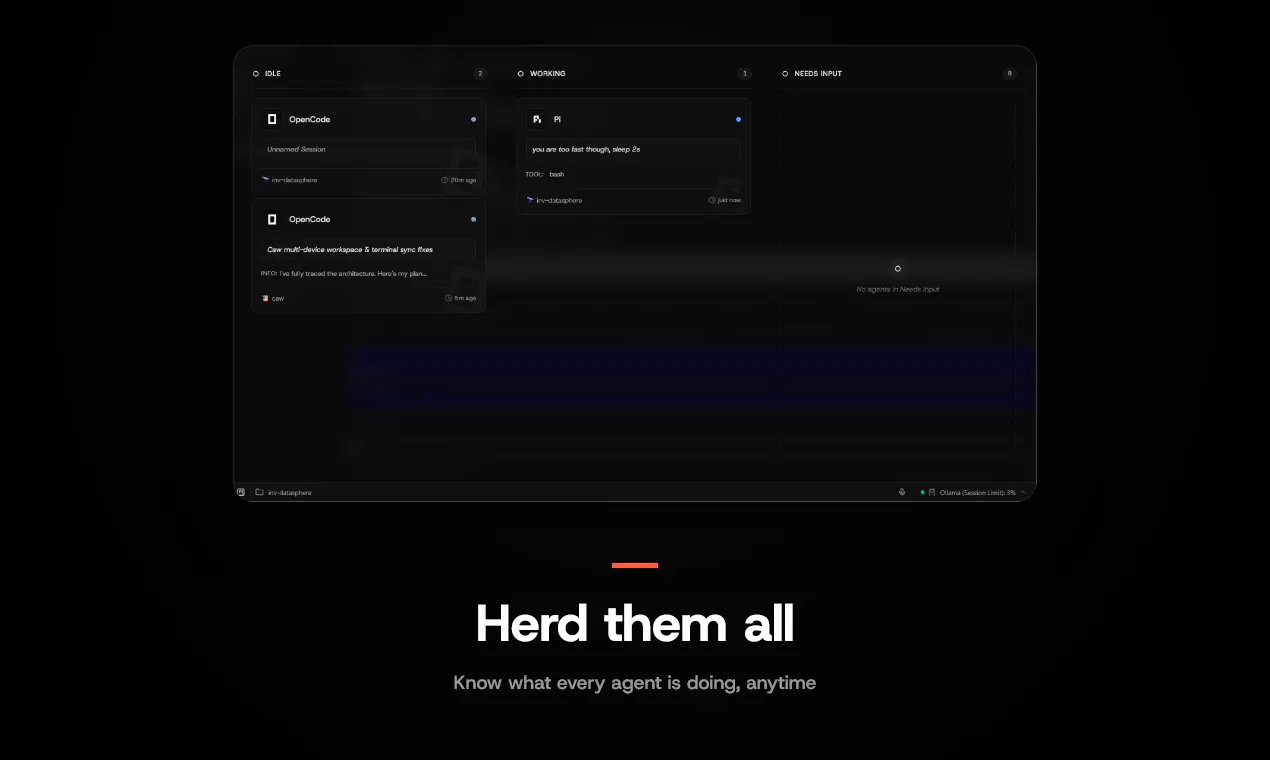
Caw is a web terminal multiplexer for OpenCode, Claude Code, Codex, Copilot, Antigravity, and Pi. It makes it easy to monitor and interact with multiple agent sessions from anywhere, especially on mobile. Besides the terminal multiplexer itself, it includes: - Built-in file browser and editor - Kanban-like board showing all running agents - Push notifications whenever an agent finishes working or requests your input - Git worktrees on demand to parallelize work - Voice mode
AI Analysis
Caw is an open-source web terminal multiplexer for AI coding agents including Claude Code, Copilot, and others. It enables monitoring and interacting with multiple agent sessions from any device, particularly mobile. Core features include a built-in file browser and editor, Kanban board for tracking agents, push notifications for task completion or input requests, on-demand Git worktrees for parallelization, and voice mode. It solves key pain points like fragmented management of AI tools, difficulty in overseeing concurrent sessions, and lack of seamless mobile access. The value proposition is a unified, accessible platform that boosts developer productivity in AI-driven coding workflows.
In 2025-2026, AI agent adoption in software development is accelerating with maturing models and multi-agent systems. Technology for web-based terminals and notifications is mature, while user demand for orchestration tools grows amid rising AI coding usage. Economic push for developer efficiency supports this. It is an Excellent Timing as the market needs specialized tools to manage proliferating AI agents.
High. Technical difficulty is medium as it builds on established web terminal tech and open-source components; integrations with AI APIs are achievable but require maintenance. Development costs are lowered by open-source community contributions. Minimal supply chain or compliance risks for a dev tool. Strong scalability for self-hosting. Team fit is suitable for developers familiar with terminals and AI.
Primary users: Software developers and engineers using AI coding assistants (ages 25-40, tech-savvy). Industries: Software development, startups, open-source communities. Geographic: Global with concentration in US, Europe, and Asia tech hubs. Estimated TAM for AI developer tools: $1B+, SAM for agent management ~$200M, SOM for open-source segment smaller. Core pains: inefficient multi-agent oversight and mobile inaccessibility. Willingness to pay: moderate; open-source model suggests reliance on donations, sponsorships or optional premium hosting.
Medium. Direct competitors: 1. OpenDevin (github.com/OpenDevin/OpenDevin), 2. Aider (aider.chat), 3. Warp Terminal (warp.dev), 4. tmux (open source terminal multiplexer), 5. Continue.dev (continue.dev). Advantages: web/mobile-first access, integrated Kanban/notifications/voice/Git worktrees, open-source focus on AI agent multiplexing. Disadvantages: potentially less mature ecosystem, narrower single-tool depth vs specialized AI IDEs, requires self-management compared to hosted platforms.
Upgrade Pro to unlock full AI analysis
Similar Products

Opaline
PostHog for team Claude Code and Codex sessions.
▲ 141 votes

React UI Kit V7
All the chat components you need. None of the complexity
▲ 115 votes

Replay QA Security Scan
Automated Penetration Testing for AI-Built Apps
▲ 102 votes

CodeBurn
See where your AI coding spend actually goes
▲ 101 votes

Audryo
Customer email your agent can operate.
▲ 68 votes

Refoid
Automate App Store refund responses and track every outcome
▲ 68 votes