
Clark
An AI coworker with its own cloud computer
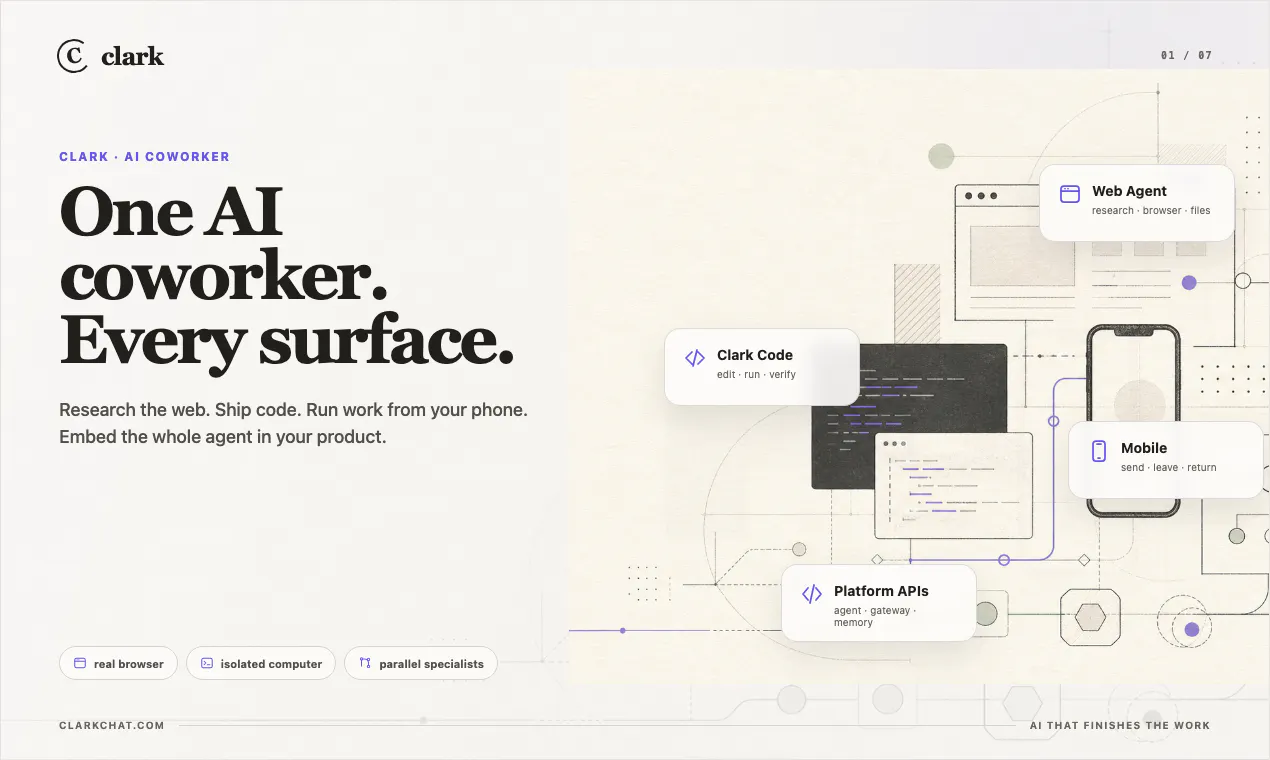
Clark is an AI coworker with its own cloud computer - browser, terminal, files, and code. Hand it a real task, close the tab, and come back to finished work: wide, sourced research; websites; spreadsheets; decks; audits; or tested code. It can fan work out to parallel specialists, run on a schedule, and return artifacts with the evidence behind them. Use Clark on web or mobile, work in real repositories with Clark Code, or embed the agent through an OpenAI-compatible API.
AI Analysis
Clark is an AI coworker equipped with its own cloud computer featuring a browser, terminal, files, and code editor. Core features include handing off real tasks like sourced research, creating spreadsheets/decks, audits, and tested code; multi-agent parallel collaboration; scheduled execution; and delivering artifacts with full evidence. It solves key pain points for professionals: time lost on repetitive digital workflows, context switching across tools, and lack of reliable autonomous execution. Available on web/mobile, integrable with real code repos via Clark Code, or embeddable via OpenAI-compatible API. The value proposition is a truly independent AI team member that completes complex work while users focus elsewhere, boosting productivity with transparency.
The timing is highly favorable for 2025-2026. Industry trends show explosive growth in agentic AI and multi-modal models, with cloud computing infrastructure now mature enough to support persistent, stateful environments. User demand is shifting rapidly from chat-based AI to autonomous coworkers that deliver completed artifacts amid economic pressures for efficiency. Policy support for AI innovation and enterprise adoption further accelerates this. Excellent Timing.
High. While controlling a full cloud computer environment (browser/terminal/code) presents technical challenges around reliability and error recovery, current LLM capabilities and cloud APIs make core implementation viable. Development costs are significant due to heavy compute usage, but scalability is strong via API and scheduling features. Compliance risks are moderate (data privacy in cloud ops). Suitable for teams with AI/cloud expertise; main risk is long-term accuracy in complex tasks. Overall High feasibility.
Primary segments: Software developers, AI engineers, product managers, and researchers in tech/consulting firms (ages 25-45, tech-savvy). Industries: Software development, data analysis, R&D. Geographic focus: Primarily North America and Europe, with global remote users. TAM for AI productivity/agent tools estimated >$40B by 2026; SAM for autonomous cloud agents ~$4-6B; SOM for developer-focused agents ~$800M. Core pain points: Manual research/coding overhead and unreliable delegation. High willingness to pay ($20-100+/mo) for time savings and output quality.
Medium. Direct competitors: 1. Devin (cognition.ai) - AI software engineer; 2. MultiOn (multion.ai) - autonomous web browser agent; 3. Adept (adept.ai) - AI agents for enterprise workflows; 4. Anthropic Claude Computer Use (anthropic.com); 5. Replit Agent (replit.com). Clark's advantages: full integrated cloud computer with files/terminal/code, evidence-backed artifacts, scheduling, multi-specialist fan-out, and seamless repo/API integration. Disadvantages: newer player with potentially less brand recognition, higher compute costs possibly leading to premium pricing, and common agent reliability challenges. Strong differentiation via "AI coworker" autonomy and transparency.
Upgrade Pro to unlock full AI analysis
Similar Products
Cohere Parse 5
Turn complex docs, tables & images into AI-ready data
▲ 158 votes

Adapt
The company brain that gets work done
▲ 124 votes
Kosshi
Simple, fast outliner for Mac and iPhone.
▲ 90 votes

WikiFix for Confluence
Find and fix issues in your knowledge base
▲ 86 votes

Audryo
Customer email your agent can operate.
▲ 68 votes
Refoid
Automate App Store refund responses and track every outcome
▲ 68 votes