ClinicFrame
Like Granola, but for healthcare. Fully HIPAA-compliant.
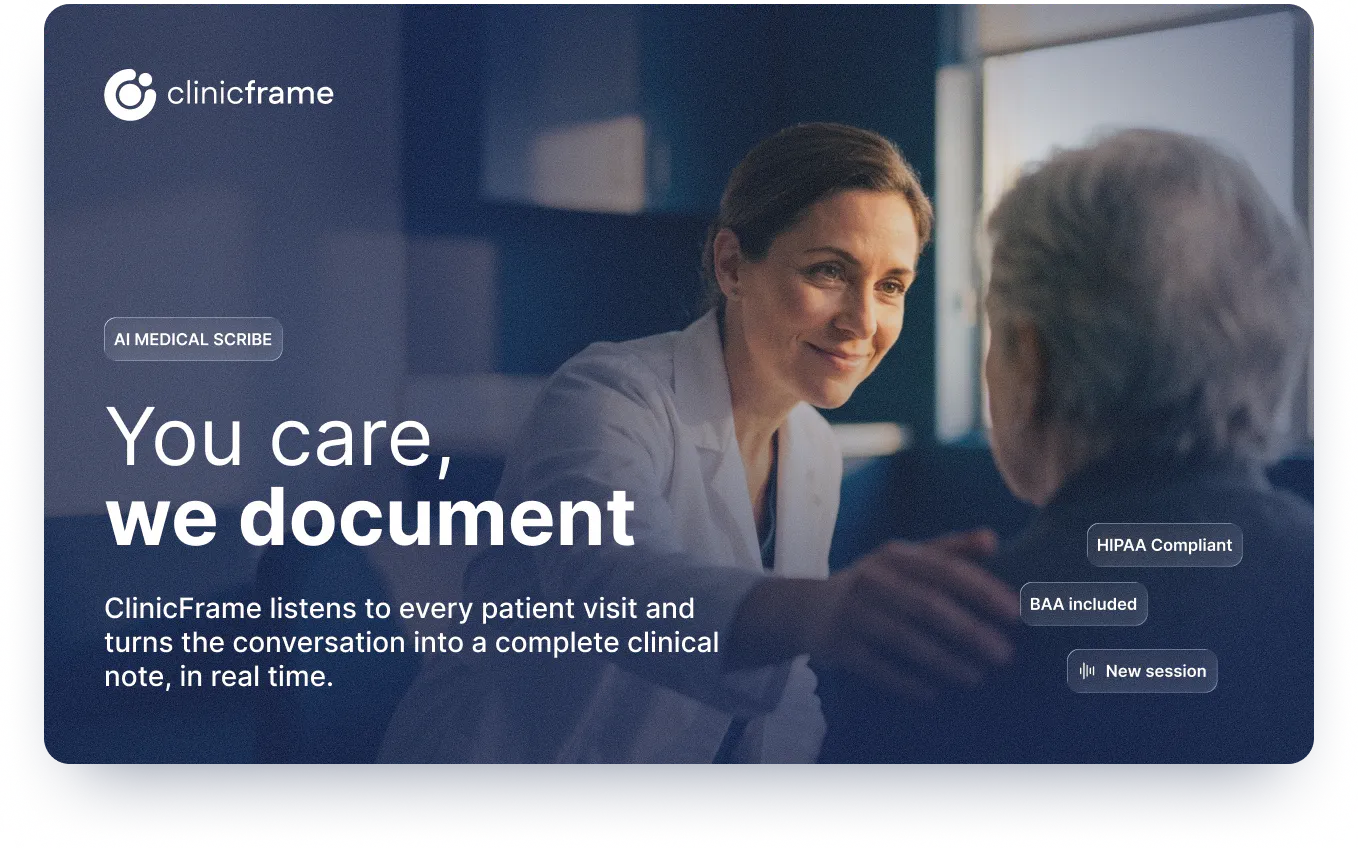
An ambient AI scribe that writes clinical notes in real time so you can focus on your patient. It passively captures every visit, whether in person or virtual, and delivers a complete, structured clinical note the moment the encounter ends. HIPAA compliant, desktop native, and EHR ready in seconds. We're launching Scribe today, with a much bigger vision ahead: a medical intelligence platform that goes beyond documentation to support the entire clinical workflow.
AI Analysis
ClinicFrame is an ambient AI scribe that passively listens to in-person or virtual patient visits and instantly generates complete, structured clinical notes upon encounter end. Core features include real-time documentation, full HIPAA compliance, desktop-native app, and seamless EHR integration in seconds. It solves key pain points like physician burnout from excessive admin time (often twice the patient-facing time) and fragmented workflows. USP is its 'Granola for healthcare' simplicity combined with medical-grade accuracy and a roadmap to a full medical intelligence platform beyond notes. Value proposition: frees clinicians to focus on patients, improves note quality, reduces documentation burden, and scales to support entire clinical workflows.
2025-2026 is an excellent period as AI transcription and NLP technologies have matured sufficiently for reliable medical use. Physician burnout and administrative burden are at crisis levels post-pandemic, driving demand for ambient scribes. Telehealth normalization, supportive digital health policies, and EHR integration standards create tailwinds. Economic pressure on healthcare systems to cut costs via automation further favors adoption. Excellent Timing.
Technical difficulty is moderate-high due to requirements for medical accuracy, context understanding, and low error rates to avoid liability. HIPAA compliance adds security and operational costs but is already addressed. Development costs for specialized AI models are significant, yet desktop-native approach simplifies deployment. Scalability is strong as cloud-backed SaaS. Overall feasibility is High given the product is launching with stated compliance and integrations; key risks are ongoing model refinement and regulatory changes. High.
Primary users: US physicians, nurse practitioners, and clinicians in outpatient clinics, private practices, and ambulatory care (demographics: 30-65 years old, tech-comfortable MDs). Industry: Healthcare providers. Geographic: Primarily United States (HIPAA focus). TAM for AI clinical documentation tools exceeds $5B globally with SAM ~$1-2B in US ambulatory market; SOM for new entrant targeting early adopters ~$50-100M. Core pains: documentation consuming 40-60% of time, leading to burnout and reduced care quality. Willingness to pay is high ($50-300/provider/month) as ROI from time savings is clear.
High. Direct competitors: 1. Abridge (abridge.com), 2. DeepScribe (deepscribe.ai), 3. Nabla Copilot (nabla.com), 4. Heidi Health (heidihealth.com), 5. Suki AI (suki.ai). Advantages: Emphasizes desktop-native simplicity 'like Granola', instant EHR readiness, and broader platform vision. Disadvantages: Newer entrant with less proven scale/track record than incumbents like Nuance/Microsoft DAX; may have fewer integrations initially and faces trust barriers in regulated healthcare. Differentiation via passive capture and full workflow ambition is promising but competition pressure is intense on features and accuracy.
Upgrade Pro to unlock full AI analysis
Similar Products

Lev8
Find, research, and reach the right people
▲ 451 votes

Auriko
Trading desk for LLM calls
▲ 332 votes

Cohere Parse 5
Turn complex docs, tables & images into AI-ready data
▲ 158 votes

Adapt
The company brain that gets work done
▲ 124 votes

Tapfree for Chrome
Voice dictation that adapts to what’s on your screen
▲ 122 votes
CodeBurn
See where your AI coding spend actually goes
▲ 101 votes