Codex GPU Queue
Run GPU jobs from multiple Codex tasks via one Windows queue
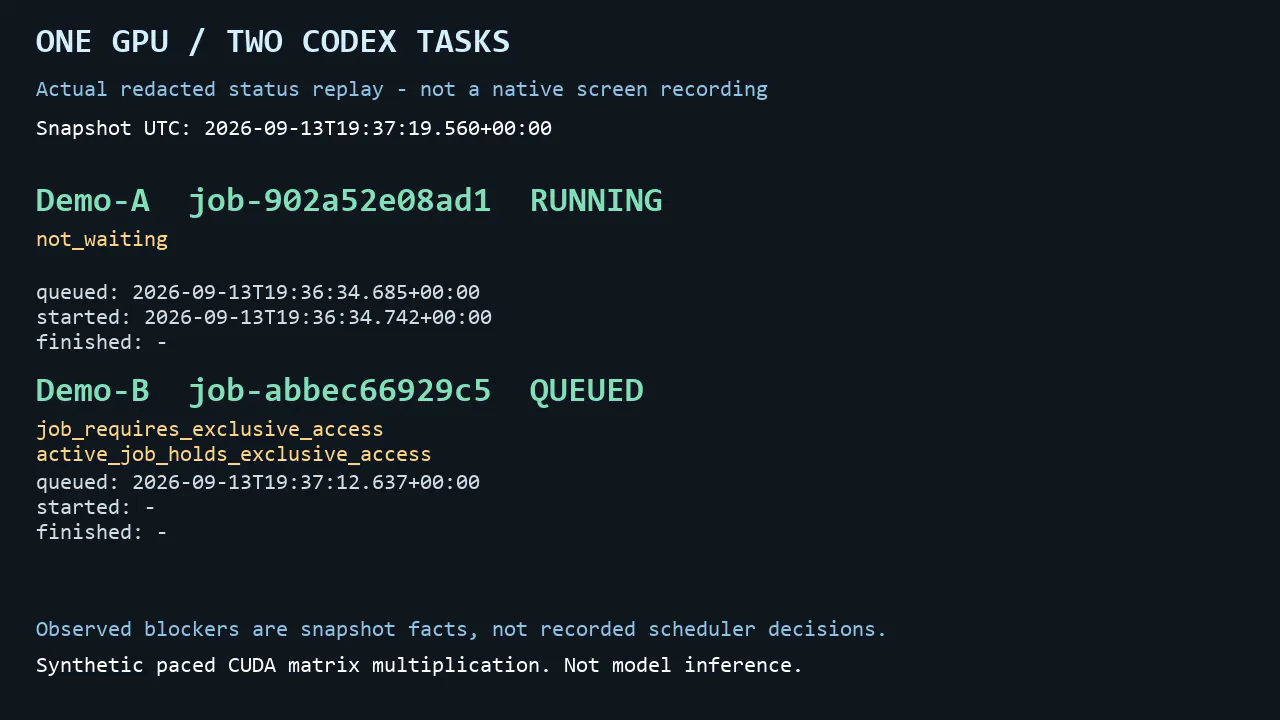
Run GPU jobs from multiple Codex tasks through one local Windows queue. A shared broker starts eligible work automatically. Inspect confirmed waiting blockers in a redacted, read-only CLI; uncertain reasons stay undetermined.
AI Analysis
Codex GPU Queue allows running GPU jobs from multiple Codex tasks via a single local Windows queue. A shared broker automatically initiates eligible tasks. It provides a redacted read-only CLI to inspect confirmed waiting blockers while leaving uncertain issues undetermined. It solves pain points around managing concurrent GPU resource conflicts and identifying blockers in AI/developer workflows. The value proposition centers on simplified, automatic job queuing to boost productivity for users handling multiple AI coding or GPU-intensive tasks on Windows.
In 2025-2026, explosive growth in AI tools, local model inference, and GPU computing demand creates strong need for efficient local resource managers. Despite Codex deprecation, similar AI coding/GPU workflows are expanding with developer productivity focus. Favorable policy for AI innovation and hardware maturation support this. Excellent Timing.
Technical difficulty is moderate, requiring Windows queue/broker implementation and GPU monitoring but no complex infrastructure. Low dev/operation costs as a lightweight desktop tool. Minimal compliance/supply chain risks. Good scalability for personal/dev use but limited for enterprise. Overall rating: High, assuming small-team development fit.
Main segments: AI developers, ML engineers, and productivity-focused programmers using Windows GPUs for local AI tasks (demographics: tech professionals 25-45). Industries: Software dev, AI research. Geographic: Global with concentration in US, Europe. TAM for AI dev tools large (~$15B+), but SAM/SOM niche (~10K-50K potential users). Pain points: GPU contention and job blocking. Moderate willingness to pay for time-saving tools.
Low. Direct competitors: 1. Ray (ray.io), 2. Dask (dask.org), 3. Slurm (slurm.schedmd.com), 4. Kubernetes GPU operators (kubernetes.io), 5. Celery (celeryproject.org). Advantages: Simpler Windows-specific auto-broker for Codex-like tasks, unique blocker CLI. Disadvantages: Narrower scope, local-only, less features/scalability than full orchestrators; no mentioned pricing edge.
Upgrade Pro to unlock full AI analysis
Similar Products

Cohere Parse 5
Turn complex docs, tables & images into AI-ready data
▲ 158 votes

Adapt
The company brain that gets work done
▲ 124 votes

Tapfree for Chrome
Voice dictation that adapts to what’s on your screen
▲ 122 votes

Replay QA Security Scan
Automated Penetration Testing for AI-Built Apps
▲ 102 votes

Kosshi
Simple, fast outliner for Mac and iPhone.
▲ 90 votes

Thoughts for Mac
Capture notes from your menubar using text, images or voice
▲ 90 votes