
Coffee Piano
Browser piano studio with visual harmony tools
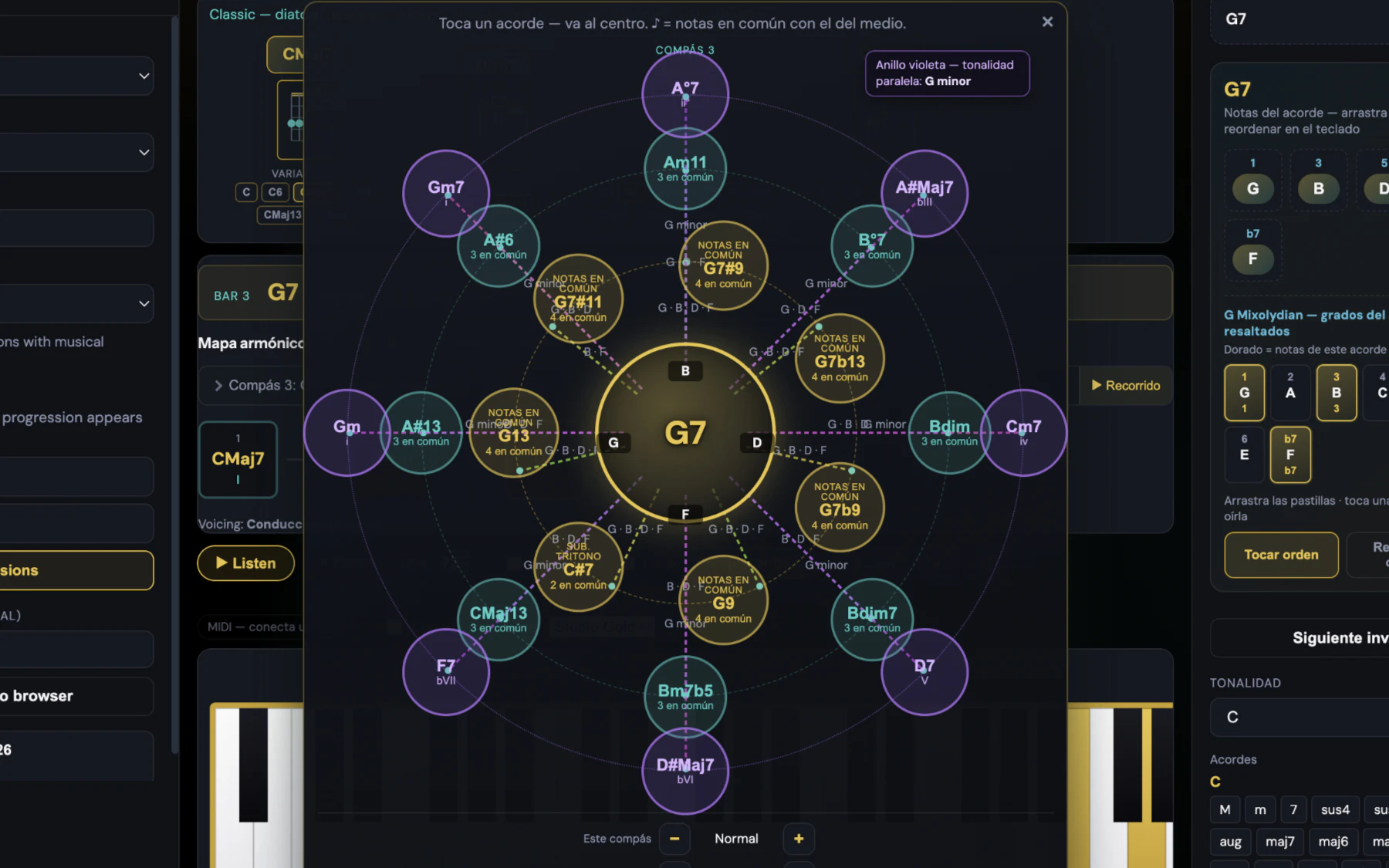
Most harmony tools are too theoretical or too simple. Coffee Piano combines a real piano studio, sampled Piano & Rhodes, MIDI, sustain pedal with a visual harmony engine. Orbit visuals show scales and chords as circular maps. A harmony map reveals voice leading and chord function. Reharmonize in one click per bar or full progression. Guitar diagrams sync to every chord. Works in the browser, no install, bilingual UI.
AI Analysis
Coffee Piano is a browser-based piano studio integrating sampled Piano & Rhodes sounds, MIDI support, and sustain pedal with a visual harmony engine. Core features include Orbit visuals (circular maps for scales/chords), harmony map for voice leading and chord functions, one-click reharmonization per bar or full progression, and synced guitar chord diagrams. It solves the pain of harmony tools being too theoretical or simplistic by offering practical, visual, interactive learning. USP is the seamless combination of playable instrument and advanced visual theory tools in an accessible, no-install, bilingual web app. Overall value: democratizes music harmony education and creativity for real-time experimentation and skill-building.
Favorable for 2025-2026 due to maturing Web Audio/MIDI APIs enabling sophisticated browser tools, rising demand for engaging online music education post-pandemic, and growing interest in visual/AI-assisted music theory learning. Users seek interactive alternatives to dry textbooks. Digital SaaS music tools are expanding with favorable economic trends toward creative hobbies. No major policy barriers. Excellent Timing.
High. Technical difficulty is manageable using established web technologies (Web Audio API, Canvas for visuals). Low ongoing operation costs as a browser SaaS with no physical supply chain. Minimal compliance risks for a music education tool. Strong scalability via cloud. Bilingual UI shows team execution capability. Already functional per launch status. High feasibility with good potential for updates.
Primary users: amateur/intermediate pianists, music theory students, self-taught musicians, and educators (ages 15-40). Industries: music education, hobbyist production. Geographic: global, with emphasis on English/Chinese speakers due to bilingual UI. TAM for digital music education ~$5-10B, SAM for web-based theory tools ~$500M, SOM for visual harmony niche ~$50M. Core pains: abstract harmony concepts hard to apply while playing. High willingness to pay for premium features like advanced reharmonization.
Medium. Direct competitors: 1. Hooktheory (hooktheory.com) - visual chord theory. 2. Chordify (chordify.net) - automatic chord detection. 3. Yousician (yousician.com) - gamified instrument learning. 4. iReal Pro (irealpro.com) - backing tracks and charts. Advantages: unique Orbit visuals, integrated playable piano + one-click reharmonize + harmony map, fully browser-based. Disadvantages: potentially less established content library or community than larger platforms; pricing unknown but must compete on value.
Upgrade Pro to unlock full AI analysis
Similar Products

Load Nova
Dispatchers AI Co-Pilot and Dashboard that care about speed
▲ 131 votes

Adapt
The company brain that gets work done
▲ 124 votes

Onpilot
An AI workforce customized to your business
▲ 105 votes

WikiFix for Confluence
Find and fix issues in your knowledge base
▲ 86 votes

Saldor
Speed up procurement and AP.
▲ 78 votes

Prowler Cloud
Where your AI agent becomes a cloud security defender
▲ 64 votes