
Comcent
AI-ready voice infrastructure on your own SIP trunk
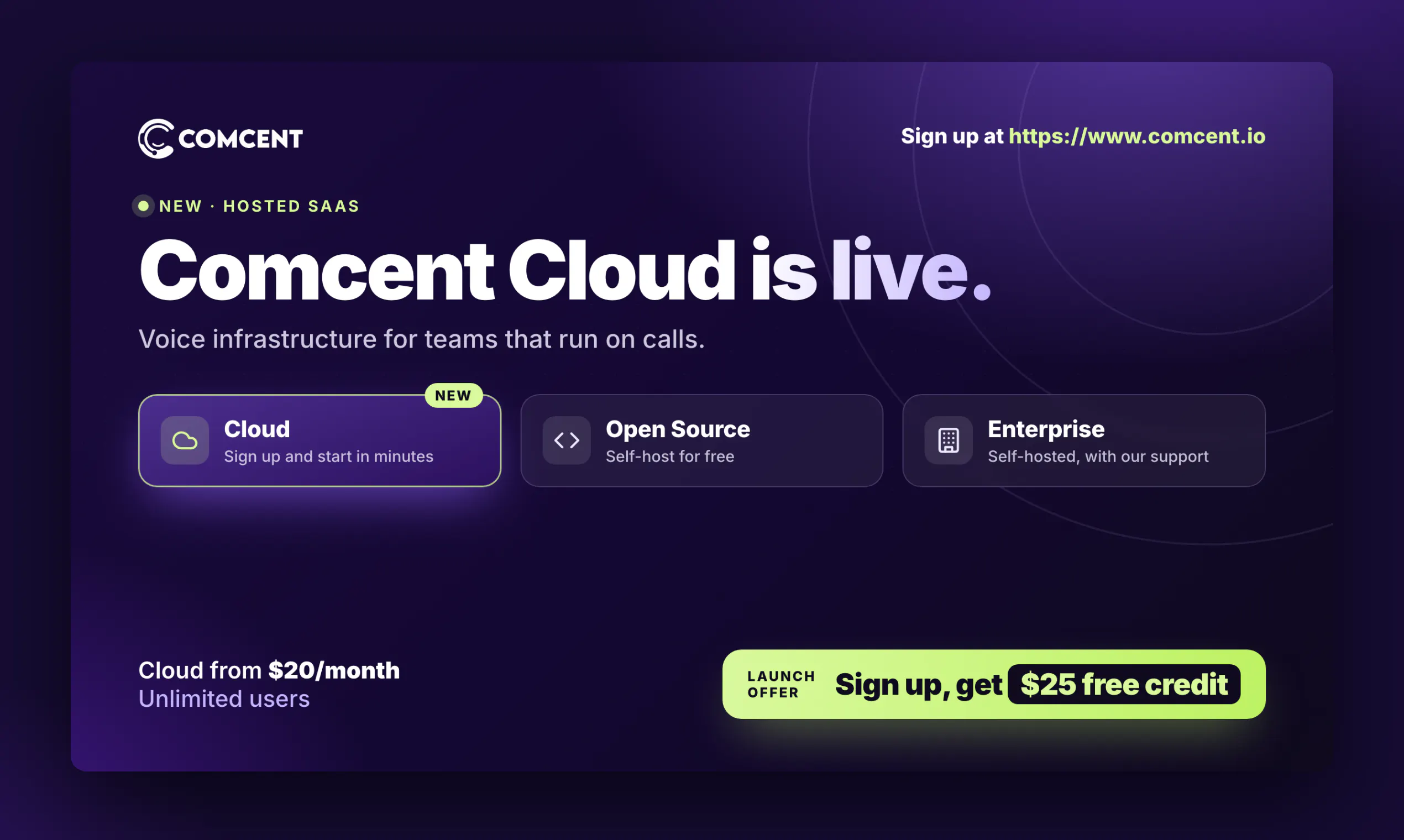
Comcent is voice infrastructure for teams that run on calls. Connect your Twilio account (or any SIP provider) in a few clicks and your team takes calls in the browser, with call flows, queues, transfers and recordings. AI transcribes and summarises every call, scores sentiment and tracks the promises agents make, and AI voice bots can answer and hand over to a person. Every call can go to your own systems as a standard vCon. Unlimited users from $20/month, and the core is open source.
AI Analysis
Comcent provides AI-ready voice infrastructure that integrates with Twilio or any SIP provider. Teams handle calls directly in the browser with features including call flows, queues, transfers, recordings, and AI-powered transcription, summarization, sentiment scoring, and promise tracking. AI voice bots can answer calls and hand off to humans. Every call exports as standard vCon for custom system integration. The core is open source. Starting at $20/month for unlimited users, it solves pain points like complex call center setup, lack of AI insights from conversations, vendor lock-in, and data ownership for customer-facing teams.
In 2025-2026, real-time AI voice tech is maturing rapidly with models enabling natural conversations, while demand surges for AI automation in customer support to cut costs amid economic pressures. Shift to browser-based, open tools avoiding vendor lock-in aligns with trends in data ownership and AI integration in comms. Policy focus on AI ethics in telecom adds some hurdles but overall favors innovative solutions. Excellent Timing.
Leverages mature tech like Twilio SIP, WebRTC for browser calls, and existing AI APIs for transcription/sentiment (no novel R&D needed). Open source core aids community support. Challenges include real-time voice bot reliability, telecom compliance (privacy, recording consent), and scaling infrastructure. Development/operation costs are manageable with cloud providers. High scalability potential. High
Main segments: Sales/support teams in SMBs and mid-market companies handling high inbound/outbound calls. Industries include SaaS, e-commerce, services, and call centers. Geographic focus: Global with emphasis on US/Europe. TAM for AI-powered contact center software ~$15-20B by 2026; SAM for voice infrastructure layer ~$1-2B; SOM for affordable open-source options ~$300M. Core pains: costly legacy systems, missing AI analytics on calls, integration friction. Strong willingness to pay for value at $20/mo unlimited.
Medium. Direct competitors: 1. Vapi.ai (vapi.ai), 2. Retell AI (retell.ai), 3. Bland.ai (bland.ai), 4. Twilio Voice with AI add-ons (twilio.com), 5. Air AI (air.ai). Advantages: open source core for customization, vCon standard for portability, full infra+AI at low flat pricing with unlimited users. Disadvantages: newer entrant with potentially less polished real-time voice AI than specialists, limited brand recognition vs established players.
Upgrade Pro to unlock full AI analysis
Similar Products

Cohere Parse 5
Turn complex docs, tables & images into AI-ready data
▲ 158 votes

Opaline
PostHog for team Claude Code and Codex sessions.
▲ 141 votes

Adapt
The company brain that gets work done
▲ 124 votes

Tapfree for Chrome
Voice dictation that adapts to what’s on your screen
▲ 122 votes

CodeBurn
See where your AI coding spend actually goes
▲ 101 votes

WikiFix for Confluence
Find and fix issues in your knowledge base
▲ 86 votes