
Compartment
Secure way to share apps built with AI Agents
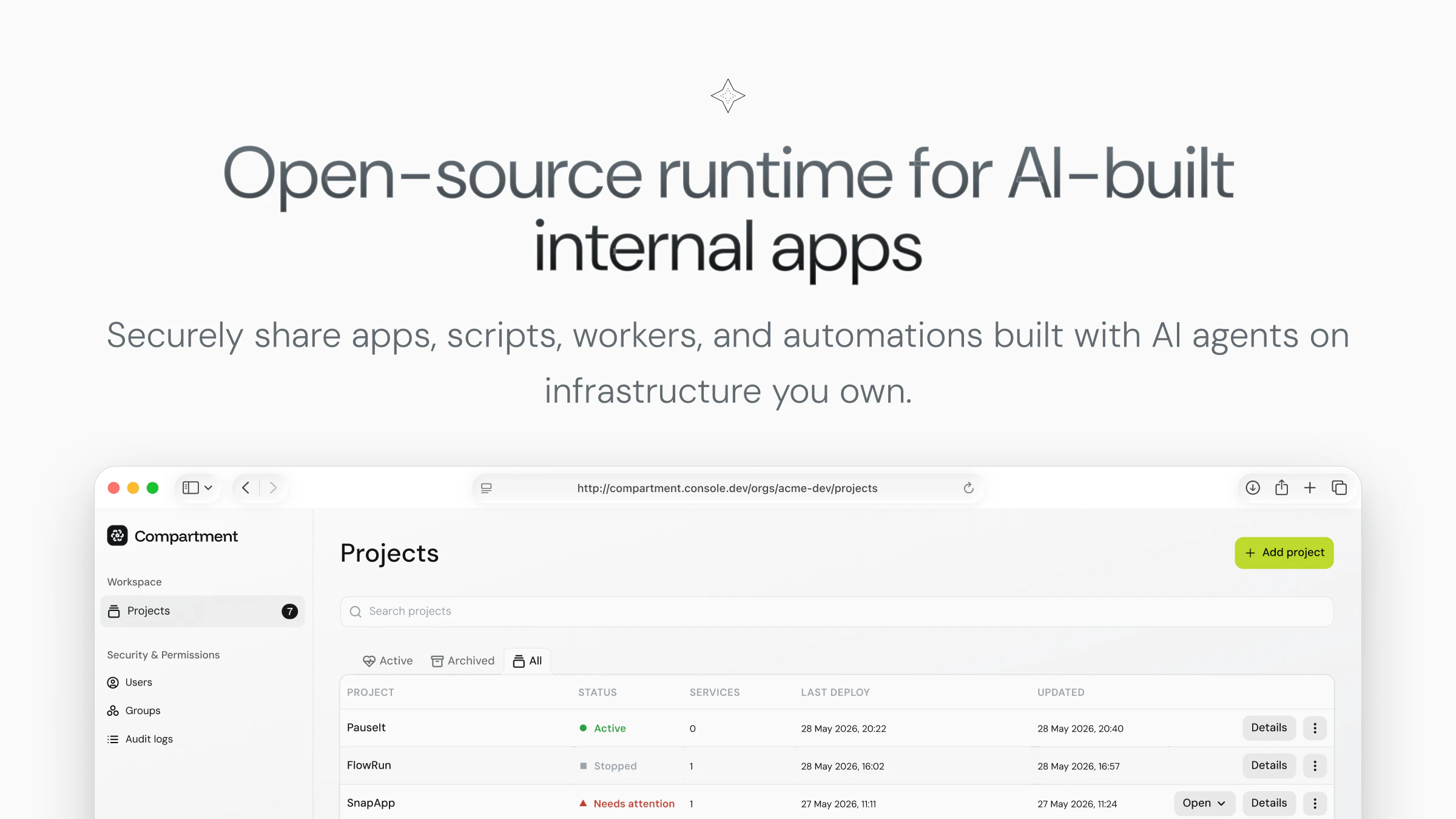
Compartment is a self-hosted open-source runtime for AI-built internal apps. It gives teams one place to run and share the apps, scripts, workers, and automations created with AI coding agents, on infrastructure they own. Use Cursor, Claude, Codex, or any stack your team already works with. Compartment turns the code into team-ready software with isolation, RBAC, SSO, and audit logs built in.
AI Analysis
Compartment is a self-hosted open-source runtime for securely running and sharing apps, scripts, workers, and automations created by AI coding agents like Cursor, Claude, or Codex. Core features include built-in isolation, RBAC, SSO, and audit logs, enabling teams to transform AI-generated code into compliant, team-ready software on their own infrastructure. It solves key pain points such as insecure deployment of AI prototypes, lack of access controls, and dependency on third-party clouds. The value proposition is providing a secure, centralized platform that maintains data ownership while fully leveraging AI development workflows.
Excellent Timing. In 2025-2026, AI coding agents are seeing rapid enterprise adoption, creating urgent demand for secure deployment solutions. Technology maturity of containerization and auth protocols supports this, while user demands shift toward self-hosted options due to privacy concerns and regulations like GDPR. Economic focus on AI productivity tools aligns perfectly, making it an ideal window before the market becomes saturated.
High. Technical difficulty is moderate leveraging mature container and auth technologies for isolation, RBAC, SSO. Development and operation costs are reduced by open-source model with users hosting on own infra. Low supply chain risk; compliance is eased by self-hosting. Strong scalability potential and good fit for dev tool teams. Key risk is maintaining robust security isolation at scale.
Primary segments: Engineering teams, DevOps professionals, and IT departments in mid-to-large tech companies using AI coding agents. Industries include software, fintech, and healthcare. Geographic focus: Global with concentration in North America and Europe. Market size is part of the rapidly expanding AI dev tools sector (large TAM driven by AI adoption). Core pain points are secure management and sharing of AI-generated internal tools with compliance needs. High willingness to pay for enterprise security features and support on top of open-source base.
Medium. Direct competitors: E2B (e2b.dev) - secure AI sandboxes; Windmill (windmill.dev) - open-source workflow and app platform; Appsmith (appsmith.com) - internal tool builder; Budibase (budibase.com) - self-hosted low-code platform; Modal (modal.com) - cloud AI app deployment. Advantages: Tight focus on AI agent outputs, comprehensive built-in security (isolation/RBAC/SSO/audit) on self-hosted infra, open-source flexibility. Disadvantages: Newer entrant may have smaller community and fewer pre-built integrations than established platforms.
Upgrade Pro to unlock full AI analysis
Similar Products

Opaline
PostHog for team Claude Code and Codex sessions.
▲ 141 votes

React UI Kit V7
All the chat components you need. None of the complexity
▲ 115 votes

Replay QA Security Scan
Automated Penetration Testing for AI-Built Apps
▲ 102 votes

CodeBurn
See where your AI coding spend actually goes
▲ 101 votes

Audryo
Customer email your agent can operate.
▲ 68 votes

Refoid
Automate App Store refund responses and track every outcome
▲ 68 votes