
Composer 2.5
Cursor’s most powerful model yet
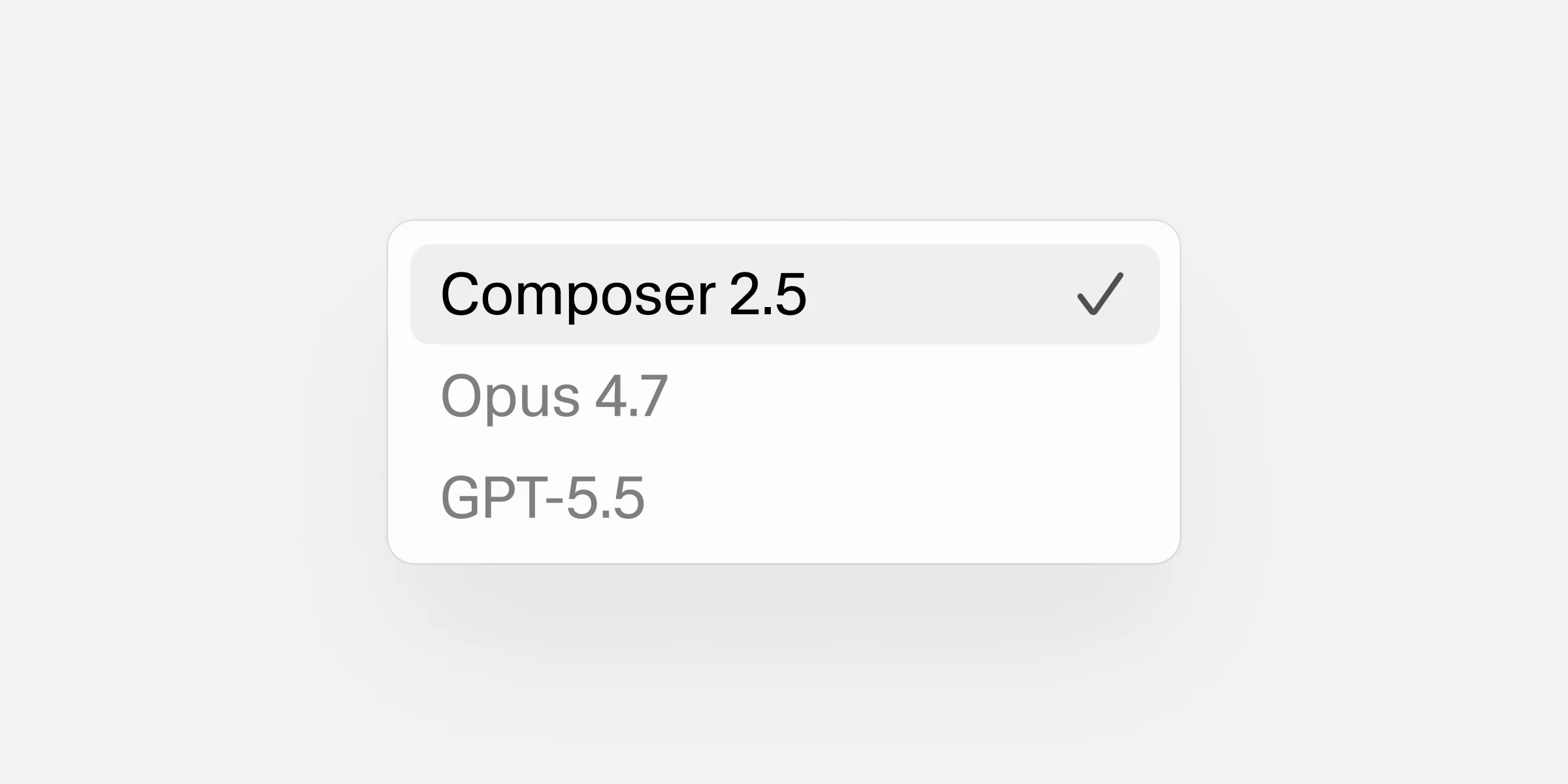
A substantial improvement in intelligence and behavior over Composer 2, particularly on long-horizon agentic tasks.
AI Analysis
Composer 2.5 is Cursor's most advanced AI model, delivering substantial improvements in intelligence, reasoning, and behavior over Composer 2. It particularly excels at long-horizon agentic tasks, enabling autonomous multi-step planning, complex code editing across large codebases, and reliable execution of ambitious development workflows. Key USPs include enhanced reliability for extended tasks with reduced hallucinations and better adherence to developer intent. It solves major pain points like frequent human corrections, context loss in intricate projects, and limited AI capability on sophisticated coding challenges. The value proposition is transforming developer productivity by acting as a highly capable AI collaborator that handles demanding software engineering tasks with greater autonomy and precision.
The timing is highly favorable for 2025-2026. Industry trends show rapid maturation of agentic AI systems, exploding demand for AI coding tools amid developer shortages, and increasing adoption of IDE-integrated AI. Technology for long-context reasoning has reached a maturity threshold, while economic pressures favor productivity-enhancing tools. No major regulatory hurdles specific to coding AI are apparent. Excellent Timing.
High. Technical difficulty is significant for training and aligning a more capable model but feasible given Cursor's existing infrastructure and prior success with Composer 2. Development costs are high for compute but manageable for an established AI company. Low supply chain or compliance risks in this software domain. Strong scalability via API/cloud delivery and good team fit. Main challenge is ongoing inference costs at scale.
Primary users: professional software engineers, full-stack developers, AI/ML engineers, and indie hackers (ages 25-45), concentrated in North America and Europe, working at startups and tech firms. TAM for AI-powered dev tools exceeds $15B, SAM for agentic coding assistants ~$3B, SOM for Cursor-like IDEs ~$500M. Core pain points include slow iteration on complex features and AI unreliability on long tasks. High willingness to pay via Cursor Pro subscriptions ($20-40/month) due to proven time savings.
High. Direct competitors: 1. GitHub Copilot (github.com/features/copilot), 2. Claude 3.5/4 (anthropic.com), 3. Aider (aider.chat), 4. Devin (cognition.ai), 5. Replit Agent (replit.com). Advantages: superior long-horizon agentic performance, deep integration in Cursor IDE, improved behavior consistency. Disadvantages: ecosystem lock-in to Cursor, potentially higher pricing, less brand recognition than GitHub Copilot in enterprise.
Upgrade Pro to unlock full AI analysis
Similar Products

Cohere Parse 5
Turn complex docs, tables & images into AI-ready data
▲ 158 votes

Opaline
PostHog for team Claude Code and Codex sessions.
▲ 141 votes

Adapt
The company brain that gets work done
▲ 124 votes

Tapfree for Chrome
Voice dictation that adapts to what’s on your screen
▲ 122 votes

CodeBurn
See where your AI coding spend actually goes
▲ 101 votes

WikiFix for Confluence
Find and fix issues in your knowledge base
▲ 86 votes