
Concordance
Three AI models on the same question. See where they split.
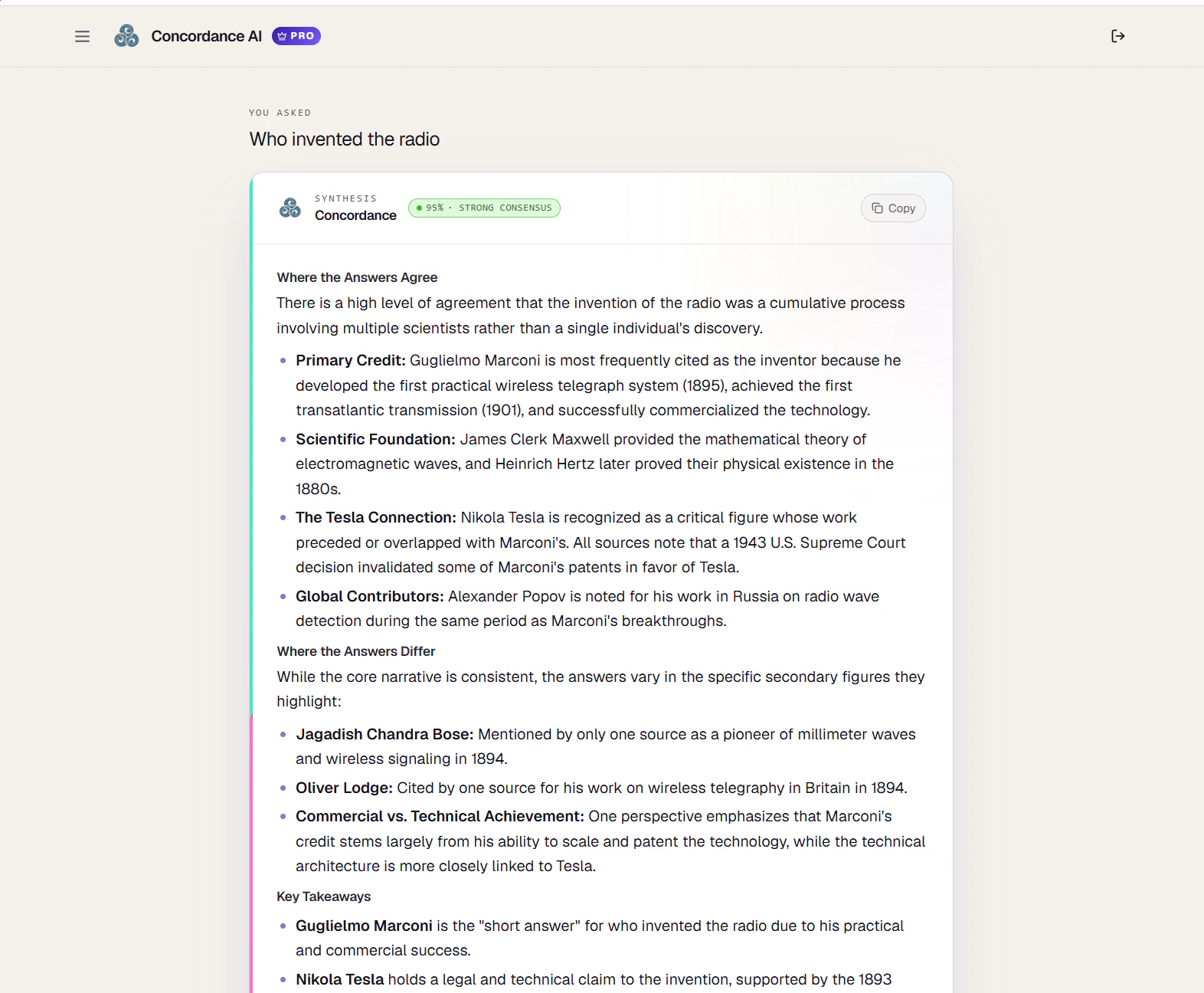
Concordance runs your question through three AI models simultaneously. A fourth synthesizes them and outputs a consensus score (0–100). High = models agree. Low = at least one is guessing. Built for the moments when one model sounds confidently wrong.
AI Analysis
Concordance runs a user's question through three AI models simultaneously. A fourth model synthesizes the outputs and generates a consensus score (0-100), where high scores indicate strong agreement and low scores flag potential guessing or divergence. Its unique selling point is providing instant visibility into model reliability, helping users identify when an AI sounds confidently wrong. It solves key pain points like AI hallucinations, overconfidence in inaccurate responses, and the difficulty of verifying outputs from single models. The value proposition is enhanced decision-making and trust in AI for important queries, making it a practical productivity tool for moments requiring verification.
In 2025-2026, LLM proliferation (GPT, Claude, Gemini, etc.) continues rapidly with maturing multi-model APIs and rising user awareness of hallucinations amid broader AI adoption in workflows. Demand for verification and trust layers is increasing as AI moves beyond novelty to critical use. Economic push for productivity tools and lighter AI regulation in key markets support this. Excellent Timing.
Technically straightforward via parallel API calls to existing LLMs and a synthesis prompt. Moderate development costs for UI/UX and orchestration; however, operational costs are a concern due to multiplied inference fees per query. Minimal supply chain or compliance risks (standard privacy focus). Strong scalability potential on cloud infrastructure with usage-based pricing. High overall, assuming optimization for cost efficiency. Rating: High.
Main segments: AI power users, software developers, researchers, content creators and analysts (ages 25-45, tech-savvy). Industries: software development, academic research, digital content, professional services. Primarily North America and Europe. Estimated market size: AI productivity tools TAM exceeding $100B by 2026; SAM for multi-model/verification tools ~$5-10B; SOM for this niche ~$50-200M. Core pain points: uncertainty in AI accuracy and time lost cross-checking. High willingness to pay via subscriptions for reliable tools among professionals.
Medium. Direct competitors: 1. Poe (poe.com), 2. LMSYS Chatbot Arena (arena.lmsys.org), 3. You.com (you.com), 4. OpenRouter (openrouter.ai). Advantages: unique synthesized consensus score and focus on reliability signaling rather than just side-by-side views; simple UX for quick checks. Disadvantages: higher per-query costs than single-model tools; less model customization than competitors; newer entrant with potentially smaller user base initially.
Upgrade Pro to unlock full AI analysis
Similar Products

Cohere Parse 5
Turn complex docs, tables & images into AI-ready data
▲ 158 votes

Adapt
The company brain that gets work done
▲ 124 votes

Kosshi
Simple, fast outliner for Mac and iPhone.
▲ 90 votes

WikiFix for Confluence
Find and fix issues in your knowledge base
▲ 86 votes

Audryo
Customer email your agent can operate.
▲ 68 votes

Refoid
Automate App Store refund responses and track every outcome
▲ 68 votes