
Contextberg
Turn your work into private memory for AI agents
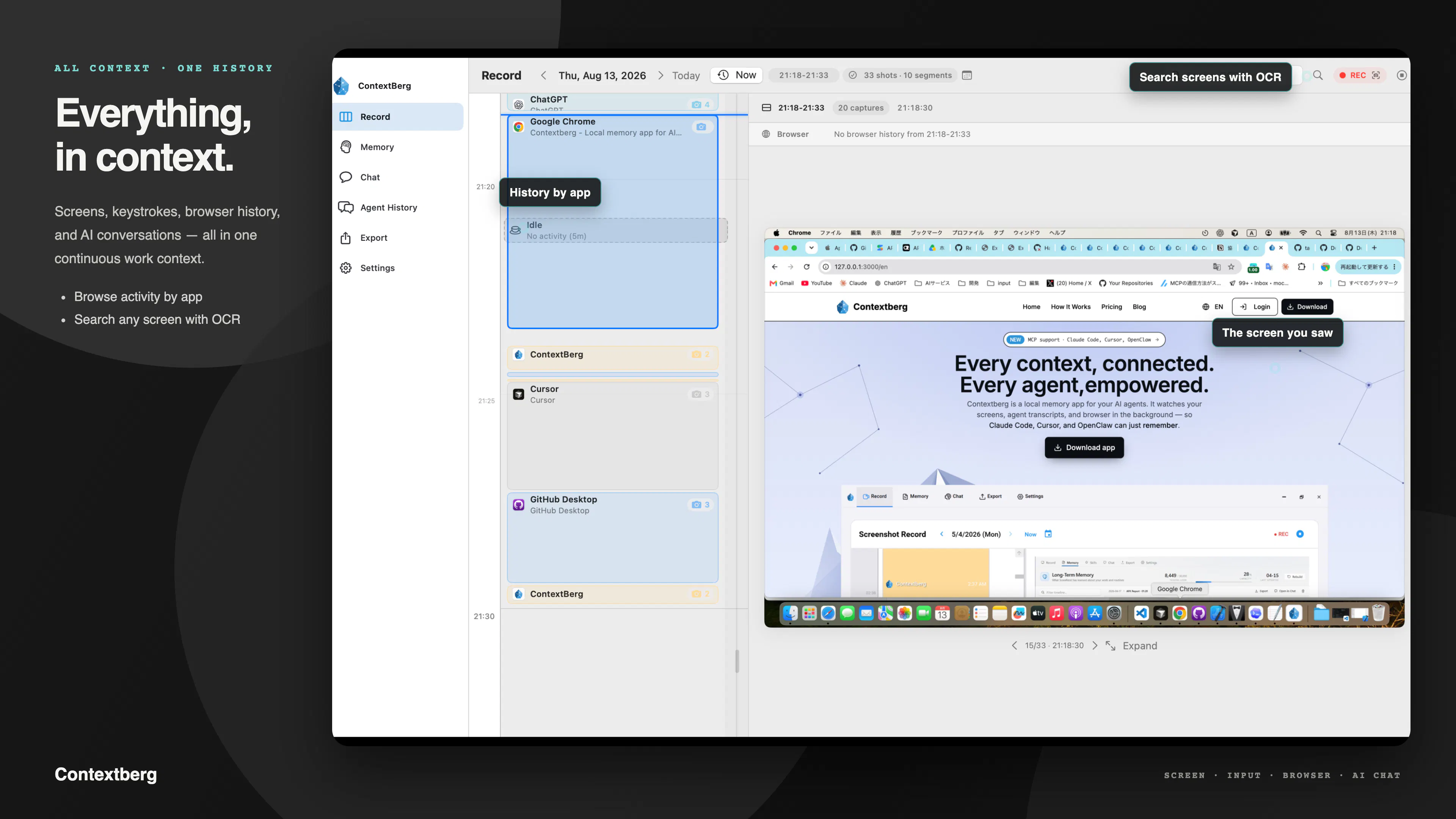
Contextberg brings local AI agent memory to macOS and Windows. It captures screens, browser history, and agent conversations into a private, searchable archive, then serves relevant context to Codex, Claude Code, Cursor, and other agents over MCP. This launch adds native macOS capture, OCR screenshot search, source exclusions, and flexible model routing: use your existing Codex sign-in, a Gemini/OpenRouter API key, Contextberg Cloud, or a fully local model.
AI Analysis
Contextberg turns your work into private memory for AI agents on macOS and Windows. It captures screens, browser history, and conversations into a private searchable archive with OCR support. Relevant context is served to tools like Cursor, Claude Code, and Codex via MCP. Unique aspects include source exclusions, native macOS capture, and flexible routing to local models, personal API keys, or cloud. It solves key pain points of AI agents lacking persistent personalized context, reducing repetition and errors while keeping all data private. Value proposition: seamless productivity boost for AI-assisted workflows with full user data ownership.
The 2025-2026 period is highly favorable due to surging adoption of AI coding agents (Cursor, Claude), maturing local LLM technologies, and growing demand for privacy-focused personal RAG solutions. User needs for persistent agent memory are acute as agentic workflows expand, supported by improving hardware for on-device AI. Economic emphasis on AI productivity tools and regulatory focus on data privacy further align perfectly. Rating: Excellent Timing.
Technical implementation is achievable using established screen capture, OCR, embedding, and local vector store technologies, with integrations to existing AI APIs. Development and operation costs are moderate for a cross-platform desktop app with optional cloud tier. Privacy/compliance risks are mitigated by local-first design. Scalability is strong via cloud options and low marginal costs per user. Team fit for AI tooling developers is natural. Overall rating: High.
Primary users: software developers, AI engineers, and technical power users working with Cursor, Claude, and similar coding agents. Demographics: tech professionals aged 25-45. Industries: software development and AI. Geographic: global with concentration in US, Europe, and East Asia. TAM: part of the $100B+ AI productivity market; SAM ~$10B for developer AI tools; SOM ~$500M for personal agent memory solutions. Core pain: lack of long-term context/memory in AI interactions. High willingness to pay for premium privacy and productivity features.
Competition level: Medium. Direct competitors: 1. Rewind.ai (rewind.ai) - continuous screen recording and search; 2. Limitless (limitless.ai) - personal AI memory pendant/app; 3. Mem (mem.ai) - AI-powered workspace and notes; 4. Recall (by Microsoft, now limited) - Windows screen memory. Advantages: specialized MCP integration for coding agents, fully local model support, OCR on screenshots with source exclusions. Disadvantages: newer product with potentially narrower scope than general memory tools, requires desktop installation.
Upgrade Pro to unlock full AI analysis
Similar Products

Cohere Parse 5
Turn complex docs, tables & images into AI-ready data
▲ 158 votes

Adapt
The company brain that gets work done
▲ 124 votes

Replay QA Security Scan
Automated Penetration Testing for AI-Built Apps
▲ 102 votes

Kosshi
Simple, fast outliner for Mac and iPhone.
▲ 90 votes

Thoughts for Mac
Capture notes from your menubar using text, images or voice
▲ 90 votes

Refoid
Automate App Store refund responses and track every outcome
▲ 68 votes