
CraftBot with Living UI
Grow your own software that is alive
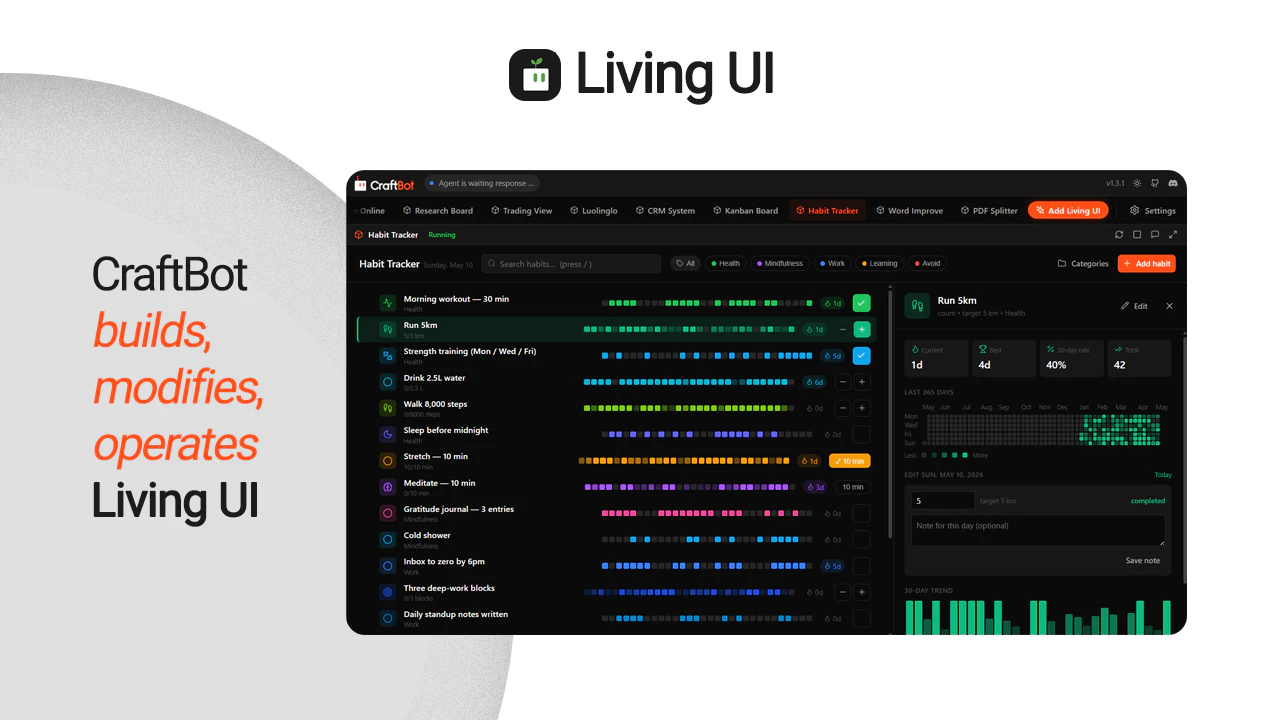
Living UI is a brand-new system that lets CraftBot (general AI agent) build, import, or evolve custom apps/dashboards that live inside CraftBot itself. The agent stays context-aware of the Living UI's state and can read, write, and act on its Living UI directly. A Living UI is never "finished". Ask CraftBot to add features or redesign a view as your needs grow. Living UI turns software from something users buy and adapt to into something CraftBot creates and adapts around them.
AI Analysis
CraftBot with Living UI enables a general AI agent to build, import, or evolve custom apps and dashboards that live inside the bot. The agent maintains full context awareness of the UI state, allowing it to read, write, and act on it directly. Users can iteratively request new features, redesigns, or modifications as needs evolve, ensuring the interface is never 'finished.' It addresses pain points of static, inflexible software that requires manual updates or developer intervention for changes. The core value is transforming software into adaptive, living entities created and evolved by AI around the user via natural 'vibe coding,' reducing development friction and enabling personalized, continuously improving tools.
The timing is favorable for 2025-2026 as AI agents and autonomous coding tools mature rapidly amid surging demand for no-code and vibe-based development. Trends toward AI-native apps, context-aware systems, and efficiency-driven tools align perfectly with evolving user needs for adaptive software. Supportive tech ecosystem (advanced LLMs, GitHub integration) and economic pressures to reduce dev costs create strong tailwinds. Rating: Excellent Timing.
Medium feasibility. Technical challenges include building reliable long-context AI for dynamic UI state management and modification, with risks of instability or hallucinations. Development and compute operation costs are high due to LLM usage, but no major supply chain issues as it's a digital SaaS product. Strong scalability potential via cloud infrastructure, though compliance with data privacy is needed. Relies on advanced AI capabilities that are progressing but not fully commoditized. Key risks center on AI reliability and seamless user experience.
Primary users: indie developers, product builders, SaaS founders, and non-technical entrepreneurs in tech/startup sectors seeking custom internal tools. Demographics: tech-savvy professionals aged 25-45. Geographic: globally distributed with heavy concentration in US, Europe. TAM: broader AI dev tools market exceeding $20B; SAM: AI agent platforms ~$5B; SOM: niche for adaptive UI agents ~$500M. Core pains: slow custom software iteration and high dev costs. High willingness to pay via subscriptions for productivity gains.
Medium. Direct competitors: 1. Cursor (cursor.com) - AI-powered code editor. 2. Replit Agent (replit.com) - AI app builder. 3. v0 by Vercel (v0.dev) - generative UI tool. 4. Devin (cognition.ai) - autonomous AI engineer. 5. Lovable (lovable.dev) - AI software creation platform. Advantages: unique persistent 'Living UI' with deep context awareness and ongoing evolution directly inside the agent, enabling true adaptation vs one-off generation. Disadvantages: potentially higher latency/cost from general agent model, less established ecosystem and proven reliability compared to specialized tools.
Upgrade Pro to unlock full AI analysis
Similar Products

Cohere Parse 5
Turn complex docs, tables & images into AI-ready data
▲ 158 votes

Opaline
PostHog for team Claude Code and Codex sessions.
▲ 141 votes

Adapt
The company brain that gets work done
▲ 124 votes

Tapfree for Chrome
Voice dictation that adapts to what’s on your screen
▲ 122 votes

CodeBurn
See where your AI coding spend actually goes
▲ 101 votes

Saldor
Speed up procurement and AP.
▲ 78 votes