
Curie
Assistant for scientific literature and document analysis.
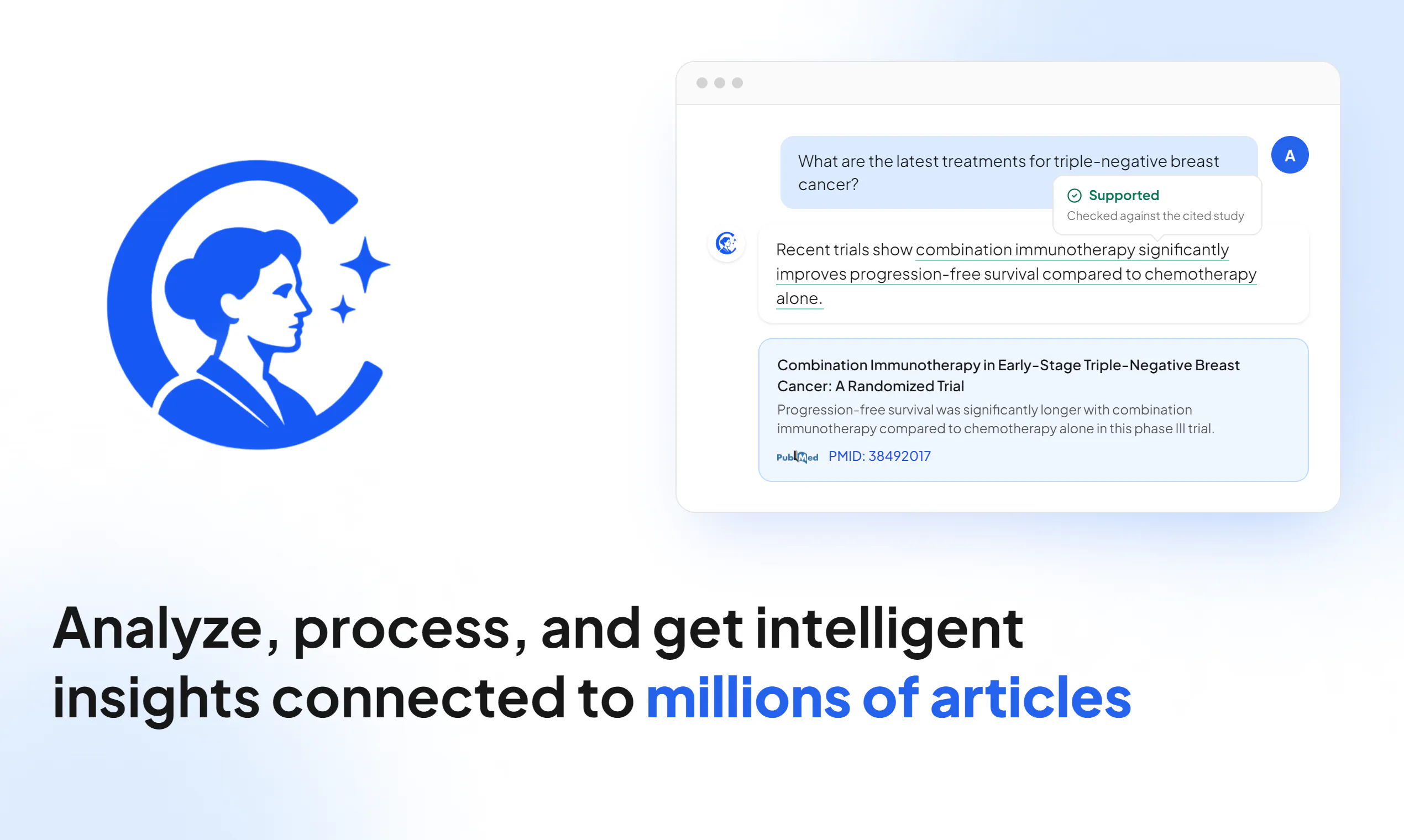
Curie is an AI research assistant built for real scientific work, not a generalist chatbot. It searches PubMed, arXiv, Europe PMC, OpenAlex and Semantic Scholar in parallel, then verifies every claim against the source text, so you see what's backed and what isn't. Point it at a document to extract structured data with the quote behind each value, or run a full systematic review, protocol, screening, PRISMA diagram, with you approving every decision. Projects and a library keep it organized.
AI Analysis
Curie is an AI research assistant built for scientific literature and document analysis. It searches multiple databases (PubMed, arXiv, Europe PMC, OpenAlex, Semantic Scholar) in parallel, verifies every claim against original sources, extracts structured data from documents with supporting quotes, and supports full systematic reviews including protocols, screening, and PRISMA diagrams. Projects and a library provide organization. It solves key pain points like unreliable AI outputs in research, time-consuming manual reviews, and lack of traceability. USP is its focus on verifiable scientific work over general chatbots, delivering efficiency and accuracy for real research workflows.
The 2025-2026 period is highly favorable due to maturing LLM technology, explosive growth in scientific publications, rising demand for AI tools in academia to handle information overload, and policy pushes for open science and reproducible research. Users seek trustworthy alternatives to general chatbots amid hallucination concerns. Excellent Timing.
Technical difficulty is moderate as it leverages existing APIs and LLMs for search and verification, but ensuring consistent accuracy in claim validation adds complexity. Development and operation costs are manageable for a SaaS AI tool (API usage dominant). No significant supply chain or compliance risks beyond data privacy. Strong scalability via cloud infrastructure. Overall High feasibility with current AI tech stack.
Main segments: Academic researchers, PhD students, scientists in life sciences, medicine, and STEM fields; research institutions and universities. Geographic focus: Global with concentration in North America, Europe, and East Asia. TAM for AI research tools exceeds $10B, SAM for scientific literature AI around $2B, SOM in hundreds of millions. Core pains: Literature overload, verification burden, lengthy systematic reviews. High willingness to pay via subscriptions, especially institutional licenses.
Medium. Direct competitors: Elicit (elicit.com), Scite (scite.ai), Consensus (consensus.app), ResearchRabbit (researchrabbit.ai), Scholarcy (scholarcy.com). Advantages: Parallel multi-database search with strict source verification, end-to-end systematic review workflow with PRISMA and human-in-loop approval, structured extraction with quotes. Disadvantages: Potentially higher complexity for users, less established brand than competitors, may have higher computational costs affecting pricing.
Upgrade Pro to unlock full AI analysis
Similar Products

Cohere Parse 5
Turn complex docs, tables & images into AI-ready data
▲ 158 votes

Opaline
PostHog for team Claude Code and Codex sessions.
▲ 141 votes

Adapt
The company brain that gets work done
▲ 124 votes

Kosshi
Simple, fast outliner for Mac and iPhone.
▲ 90 votes

Thoughts for Mac
Capture notes from your menubar using text, images or voice
▲ 90 votes

Refoid
Automate App Store refund responses and track every outcome
▲ 68 votes