
Deep Work Plan
Models matter. Context matters more. Give your agent a plan.
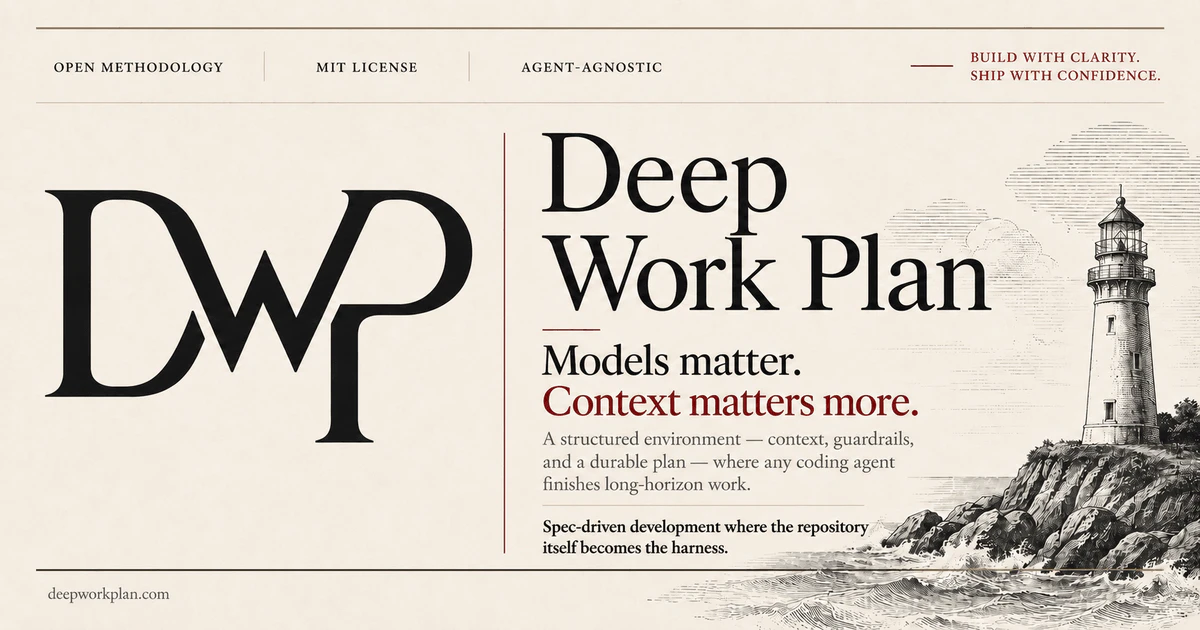
Deep Work Plan turns any repo into a harness with the context of your best engineer — so any AI agent codes like your smartest model and can't drift from the plan. Not a chat window it forgets, a spec written into the repo: atomic tasks, acceptance criteria, validation gates, resumable state. Long runs survive context resets; any agent picks up where the last left off. Point an agent at it, walk away, come back to work you can verify. Any agent, any repo, no lock-in. Open Source, MIT.
AI Analysis
Deep Work Plan embeds a detailed engineering plan directly into any code repository, including atomic tasks, acceptance criteria, validation gates, and resumable state. This turns the repo into a persistent harness so AI agents code like your best engineer without drifting. It solves key pain points like context loss in long sessions, forgotten instructions in chat interfaces, and difficulty verifying AI-generated code. The USP is agent-agnostic operation, survival across context resets, no vendor lock-in, and full open-source MIT licensing. Overall value: reliable, verifiable autonomous coding that lets developers point an agent at a repo and return to trustworthy results.
In 2025-2026, explosive growth in AI coding agents (e.g. autonomous devs like Devin-style tools) and demand for reliable long-running tasks make this highly relevant. Tech maturity of LLMs is sufficient for agentic workflows, while user needs shift toward verifiable, non-drifting AI output amid rising AI adoption in software engineering. Economic tailwinds for dev productivity tools are strong. Excellent Timing.
High. Technical difficulty is moderate as it builds on existing git repos, LLMs, and standard specs rather than novel AI research. Development and operation costs are low given its open-source MIT model and community contributions. Minimal supply chain or compliance risks. Strong scalability across any repo/agent and good team fit for developer-focused creators. Main challenge is adoption in a noisy AI tools space.
Primary users: Software developers, AI engineers, and engineering teams at tech/SaaS companies who use or build AI coding agents. Industries: Software development and IT services. Geographic: Global with concentration in US, Europe, and Asia tech hubs. TAM for AI-powered dev tools exceeds $10B by 2026; SAM for agent orchestration ~$2-3B; SOM for open-source planning tools in tens of millions. Core pains: agent context drift and unverifiable output. High willingness to pay for time savings, though currently free/open-source (potential for consulting or premium tiers).
Medium. Direct competitors: 1. OpenDevin (github.com/OpenDevin/OpenDevin), 2. SWE-agent (github.com/princeton-nlp/SWE-agent), 3. Aider (aider.chat), 4. Cursor Composer (cursor.com), 5. GitHub Copilot Workspace (github.com). Advantages: truly agent-agnostic, repo-native persistent plans that survive resets, strong emphasis on verification gates and no lock-in. Disadvantages: newer/less known than established players, lacks polished UI or broad ecosystem integrations that competitors offer, and being fully open-source may limit monetization speed compared to venture-backed tools.
Upgrade Pro to unlock full AI analysis
Similar Products

Cohere Parse 5
Turn complex docs, tables & images into AI-ready data
▲ 158 votes

Adapt
The company brain that gets work done
▲ 124 votes

Tapfree for Chrome
Voice dictation that adapts to what’s on your screen
▲ 122 votes

React UI Kit V7
All the chat components you need. None of the complexity
▲ 115 votes

Replay QA Security Scan
Automated Penetration Testing for AI-Built Apps
▲ 102 votes

CodeBurn
See where your AI coding spend actually goes
▲ 101 votes