
Dial
Give your AI agent a real phone number in 10 seconds
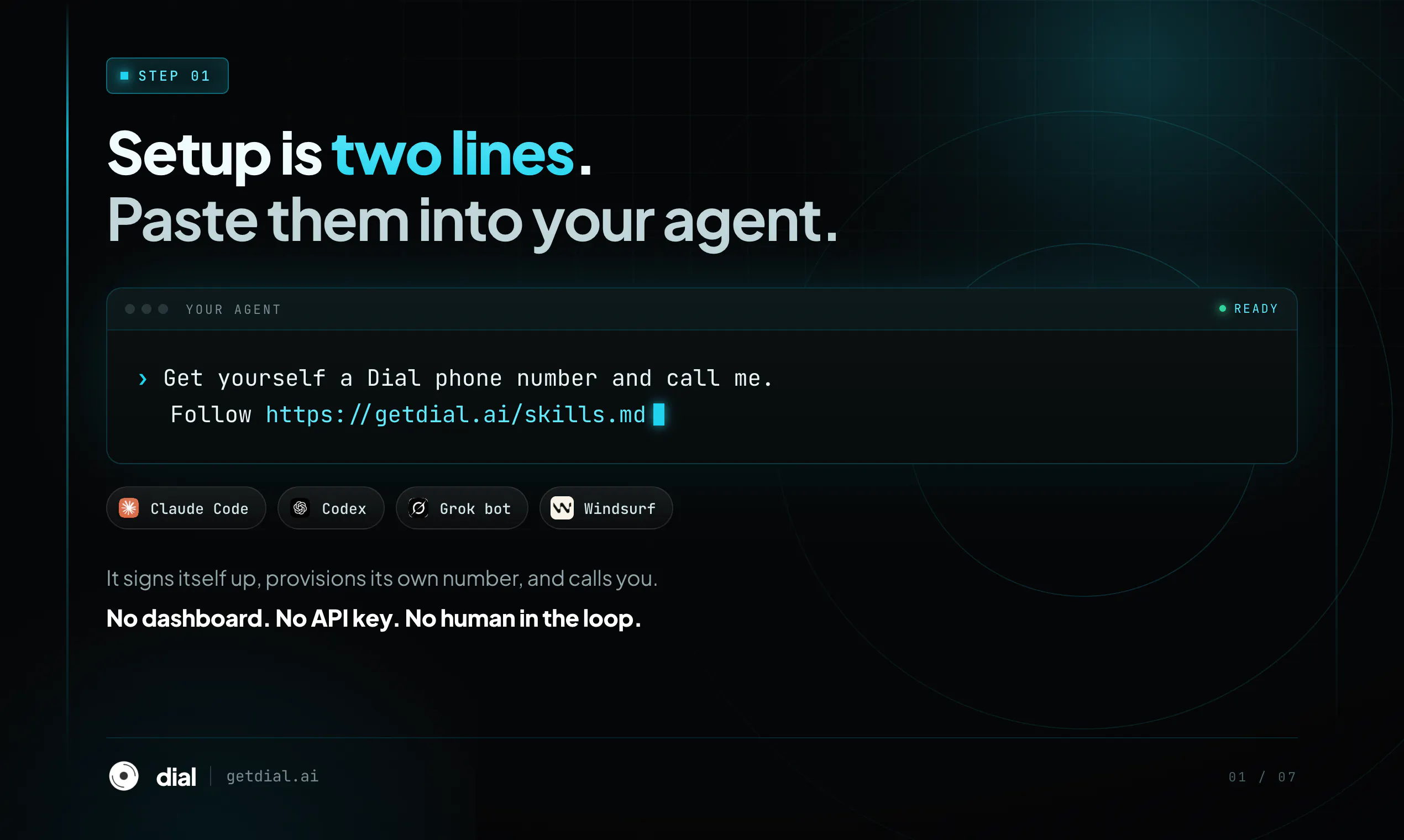
Your agent can deploy in seconds but cannot get a phone number. Dial fixes that - one API call and it gets a real one in about 10 seconds. It places and receives voice calls, sends and receives SMS in 200+ countries, and messages over iMessage. It can even read inbound verification codes, so phone-gated signups stop being a dead end. Works via REST API, CLI, MCP servers, and SDKs. Free credit on signup, no card.
AI Analysis
Dial allows AI agents to acquire a real phone number in 10 seconds via one API call. Key features include voice calls, SMS in 200+ countries, iMessage messaging, and reading inbound verification codes. It solves the pain point that deployed AI agents lack telephony integration for communications and phone-gated signups. USPs are instant deployment, broad global coverage, multi-channel support (including iMessage), and easy integration through REST API, CLI, MCP servers, and SDKs. Value proposition: Enables seamless real-world phone interactions for AI agents without infrastructure hassle, with free signup credits and no card needed.
The 2025-2026 period features explosive growth in AI agents and agentic AI frameworks, with rising demand for real-world interfaces like telephony amid maturing voice AI tech. User needs for automated customer interactions and verifications are surging, supported by favorable economic pushes for AI automation despite regulatory scrutiny on communications. This aligns perfectly with AI infrastructure tool adoption. Excellent Timing.
Technical difficulty is moderate, relying on established telecom APIs for calls/SMS. Development and operation costs are manageable with usage-based pricing, though compliance risks (international telecom regs, data privacy, anti-spam laws) are notable. High scalability via cloud and API model; suitable for teams with AI/API expertise. Overall High with strong potential despite regulatory hurdles.
Primary users: AI developers, indie hackers, and teams building autonomous agents or AI customer service tools; industries include SaaS, productivity software, and automation. Geographically focused on global tech hubs (US, Europe, Asia). TAM for AI comms infrastructure exceeds $50B, SAM for agent telephony APIs ~$5B, SOM for quick-setup tools ~$500M. Core pains: complex telephony setup and verification barriers. High willingness to pay for time-saving, reliable API service.
Medium. Direct competitors: 1. Vapi.ai (vapi.ai), 2. Bland.ai (bland.ai), 3. Retell AI (retell.ai), 4. Twilio (twilio.com), 5. Sinch (sinch.com). Advantages: ultra-fast 10-second setup, iMessage support, verification code reading, and agent-focused simplicity with free credits. Disadvantages: narrower scope (focuses on number provisioning vs. full conversational AI), potentially higher dependency on underlying carriers compared to integrated platforms with advanced voice features and enterprise support.
Upgrade Pro to unlock full AI analysis
Similar Products

Cohere Parse 5
Turn complex docs, tables & images into AI-ready data
▲ 158 votes

Adapt
The company brain that gets work done
▲ 124 votes

Cercle
The bat signal for your closest friends.
▲ 121 votes

Orus
Claude for investing in perpetuals
▲ 121 votes

WikiFix for Confluence
Find and fix issues in your knowledge base
▲ 86 votes

Refoid
Automate App Store refund responses and track every outcome
▲ 68 votes