
display.dev
Publish agent-generated HTML behind company auth
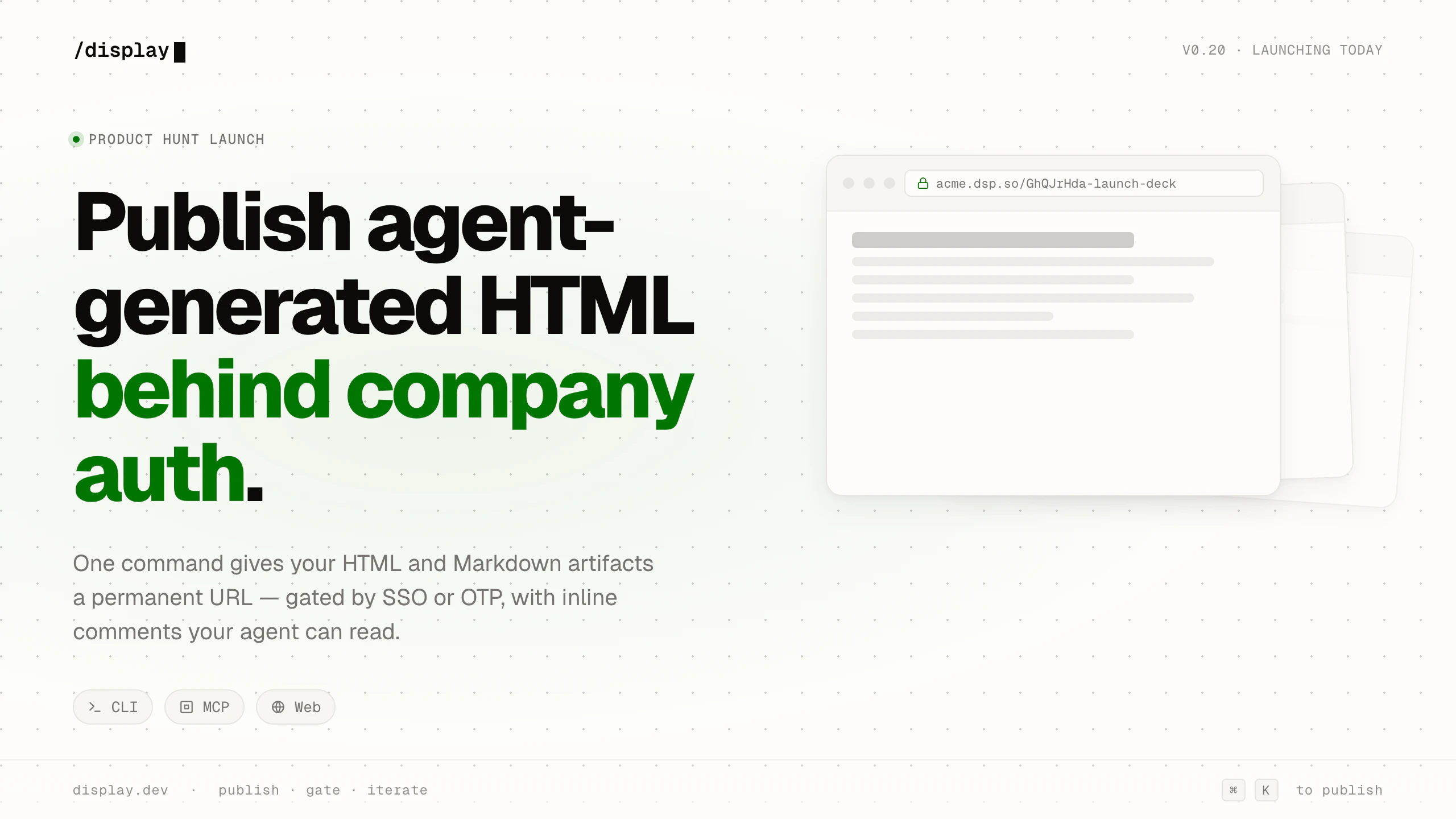
display.dev is the easiest way to publish agent-generated artifacts behind company authentication. One command gives your HTML and Markdown files a permanent URL. Your colleagues sign in securely via OTP or Google/Microsoft SSO, and drive iteration with in-line comments.
AI Analysis
display.dev enables one-command publishing of agent-generated HTML and Markdown artifacts to permanent URLs, secured behind company authentication (OTP, Google/Microsoft SSO). Core features include secure access for colleagues and in-line commenting for real-time feedback and iteration. It solves key pain points of securely sharing AI-generated prototypes internally without exposing them publicly or using cumbersome tools. USP is its simplicity tailored for AI agent workflows in enterprises. Overall value proposition: frictionless, authenticated publishing and collaboration to accelerate team iteration on AI outputs.
In 2025-2026, AI agents and generative AI are seeing explosive adoption in enterprises, driving demand for specialized tools to integrate and collaborate on AI outputs securely. Authentication, hosting, and commenting technologies are mature. User demands are shifting towards seamless internal AI workflows amid rising IP protection concerns. Favorable policy and economic environment for SaaS dev tools. This is an Excellent Timing.
Technical difficulty is moderate: leverages existing cloud hosting, standard SSO/OTP auth, and web-based commenting systems. Development and operation costs are typical for SaaS with low supply chain risks. Compliance risks around data security and enterprise auth are manageable. Strong scalability potential via cloud infrastructure. Overall rating: High, supported by use of proven web technologies and clear product scope.
Main target segments: AI engineers, frontend developers, product teams in tech/SaaS companies and enterprises adopting AI agents (demographics: tech professionals aged 25-45). Industries: software development, AI/ML, digital agencies. Geographic: primarily US and Europe-based companies. Estimated market: Dev tools TAM ~$20B+, SAM for AI collaboration tools ~$2B, SOM niche share in hundreds of millions. Core pain points: insecure or complex sharing of AI artifacts and lack of integrated feedback. High willingness to pay for secure, productivity-enhancing enterprise plans.
Competition level: Medium. Direct competitors: 1. Vercel (vercel.com), 2. Netlify (netlify.com), 3. SharePoint (microsoft.com/sharepoint), 4. Coda (coda.io), 5. Figma (figma.com). Advantages: hyper-focused on agent-generated HTML/MD with one-command deploy, built-in company auth and inline HTML comments for rapid iteration. Disadvantages: narrower scope than general hosting platforms, newer entrant so potentially less mature ecosystem/integration options, pricing not detailed but may face pressure from freemium models of competitors.
Upgrade Pro to unlock full AI analysis
Similar Products

Cohere Parse 5
Turn complex docs, tables & images into AI-ready data
▲ 158 votes

Adapt
The company brain that gets work done
▲ 124 votes

Replay QA Security Scan
Automated Penetration Testing for AI-Built Apps
▲ 102 votes

Saldor
Speed up procurement and AP.
▲ 78 votes

Refoid
Automate App Store refund responses and track every outcome
▲ 68 votes

Audryo
Customer email your agent can operate.
▲ 0 votes