DockLog
Docker logs without the logging stack
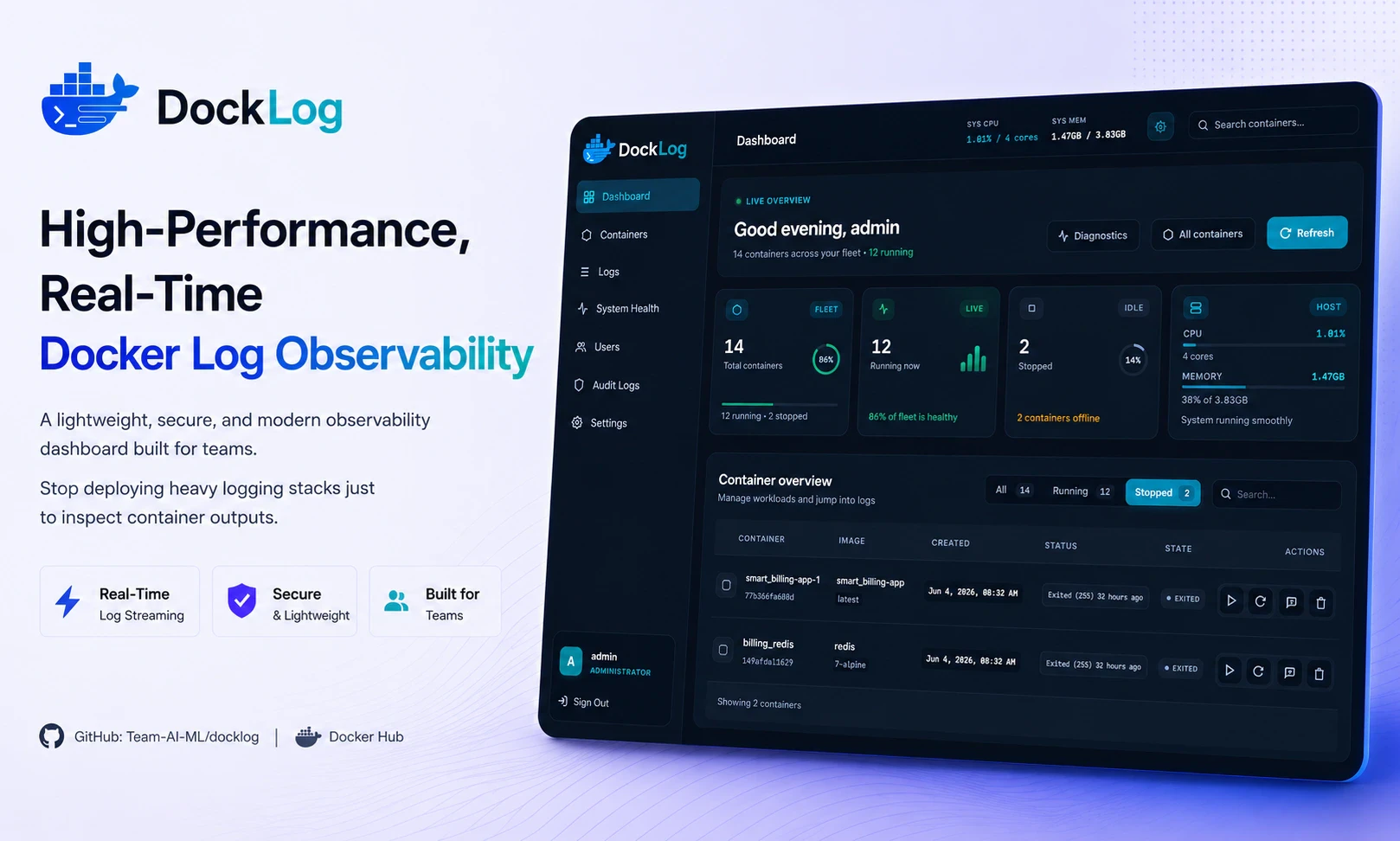
DockLog is a self-hosted Docker observability platform for developers, DevOps teams, and homelab enthusiasts. Monitor containers in real time, stream logs instantly, manage Docker workloads, and track host resources from a web dashboard, desktop app, or Android app. Features include container lifecycle management, RBAC, audit logs, multi-server support, and lightweight deployment using a single Docker container.
AI Analysis
DockLog is a lightweight, self-hosted Docker observability platform designed for developers, DevOps teams, and homelab enthusiasts. Core features include real-time container monitoring, instant log streaming, Docker workload management, host resource tracking, container lifecycle operations, RBAC, audit logs, and multi-server support. It deploys as a single Docker container and offers access via web dashboard, desktop app, or Android app. Unique selling points are its simplicity without requiring heavy logging stacks like ELK, cross-platform accessibility (especially mobile), and open-source nature. It solves key pain points such as complex setup of traditional observability tools, high resource usage, and limited real-time visibility in homelabs or small deployments. The value proposition is efficient, private, and portable Docker management that empowers users with instant insights and control.
In 2025-2026, market timing is favorable due to maturing Docker and container technologies, rising adoption of self-hosted and open-source solutions amid cloud cost concerns and data privacy demands, and the booming homelab/edge computing trend. User needs are shifting toward lightweight, real-time observability tools that avoid complex stacks. Economic factors favor cost-effective alternatives to enterprise software. Excellent Timing.
High feasibility. Technical difficulty is low as it leverages standard Docker APIs and deploys via a single container. Development and operation costs are manageable for an open-source project with GitHub presence. Minimal supply chain risks; compliance for RBAC/audit is straightforward but important for team use. Strong scalability for multi-server setups and good fit for developer-focused teams. Key risks are building/maintaining cross-platform apps (web/desktop/Android).
Primary segments: Individual developers, DevOps engineers, and homelab enthusiasts (tech-savvy males/females, ages 25-45). Industries: Software development, IT operations, personal/home projects. Geographic: Global, with high concentration in North America, Europe, and Asia (China, India). TAM for container management/observability tools exceeds $5B, SAM for self-hosted Docker tools ~$500M, SOM for this lightweight niche ~$50-100M. Core pain points: cumbersome traditional logging setups and lack of simple real-time multi-device access. Willingness to pay: Moderate to high for premium support, advanced features, or enterprise editions despite open-source core.
Medium. Direct competitors: 1. Dozzle (dozzle.dev) - real-time Docker log viewer. 2. Portainer (portainer.io) - full container management platform. 3. LazyDocker (github.com/jesseduffield/lazydocker) - terminal-based Docker UI. 4. Netdata (netdata.cloud) - real-time monitoring. Advantages: Lightweight single-container deploy without full stacks, dedicated Android app, built-in RBAC/audit logs, and multi-server focus. Disadvantages: Newer entrant with potentially smaller community compared to Portainer; may overlap with Dozzle on logs but extends further in management. Strong differentiation in cross-platform accessibility and homelab-friendly design.
Upgrade Pro to unlock full AI analysis
Similar Products

Opaline
PostHog for team Claude Code and Codex sessions.
▲ 141 votes

Orus
Claude for investing in perpetuals
▲ 121 votes

React UI Kit V7
All the chat components you need. None of the complexity
▲ 115 votes

Replay QA Security Scan
Automated Penetration Testing for AI-Built Apps
▲ 102 votes

Audryo
Customer email your agent can operate.
▲ 68 votes

Refoid
Automate App Store refund responses and track every outcome
▲ 68 votes