
DocsAlot MCP Connector
Maintain your help-center by asking Claude, Cursor or Codex
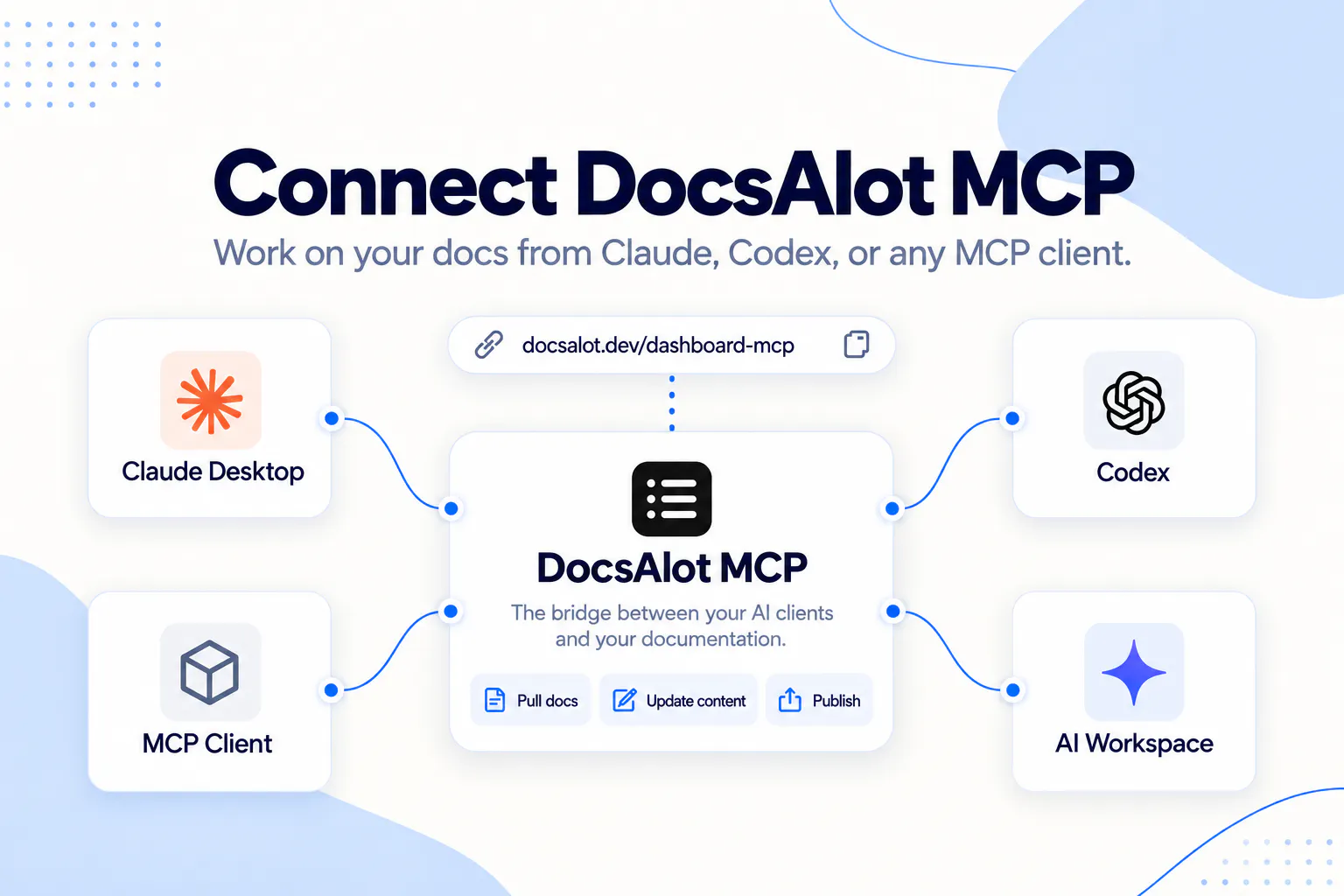
Create and update your knowledge base from Claude, Codex, or any compatible MCP client. Ask DocsAlot to add a page, fix an error, or improve your help center. It finds the relevant content, makes changes, creates a new version, and publishes, all from your existing workflow. See what questions users ask in your help center, discover what’s missing, and use those insights to improve your docs and decide what to build next.
AI Analysis
DocsAlot MCP Connector allows users to maintain help centers and knowledge bases by conversing with AI models like Claude, Cursor, or Codex. Core features include adding pages, fixing errors, improving content, automatic relevant content detection, versioning, and publishing directly from AI workflows. It also analyzes user questions in the help center to reveal gaps and inform product decisions. USP is seamless integration into existing AI client workflows without context switching. It solves key pain points of time-consuming manual documentation updates, keeping docs synchronized with product changes, and identifying missing content. Value proposition: AI-powered automation that improves documentation quality, reduces maintenance effort, and turns support data into actionable insights.
In 2025-2026, AI coding and agent tools like Claude and Cursor are reaching mainstream adoption, with strong industry trends toward AI automation for developer productivity and documentation. User demand is shifting to AI-native workflows for operational tasks amid growing SaaS support needs. Economic environment favors efficiency tools. This represents Excellent Timing as MCP-compatible AI clients mature and documentation debt becomes a larger pain point.
Technical difficulty is medium-high due to need for reliable integrations with diverse help center platforms, safe AI-driven editing, and accurate content retrieval. Development and operation costs are moderate for an API-first tool. Compliance risks around data privacy and AI accuracy exist but are manageable. Strong scalability potential via cloud. Overall High feasibility for teams with AI/API expertise, though initial integration breadth may require significant effort.
Primary segments: technical writers, developers, product managers, and support teams in SaaS, software, and tech companies (primarily North America and Europe). Estimated market size: TAM for documentation/knowledge base software ~$1B+, SAM for AI-enhanced dev docs ~$300M, SOM for MCP/AI connector niche ~$50M. Core pain points include labor-intensive doc maintenance, outdated content, and missed insights from user queries. High willingness to pay for time-saving AI automation via subscription pricing.
Medium. Direct competitors: 1. GitBook (gitbook.com) with AI co-pilot, 2. Mintlify (mintlify.com) for AI docs, 3. ReadMe (readme.com) AI features, 4. Notion AI (notion.so), 5. Document360 (document360.com). Advantages: direct MCP client integration for natural edits from Claude/Cursor, user query analytics for product insights, workflow-native updates. Disadvantages: narrower focus than full doc platforms, potentially higher dependency on specific AI models, less brand recognition as a newer tool.
Upgrade Pro to unlock full AI analysis
Similar Products

Cohere Parse 5
Turn complex docs, tables & images into AI-ready data
▲ 158 votes

Opaline
PostHog for team Claude Code and Codex sessions.
▲ 141 votes

Replay QA Security Scan
Automated Penetration Testing for AI-Built Apps
▲ 102 votes

Kosshi
Simple, fast outliner for Mac and iPhone.
▲ 90 votes

Audryo
Customer email your agent can operate.
▲ 68 votes

Refoid
Automate App Store refund responses and track every outcome
▲ 68 votes