
DuckFightClub
Train your MicroDuck and win the Golden Beak Belt
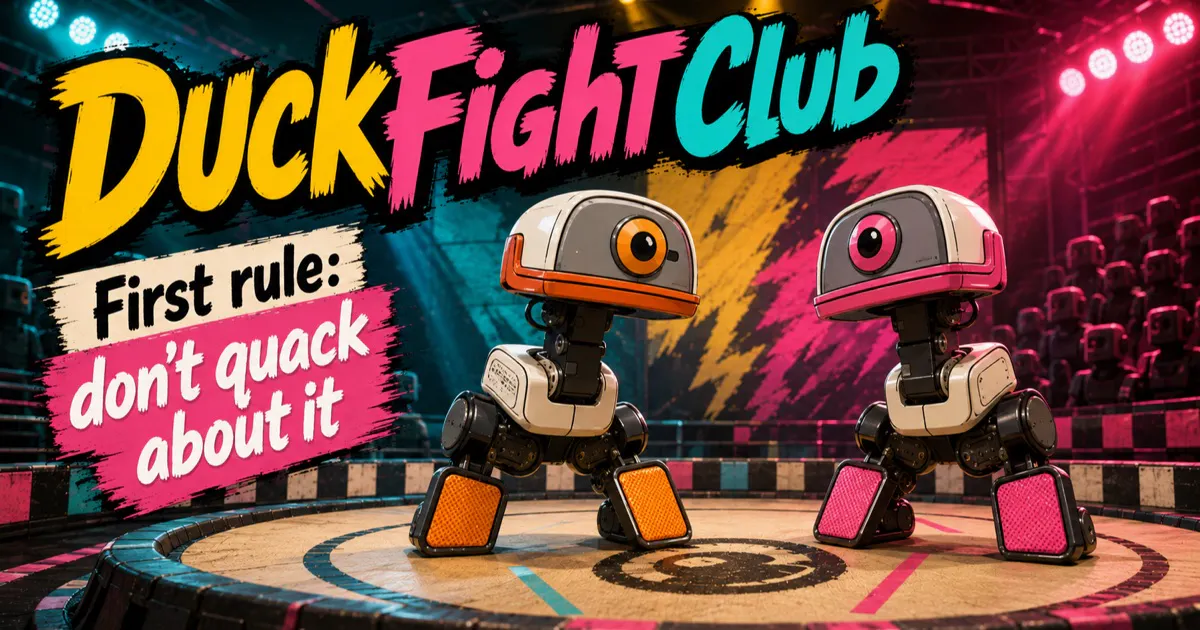
Imagine WWE SmackDown, but with cute, AI-trained robots. Eight teams spend days training reinforcement-learning policies for Pollen’s open-source MicroDuck, then we throw them in the simulator to fight for the Golden Beak Belt. The whole competition will be livestreamed. The catch: you’re not building a robot, you’re training its brain. Want in? Register a team, train your policy, or host a showdown in your city. When the real MicroDucks ship, we go IRL.
AI Analysis
DuckFightClub is a competitive platform where teams train reinforcement learning policies for Pollen’s open-source MicroDuck robots in a simulated environment, competing in WWE-style battles for the Golden Beak Belt. Core features include team registration, policy training in simulator, livestreamed events, and future transition to physical IRL fights. Unique selling points are the focus on training the AI 'brain' rather than hardware, combined with entertaining sports-robotics theme. It solves user pain points of abstract and unengaging AI/RL education by offering fun, hands-on competition and community. Overall value proposition: making advanced AI and robotics accessible, educational, and exciting through gamified events.
The timing is favorable for 2025-2026 due to rapid AI advancement (especially RL and embodied AI), growing public interest in hands-on robotics post-LLM boom, maturing simulator technologies, and global emphasis on STEM education amid economic recovery and innovation policies. It aligns well with trends in AI competitions and consumer robotics. Rating: Excellent Timing.
Technical difficulty is moderate with provided open-source simulator and MicroDuck reducing barriers for RL training; however, developing robust policies and managing IRL hardware transitions add complexity. Development and operation costs are manageable for event-driven model with community involvement. Low supply chain risk initially, but compliance for physical robots is a consideration. Strong scalability via online events. Overall rating: Medium, supported by reliance on participant expertise and event execution needs.
Main target segments: AI/ML developers, robotics hobbyists, computer science students and researchers (ages 18-35), tech educators, primarily in North America, Europe, and East Asia. Estimated market size: TAM for AI/robotics education and events in billions USD, SAM for RL competitions and hobbyist platforms ~$200-500M, SOM for this specific event format ~$5-20M. Core pain points: lack of engaging, practical ways to apply RL beyond theory. Potential willingness to pay: moderate to high for hardware kits, event participation fees, and premium training tools.
Competition level: Medium. Direct competitors: 1. AWS DeepRacer (aws.amazon.com/deepracer), 2. RoboCup (robocup.org), 3. Unity ML-Agents (unity.com/products/machine-learning-agents), 4. Farama Gymnasium (gymnasium.farama.org). This product has advantages in its highly entertaining wrestling theme with cute robots, strong community/livestream focus, open-source accessibility, and clear path from sim to IRL. Disadvantages: narrower scope than broad RL platforms, less established brand/ecosystem, and higher barrier for non-ML users compared to simpler tools.
Upgrade Pro to unlock full AI analysis
Similar Products

Cohere Parse 5
Turn complex docs, tables & images into AI-ready data
▲ 158 votes

Opaline
PostHog for team Claude Code and Codex sessions.
▲ 141 votes

Adapt
The company brain that gets work done
▲ 124 votes

Tapfree for Chrome
Voice dictation that adapts to what’s on your screen
▲ 122 votes

CodeBurn
See where your AI coding spend actually goes
▲ 101 votes

WikiFix for Confluence
Find and fix issues in your knowledge base
▲ 86 votes