
EAS Observe
Performance monitoring built for Expo and React Native
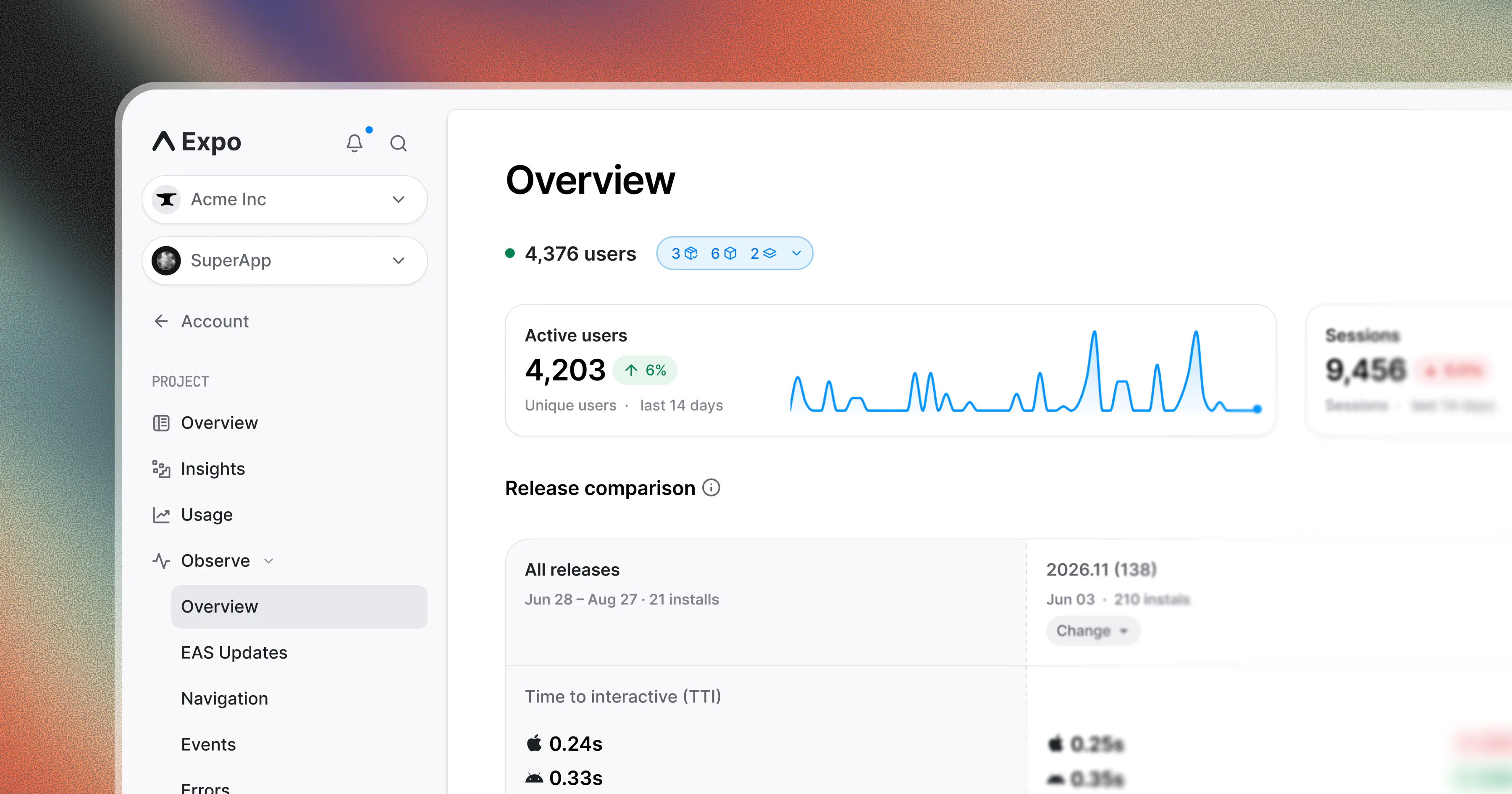
Observe measures how fast your Expo app starts and how fast each screen becomes usable, on real user devices. Install the library, wrap your root layout, and startup metrics arrive with nothing to instrument. Every native build and every EAS Update gets its own marker on the chart, so you can see which release moved the line. Full device context on every session: model, OS, country, network type, thermal state, frame data. Free plan covers 100K events a month.
AI Analysis
EAS Observe is a performance monitoring solution for Expo and React Native apps that automatically measures real-user startup times and screen usability without any instrumentation. Core features include zero-setup integration by wrapping the root layout, release markers for every native build and EAS Update, and rich device context such as model, OS, country, network type, thermal state, and frame data. It addresses key pain points like difficulty in tracking real-world performance impacts of updates and lack of actionable metrics on actual devices. The value proposition is effortless, tailored observability that helps developers quickly identify and resolve performance regressions, with a generous free plan for 100K events/month.
Favorable in 2025-2026 as mobile app complexity grows, React Native adoption expands, and demand for real user monitoring (RUM) rises with higher user experience expectations. Expo's ecosystem is maturing with frequent EAS updates, aligning with trends in automated DevTools and performance optimization. Economic pressures push for tools that improve retention without high instrumentation costs. Excellent Timing.
High. Technical difficulty is moderate leveraging Expo's existing SDK and React Native bridges for metric collection. Development and operation costs are manageable via cloud-based analytics with usage-based scaling. Low supply chain or compliance risks as a developer tool. Strong scalability within the Expo community and good team fit for those familiar with the ecosystem. Key risks are data privacy handling but overall highly feasible.
Primary users: Mobile developers, engineering teams, and CTOs building apps with Expo/React Native. Demographics: Tech-savvy professionals aged 25-45. Industries: Software development, consumer apps, startups. Geographic: Global with strong presence in US, Europe, and Asia. TAM for mobile dev tools is multi-billion; SAM for RN performance monitoring ~$200M+; SOM for Expo niche ~$20-50M. Core pains: Opaque real-device performance and release impact analysis. High willingness to pay for premium tiers beyond free 100K events.
Medium. Direct competitors: 1. Sentry (sentry.io), 2. Firebase Performance Monitoring (firebase.google.com), 3. Datadog RUM (datadoghq.com), 4. Embrace (embrace.io), 5. New Relic Mobile (newrelic.com). Advantages: Zero-instrumentation for Expo-specific startup metrics, seamless EAS Update tracking, rich thermal/frame context not emphasized by others. Disadvantages: Limited to Expo/React Native users, potentially narrower feature set than full APM suites. Strong differentiation in ease and niche focus reduces direct pressure.
Upgrade Pro to unlock full AI analysis
Similar Products

Opaline
PostHog for team Claude Code and Codex sessions.
▲ 141 votes

React UI Kit V7
All the chat components you need. None of the complexity
▲ 115 votes

Coarena by Coasty
The arena where agents battle on real-world work
▲ 104 votes

Replay QA Security Scan
Automated Penetration Testing for AI-Built Apps
▲ 102 votes

Audryo
Customer email your agent can operate.
▲ 68 votes

Refoid
Automate App Store refund responses and track every outcome
▲ 68 votes