
Edgee Codex Compressor V2
Use Codex at 35.6% lower costs
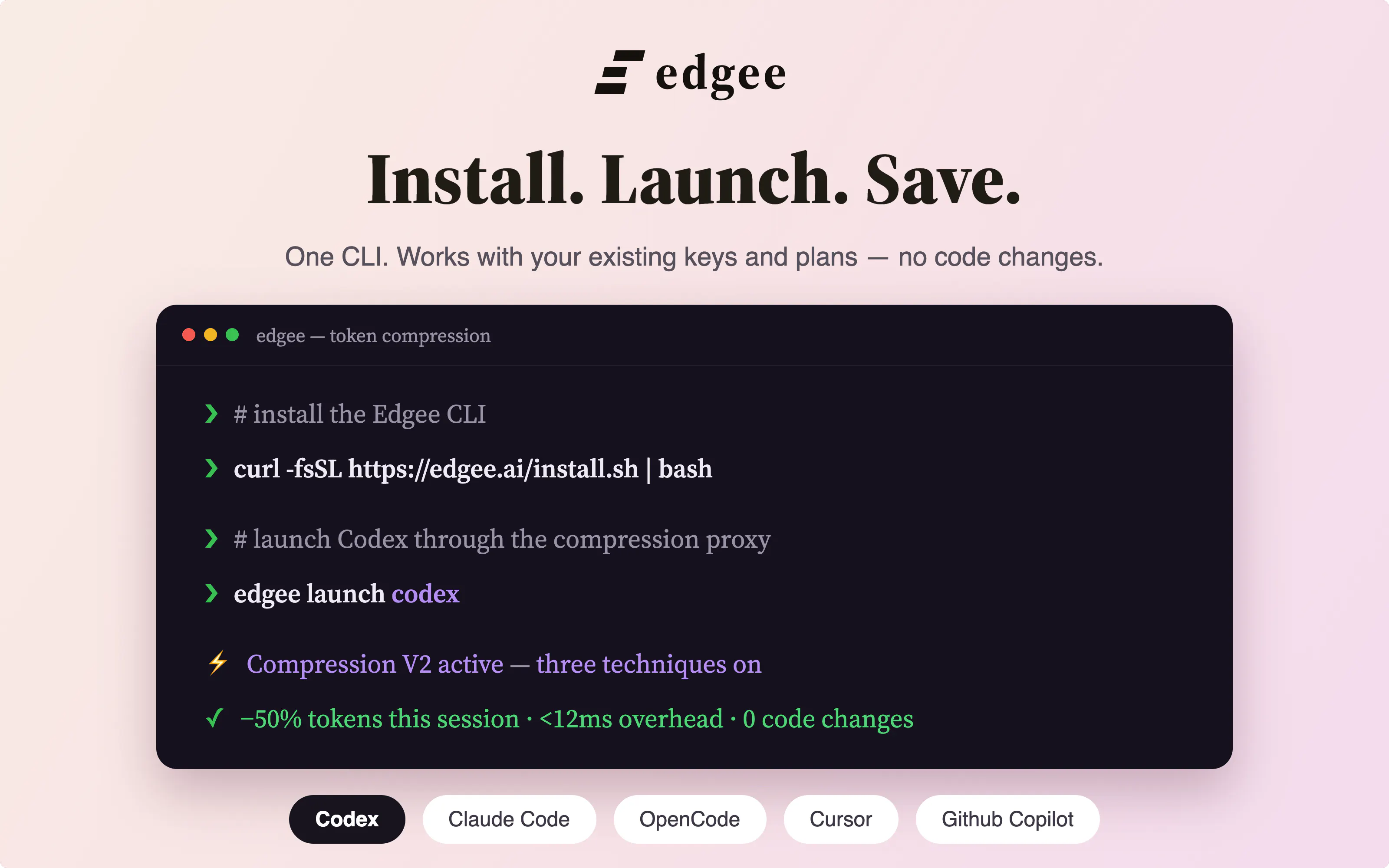
We benchmarked Codex alone against Codex routed through Edgee's compression gateway on the same repo, with the same model, under the same workflow. The result: Codex + Edgee used 49.5% fewer input tokens, improved cache hit rate from 76.1% to 85.4%, and reduced total session cost by 35.6%. This post breaks down why context compression makes Codex more efficient, more frugal, and materially cheaper to run without sacrificing useful output.
AI Analysis
Edgee Codex Compressor V2 is a compression gateway that routes Codex requests to reduce input tokens by 49.5%, improve cache hit rate from 76.1% to 85.4%, and lower total session costs by 35.6% without sacrificing output quality. It solves key pain points of high API costs and inefficient context management in AI coding workflows. Unique selling point is specialized context compression for more frugal LLM usage. Value proposition: Enables developers to run Codex significantly cheaper while maintaining effectiveness.
The current market timing is favorable. In 2025-2026, LLM adoption in software engineering continues to surge, driving up API costs and creating strong demand for efficiency tools. Context compression and caching technologies are maturing while economic pressures emphasize ROI on AI spend. This positions cost-reduction solutions like Edgee ideally. Excellent Timing.
High. Technical difficulty is manageable using existing API gateway, caching, and compression methods, as proven by the benchmarks. Development and operation costs are moderate for a SaaS proxy service with usage-based scaling. Low supply chain or compliance risks. Strong scalability potential via cloud deployment, though maintaining compression quality across diverse repos is key.
Main target segments: Software developers, engineering teams, and tech companies using OpenAI Codex for coding tasks (primarily mid-to-large engineering organizations). Industries: Software development and IT. Geographic: Global with concentration in North America and Europe. Estimated market size: Part of the rapidly expanding multi-billion dollar AI developer tools market. Core pain points: Rising token usage and API expenses in repetitive coding sessions. High willingness to pay for demonstrated 35%+ cost savings.
Medium. Direct competitors: 1. Helicone (helicone.ai), 2. Portkey (portkey.ai), 3. PromptLayer (promptlayer.com), 4. LiteLLM (github.com/BerriAI/litellm). Advantages: Highly specific Codex-focused compression with concrete benchmarks showing 35.6% cost reduction and better cache rates. Disadvantages: Narrower scope than broad LLM observability platforms; may require updates as Codex evolves to newer models like GPT variants.
Upgrade Pro to unlock full AI analysis
Similar Products

Auriko
Trading desk for LLM calls
▲ 332 votes
Xirp
The agentic development environment built by Spotify
▲ 224 votes

React UI Kit V7
All the chat components you need. None of the complexity
▲ 115 votes

Replay QA Security Scan
Automated Penetration Testing for AI-Built Apps
▲ 102 votes

CodeBurn
See where your AI coding spend actually goes
▲ 101 votes
Blop
Describe your app and Blop tests it and repairs broken tests
▲ 80 votes