
Emily by Co-Desk
Voice AI copilot for coworking & coliving operators
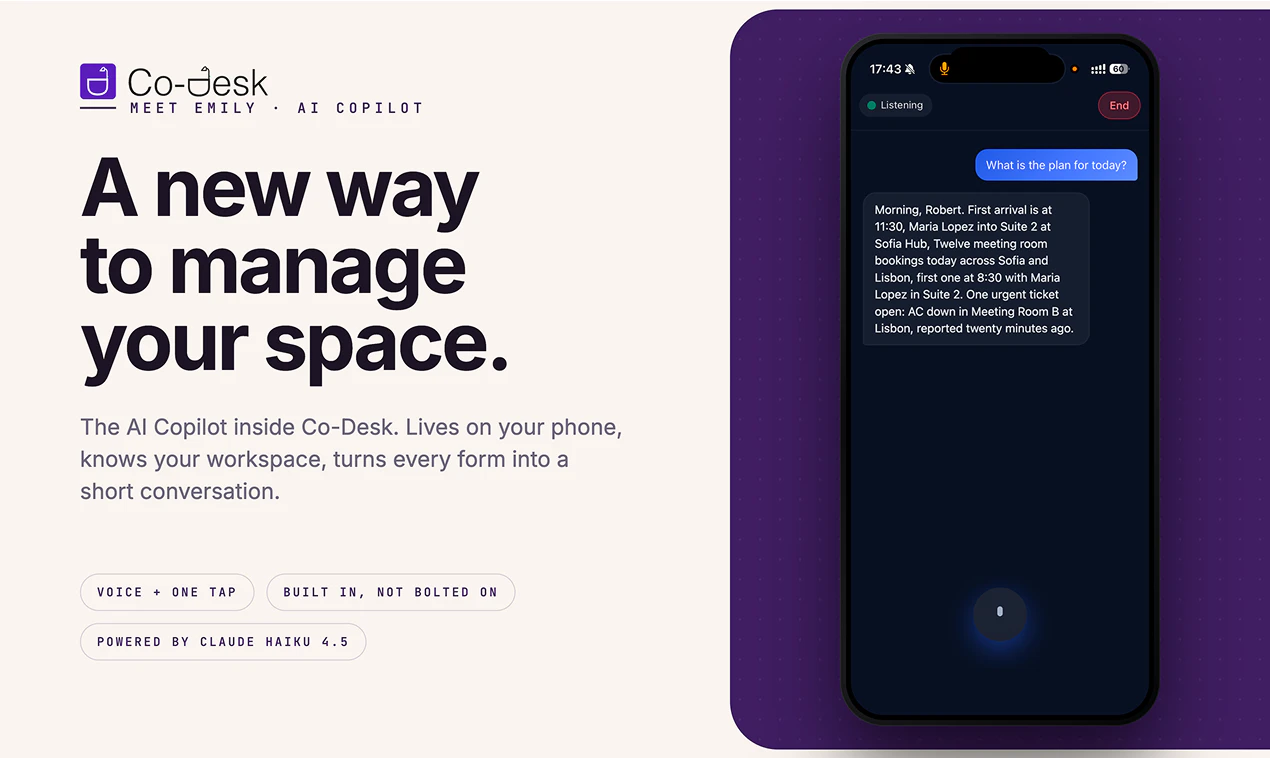
Emily is the voice assistant inside Co-Desk, now in public beta. She lives on your phone and knows your workspace. Ask about today's arrivals or overdue invoices. Tell her to book a room for a member. She prepares it as a card, you tap Confirm. Voice proposes, you confirm, always two steps. Built for operators who don't sit at a desk: walking a tour, setting up an event, turning over a room. Hands busy, phone in pocket, Emily ready.
AI Analysis
Emily is a voice AI copilot for coworking and coliving operators, integrated with Co-Desk and accessible via phone. Core features include querying real-time workspace data (e.g., arrivals, overdue invoices) and executing tasks like room booking through natural voice commands. Its unique two-step process (AI proposes, user taps to confirm) ensures control. USP is hands-free operation tailored for mobile operators handling tours, events, or room turnovers away from desks. It solves key pain points of limited mobility and slow access to operational tools. Value proposition: boosts productivity and efficiency with an always-ready AI assistant that fits busy, on-the-go workflows.
In 2025-2026, voice AI and LLM technologies have reached practical maturity with improved accuracy and integration ease. The coworking industry continues expanding with strong demand for operational efficiency tools amid economic pressures to optimize staffing. Post-pandemic shifts favor mobile, hands-free solutions for hybrid work management. Policy support for AI innovation and digital transformation in real estate further aids adoption. This is an ideal window before full market saturation. Excellent Timing.
Technical difficulty is moderate leveraging mature voice AI APIs and existing Co-Desk integration; already in public beta demonstrates viability. Development and operation costs are manageable but include ongoing AI inference expenses. Minimal supply chain risks as a pure SaaS product; main considerations are data privacy compliance (e.g., voice recordings). Scalability is high via cloud infrastructure with strong potential for expansion. Team fit appears excellent given the product's targeted design. Overall rating: High.
Main segments: Coworking/coliving space operators, managers, and frontline staff (ages 25-45, tech-comfortable) in the flexible workspace and hospitality industries. Geographically focused on urban centers with dense coworking scenes (US, Europe, Asia-Pacific). Estimated market size: TAM for global coworking management software ~$2B+, SAM for AI-enhanced tools ~$300M, SOM for voice-specific solutions ~$50M. Core pain points: inability to access data or complete tasks while mobile and hands-occupied. Potential willingness to pay: High, as a value-adding SaaS subscription feature for efficiency gains.
Medium. Direct competitors: 1. OfficeRnD (officernd.com), 2. Nexudus (nexudus.com), 3. Coworks (coworks.com), 4. Robin (robinpowered.com). Emily's advantages: unique voice-first mobile copilot for hands-busy operators and simple two-step confirmation not emphasized by others. Disadvantages: newer beta product with narrower scope (tied to Co-Desk), potentially fewer comprehensive management features and less brand recognition than established platforms. Strong differentiation in the voice AI niche reduces direct pressure.
Upgrade Pro to unlock full AI analysis
Similar Products

Cohere Parse 5
Turn complex docs, tables & images into AI-ready data
▲ 158 votes

Adapt
The company brain that gets work done
▲ 124 votes

Kosshi
Simple, fast outliner for Mac and iPhone.
▲ 90 votes

WikiFix for Confluence
Find and fix issues in your knowledge base
▲ 86 votes

Saldor
Speed up procurement and AP.
▲ 78 votes

Refoid
Automate App Store refund responses and track every outcome
▲ 68 votes