
Enjo Help Center
AI auto-builds your help centers that learn from your team
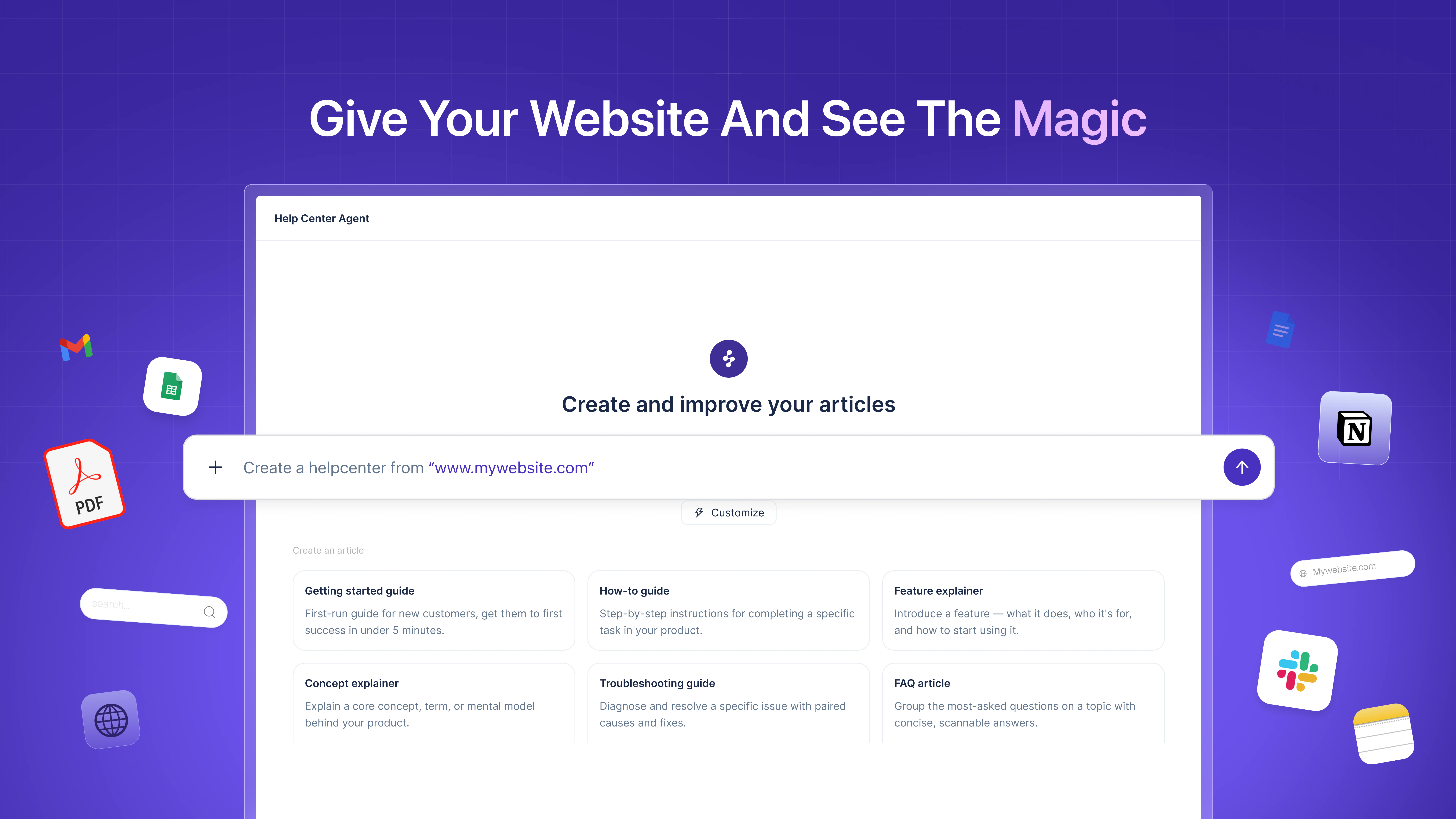
Enjo generates a full help center from just your website URL. Pick a template, answer 2 questions, and you're live. When customers ask questions it can't answer, Enjo learns from the resolution and writes new articles automatically.
AI Analysis
Enjo Help Center is an AI-powered SaaS tool that instantly generates a full help center from a company's website URL. Users select a template, answer two simple questions, and launch live. Its core USP is autonomous learning: when it cannot answer customer queries, it incorporates team resolutions to automatically create and add new articles. This addresses key pain points like the time-intensive process of building, writing, and continuously updating help documentation for customer support teams. The value proposition is a self-improving, always-current knowledge base that minimizes manual effort, reduces support volume, and improves customer self-service experience.
The market timing is favorable for 2025-2026 as generative AI matures, enabling sophisticated content generation and learning systems. User demand is shifting towards automated, self-service support tools amid rising customer expectations and labor costs in customer success. Economic environments favor efficiency-focused SaaS solutions. AI integration in helpdesks is a growing trend with increasing adoption of no-code tools. Excellent Timing.
Technically feasible with existing LLM APIs for scraping, content generation, and iterative learning (e.g., RAG pipelines). Development and operation costs are moderate but ongoing LLM inference expenses require optimization. Low supply chain risk as pure SaaS; compliance risks around data privacy (GDPR) manageable with proper implementation. Strong scalability potential. Overall rating: High, supported by proven AI tech and simple user onboarding.
Primary segments: SaaS/product teams, customer success managers, and support leads in startups to mid-sized companies (10-500 employees). Industries: Software, SaaS, e-commerce, digital services. Geographic: Global with heavy concentration in US/Europe. TAM for AI customer support tools estimated at $5B+, SAM for AI help centers ~$800M, SOM ~$50M for early adopters. Core pains: Manual KB maintenance and outdated docs leading to high ticket volumes. High willingness to pay for time-saving AI ($29-199/mo tiers expected).
Competition level: Medium. Direct competitors: 1. Intercom (intercom.com), 2. Zendesk (zendesk.com), 3. Document360 (document360.com), 4. Helpjuice (helpjuice.com), 5. Forethought (forethought.ai). Advantages: Faster onboarding via URL auto-generation, truly autonomous article writing from resolutions (stronger self-learning than basic AI search in competitors). Disadvantages: As a newer entrant, it may lack deep integrations, analytics, and enterprise-grade security compared to established platforms. Pricing likely more accessible but unproven at scale. Good differentiation in simplicity and automation.
Upgrade Pro to unlock full AI analysis
Similar Products

Cohere Parse 5
Turn complex docs, tables & images into AI-ready data
▲ 158 votes

Opaline
PostHog for team Claude Code and Codex sessions.
▲ 141 votes

Adapt
The company brain that gets work done
▲ 124 votes

Tapfree for Chrome
Voice dictation that adapts to what’s on your screen
▲ 122 votes

CodeBurn
See where your AI coding spend actually goes
▲ 101 votes

Saldor
Speed up procurement and AP.
▲ 78 votes