Fei Design Mode
The OS for Building in Production
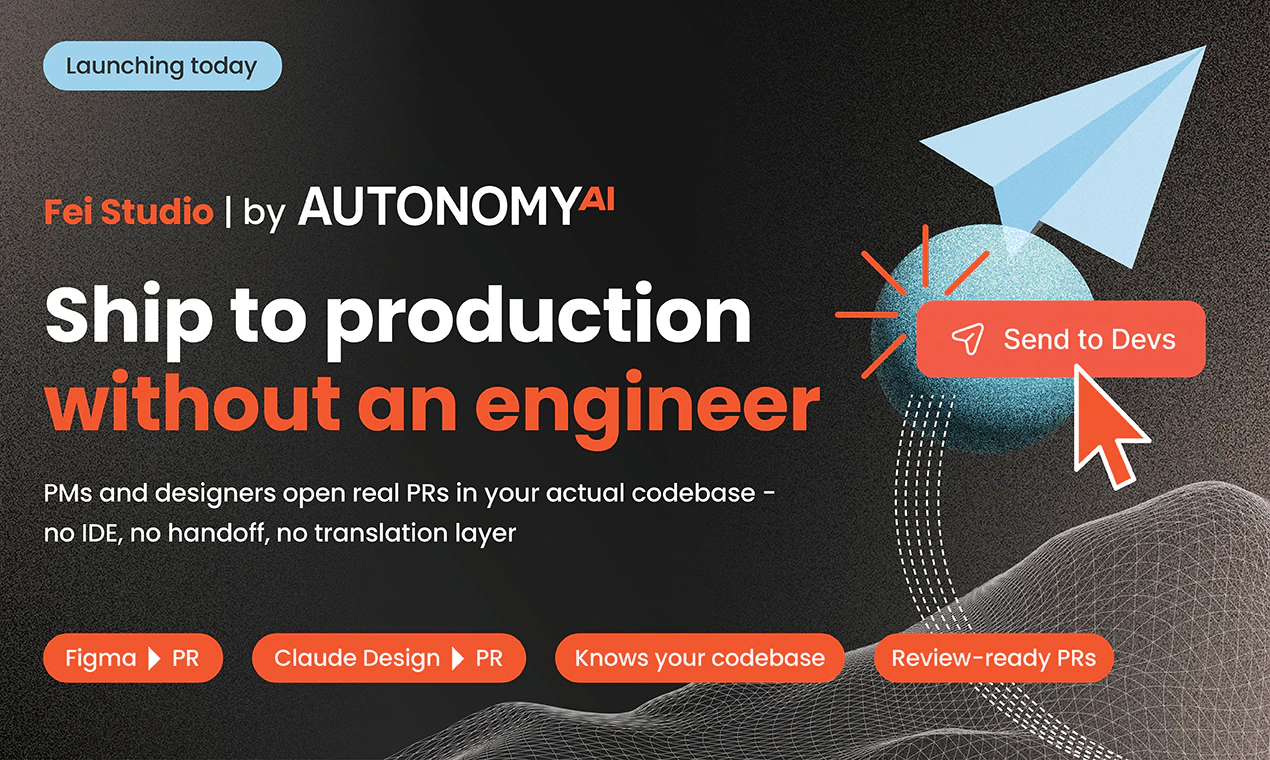
Design Mode gives designers direct ownership of what ships. Point to any element in the live preview, tweak styles visually, and push straight to your codebase from Figma or Claude Design. No handoff. No translation layer. What you designed is what ships. Finally, real superpowers for designers.
AI Analysis
Fei Design Mode empowers designers with direct ownership of production code. Core features include pointing at live preview elements, visual style tweaks, and one-click pushes to the codebase from Figma or Claude Design. It eliminates handoffs and translation layers, ensuring 'what you design is what ships.' USP is granting designers real superpowers in an AI/no-code world. It solves key pain points: designer-developer miscommunication, implementation gaps, slow iterations, and loss of design intent. Value proposition is seamless, accurate design-to-production workflow for faster, truer product building.
Excellent Timing. In 2025-2026, AI tools like Claude are maturing rapidly for code generation, no-code platforms are mainstream, and teams demand faster design-to-ship cycles amid economic pressure for efficiency. Designer empowerment aligns with growing AI-augmented workflows and remote collaboration trends. Policy support for digital innovation further favors such tools.
High. Technical integrations with Figma API and Claude are established; visual-to-code tech leverages mature AI. Development costs are moderate for an MVP with SaaS delivery. Low supply chain risk, standard compliance for software. Strong scalability via cloud. Main challenge is maintaining accurate code sync across frameworks, but current tech supports it well.
Primary users: UI/UX and product designers (ages 25-40), frontend teams at startups and mid-size SaaS companies. Industries: Software development, digital agencies, tech product firms. Geographic: Global with concentration in US, Europe, Asia tech hubs. Design tools TAM ~$15B+, SAM for design-to-code ~$2B, SOM ~$150M. Pain points: Handoff friction and fidelity loss. High willingness to pay ($29-99/mo) for time-saving professional tools.
Medium. Direct competitors: 1. Figma Dev Mode (figma.com), 2. Locofy (locofy.ai), 3. Anima (animaapp.com), 4. Framer (framer.com), 5. Webflow (webflow.com). Advantages: Direct codebase push from Figma/Claude with no translation layer, true live preview ownership, AI-native integration for designers. Disadvantages: Newer entrant with potentially less mature ecosystem and framework support compared to established players; pricing unknown but must compete on seamless AI workflow.
Upgrade Pro to unlock full AI analysis
Similar Products

Auriko
Trading desk for LLM calls
▲ 332 votes

Cohere Parse 5
Turn complex docs, tables & images into AI-ready data
▲ 158 votes

Opaline
PostHog for team Claude Code and Codex sessions.
▲ 141 votes

Adapt
The company brain that gets work done
▲ 124 votes

Tapfree for Chrome
Voice dictation that adapts to what’s on your screen
▲ 122 votes

CodeBurn
See where your AI coding spend actually goes
▲ 101 votes