
Files SDK
A unified storage SDK for object and blob backends
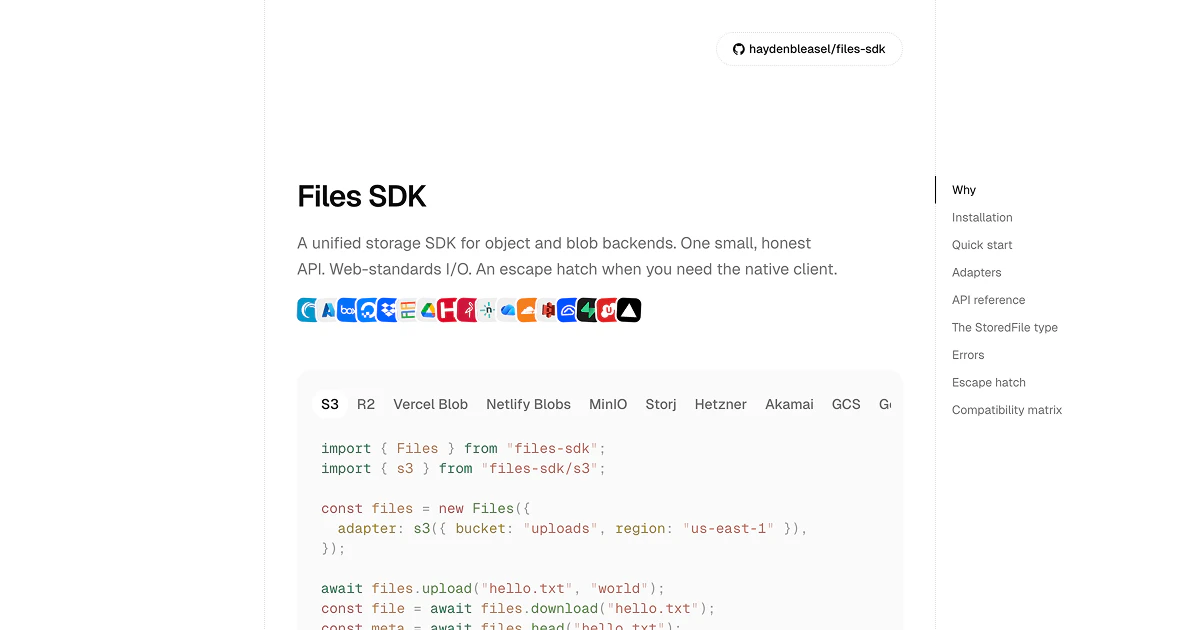
A unified storage SDK for object and blob backends. One small, honest API. Web-standards I/O. An escape hatch when you need the native client.
AI Analysis
Files SDK is an open-source unified storage SDK for object and blob backends, providing one small, honest API with web-standards I/O. It serves as an escape hatch to native clients when needed. It solves key developer pain points like inconsistent provider APIs, vendor lock-in, and complex integrations across storage services. The value proposition is simplicity, standardization, and flexibility, enabling faster development and multi-backend compatibility for cloud applications.
In 2025-2026, with accelerating multi-cloud adoption, AI-driven data growth, and demand for avoiding vendor lock-in amid maturing cloud storage tech, timing is favorable. Developers prioritize flexible, standardized tools in a fragmented market. Excellent Timing.
High. Low technical difficulty for an SDK with clear scope and web standards focus. Minimal development/operation costs as open-source on GitHub. Low compliance/supply chain risks, strong scalability potential for widespread developer adoption. Limited team fit risks if maintainers are experienced.
Primary users: Software developers, backend engineers, and DevOps teams building cloud-native apps, AI/ML services, and SaaS products. Global distribution with concentration in US/Europe tech hubs. Industries: technology, software development. TAM for developer storage tools ~$5B+, SAM ~$500M, SOM ~$50M. Core pains: API fragmentation and lock-in. Moderate willingness to pay for premium support despite open-source base.
Medium. Direct competitors: 1. Apache Libcloud (libcloud.apache.org), 2. MinIO SDK (min.io/docs), 3. AWS SDKs (aws.amazon.com/sdk), 4. rclone (rclone.org). Advantages: smaller/more honest API, web-standards focus, unified escape hatch. Disadvantages: potentially smaller community/ecosystem, less mature feature set vs. established providers.
Upgrade Pro to unlock full AI analysis
Similar Products

Opaline
PostHog for team Claude Code and Codex sessions.
▲ 141 votes

React UI Kit V7
All the chat components you need. None of the complexity
▲ 115 votes

Replay QA Security Scan
Automated Penetration Testing for AI-Built Apps
▲ 102 votes

CodeBurn
See where your AI coding spend actually goes
▲ 101 votes

Audryo
Customer email your agent can operate.
▲ 68 votes

Refoid
Automate App Store refund responses and track every outcome
▲ 68 votes