
Flare
The graph-first IDE and interactive map for agentic coding
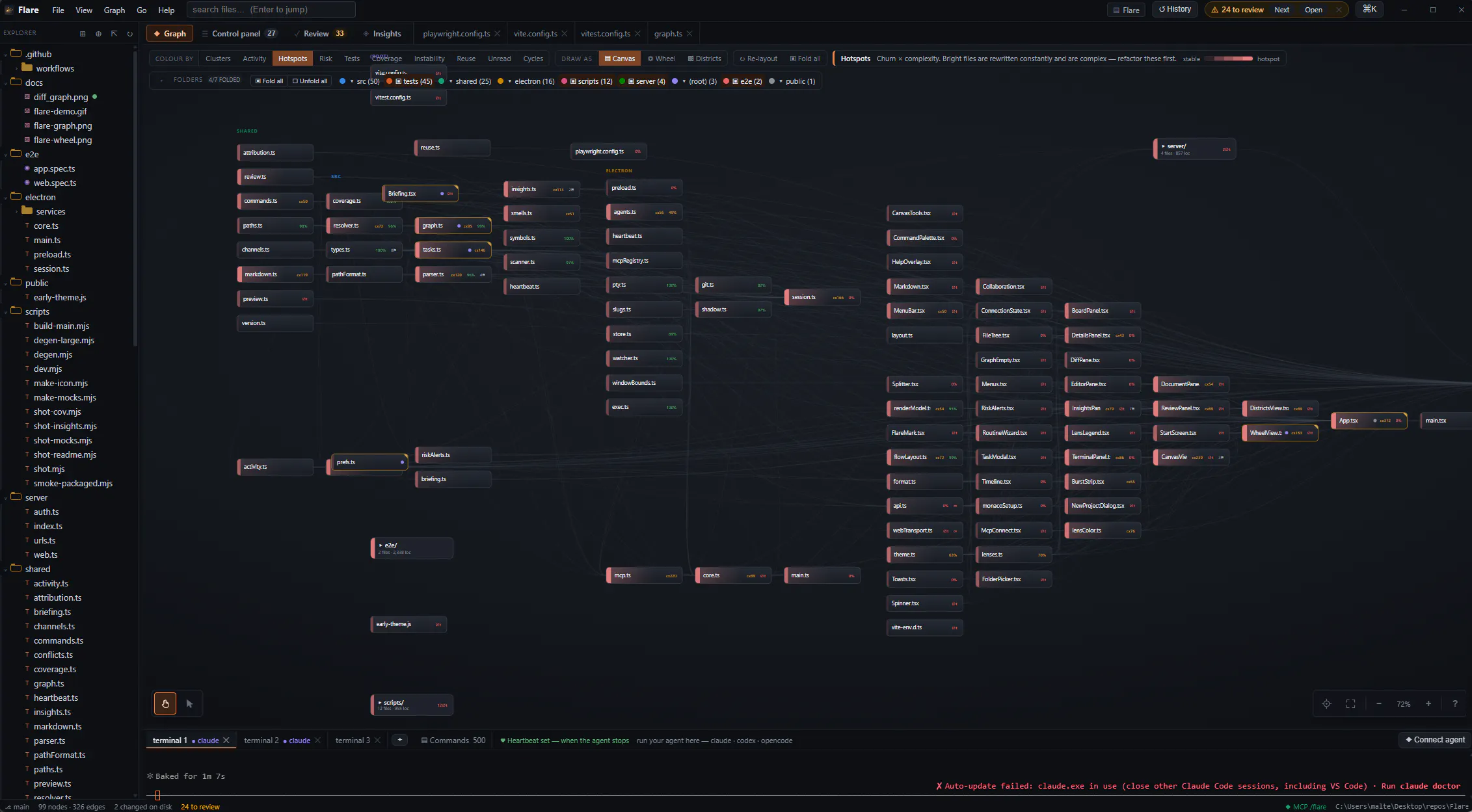
Most agentic coding tools hand you a chat log. Flare hands you the map. Every file is a node, every import an edge, with a real terminal underneath where you run claude, codex or opencode. The graph updates live as the agent edits, attributes every write to whoever made it, and pulls you in when it rewrites something the rest of the app imports. Change bursts snapshot to local history you can diff and revert. Agents take work from a board over MCP. Your machine. No account. MIT licensed.
AI Analysis
Flare is a graph-first IDE and interactive map for agentic coding. It represents files as nodes and imports as edges in a live-updating graph, with an integrated terminal for running AI agents like Claude, Codex, or opencode. The graph attributes edits, notifies on impactful changes, and supports change burst snapshots for local history, diffing, and reverting. Agents pull tasks from a board via MCP. It runs locally with no account needed, is MIT licensed, and open source. It addresses the pain of opaque chat logs in other agentic tools by offering visual transparency, control, and traceability over AI code modifications. Value proposition: empowers developers with a clear map of agent actions for safer, more collaborative AI-assisted coding.
The market timing is favorable for 2025-2026 as AI coding agents and LLMs are rapidly maturing with widespread adoption of tools like Claude and open models. Developer demand is shifting from basic autocomplete to full agentic workflows needing better visibility and control. Industry trends favor productivity-enhancing dev tools amid economic pressures for efficiency. No major policy barriers for local open-source software. This is an Excellent Timing as the limitations of chat-based agents are becoming evident.
High feasibility. Technical complexity of real-time graph analysis and agent integration exists but is demonstrated as the product is launched and open source. Low development/operation costs as it runs locally without servers or user accounts. Minimal compliance risks (MIT license, local execution). High scalability potential for open-source contributions and adaptation to various codebases. Team fit strong for developers experienced in IDEs and AI tools. Key challenge is maintaining graph accuracy on very large projects.
Main target users: Software developers, full-stack engineers, and AI tool enthusiasts using agentic coding (demographics: tech professionals aged 25-45). Industries: Software development, open-source projects, startups. Geographic distribution: Global, concentrated in US, Europe, and Asia tech hubs. Core pain points: Lack of visibility and control when AI agents modify large codebases, difficulty tracking changes from chat logs. Estimated market: Large and growing developer tools segment with millions of potential users; high willingness to pay for premium features though core product is free/open-source. TAM is the multi-billion dollar AI-enhanced dev tools market.
Medium. Direct competitors: 1. Cursor (cursor.com) - AI-powered IDE with chat. 2. Aider (aider.chat) - Terminal-based AI coding. 3. Continue (continue.dev) - Open-source autopilot for VS Code. 4. OpenDevin (github.com/OpenDevin/OpenDevin) - Open-source AI software engineer. 5. Devin by Cognition (cognition-labs.com). Advantages: Unique live graph visualization and edit attribution not offered by others; fully local, no account, strong open-source model. Disadvantages: Newer entrant may lack ecosystem maturity and broad language support compared to established IDE plugins; relies on user-run terminal agents which could be less polished than integrated solutions. Strong differentiation in visual mapping reduces direct competition pressure.
Upgrade Pro to unlock full AI analysis
Similar Products

Opaline
PostHog for team Claude Code and Codex sessions.
▲ 141 votes

React UI Kit V7
All the chat components you need. None of the complexity
▲ 115 votes

Replay QA Security Scan
Automated Penetration Testing for AI-Built Apps
▲ 102 votes

CodeBurn
See where your AI coding spend actually goes
▲ 101 votes

Audryo
Customer email your agent can operate.
▲ 68 votes

Refoid
Automate App Store refund responses and track every outcome
▲ 68 votes