
Frigade Assist API
Give your AI agent guides that show users where to click
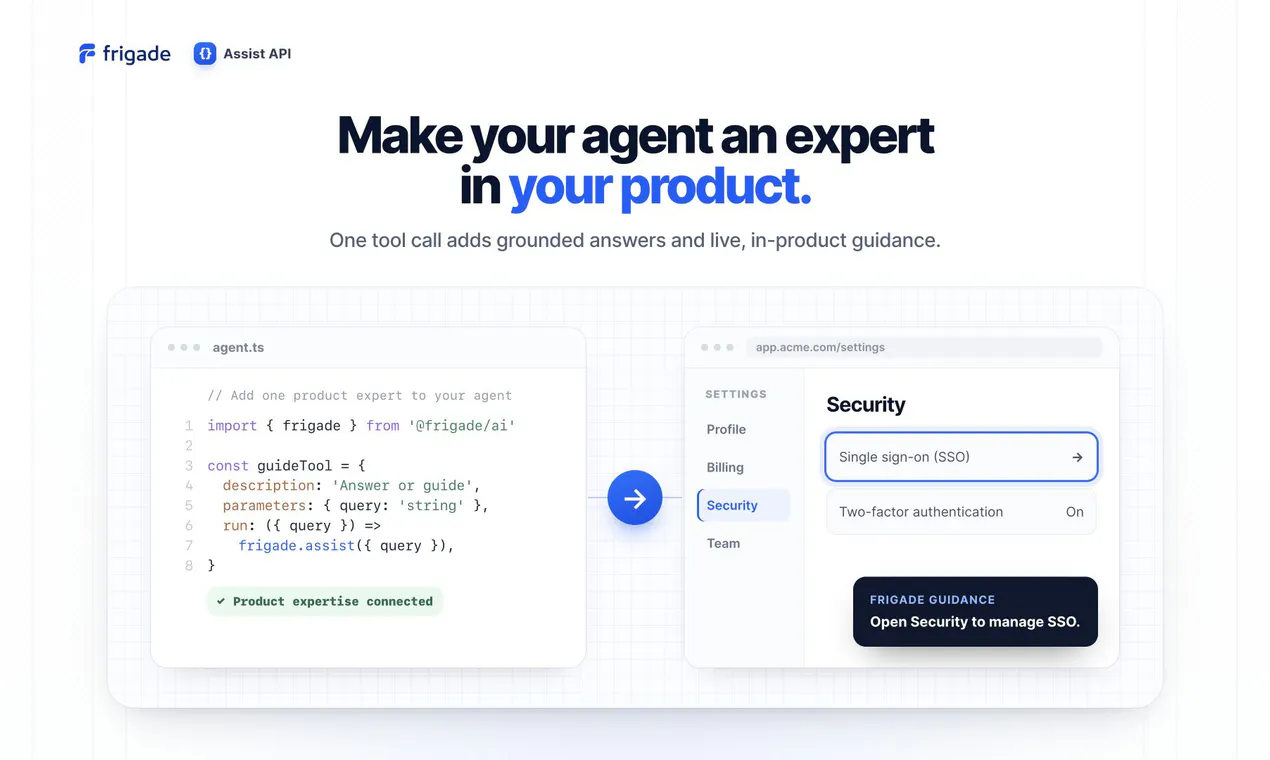
Most in-app AI agents answer "how do I do this?" with a wall of text, because they can't see the screen. The Frigade Assist API is one tool call your existing agent makes. Frigade draws a step-by-step guide right on the page, hands the agent a plain answer when it can't, and tells it what the user is looking at. It knows your product because browser agents used it first, and it relearns every release. Works with the Vercel AI SDK or anything that can call a tool.
AI Analysis
Frigade Assist API enables AI agents to deliver visual step-by-step guides overlaid directly on the user's screen via a single tool call, rather than walls of text. It identifies UI context, provides plain answers when needed, and maintains product knowledge by relearning with each release. Solves the core pain of AI agents lacking visual screen awareness, improving guidance accuracy. USP: seamless integration with Vercel AI SDK, browser-trained product familiarity. Value proposition: transforms in-app AI from generic to contextual and interactive for better customer success and user experience.
In 2025-2026, AI agent adoption and LLM tool-calling are surging, with strong demand for multimodal and contextual interfaces beyond text. Web overlay and guidance tech is mature, user expectations for intuitive in-app AI are rising, and economic focus on efficiency tools supports growth. Excellent fit for customer success AI trends. Rating: Excellent Timing.
Medium technical difficulty for DOM/UI mapping, overlay rendering and auto-updates, but builds on established SDK patterns. Moderate dev/operation costs for maintenance and hosting; low supply chain risks, manageable compliance for web data. Strong scalability and fit for AI/web teams. Overall rating: High, supported by existing browser agent foundations.
Primary segments: SaaS developers and product teams integrating AI agents (especially Vercel AI SDK users), customer success teams in tech. Industries: software/SaaS, AI tools, productivity apps; mainly North America/Europe. Estimated market: part of expanding AI customer experience sector (large TAM, niche SAM for in-app AI guidance SDKs). Pain points: unhelpful text-only AI responses causing frustration/churn. High willingness to pay for improved retention and reduced support needs.
Medium. Direct competitors: 1. WalkMe (walkme.com), 2. Whatfix (whatfix.com), 3. Appcues (appcues.com), 4. Pendo (pendo.io), 5. Userpilot (userpilot.com). Advantages: AI-agent centric with simple tool-call triggers, dynamic visual overlays, automatic product relearning for precise context. Disadvantages: narrower scope than full digital adoption platforms, less brand recognition as a newer API-focused offering, integration may require AI workflow changes.
Upgrade Pro to unlock full AI analysis
Similar Products

Cohere Parse 5
Turn complex docs, tables & images into AI-ready data
▲ 158 votes

Opaline
PostHog for team Claude Code and Codex sessions.
▲ 141 votes

Adapt
The company brain that gets work done
▲ 124 votes

Tapfree for Chrome
Voice dictation that adapts to what’s on your screen
▲ 122 votes

CodeBurn
See where your AI coding spend actually goes
▲ 101 votes

WikiFix for Confluence
Find and fix issues in your knowledge base
▲ 86 votes