
Fudge MCP
Give your AI agents design taste from existing websites
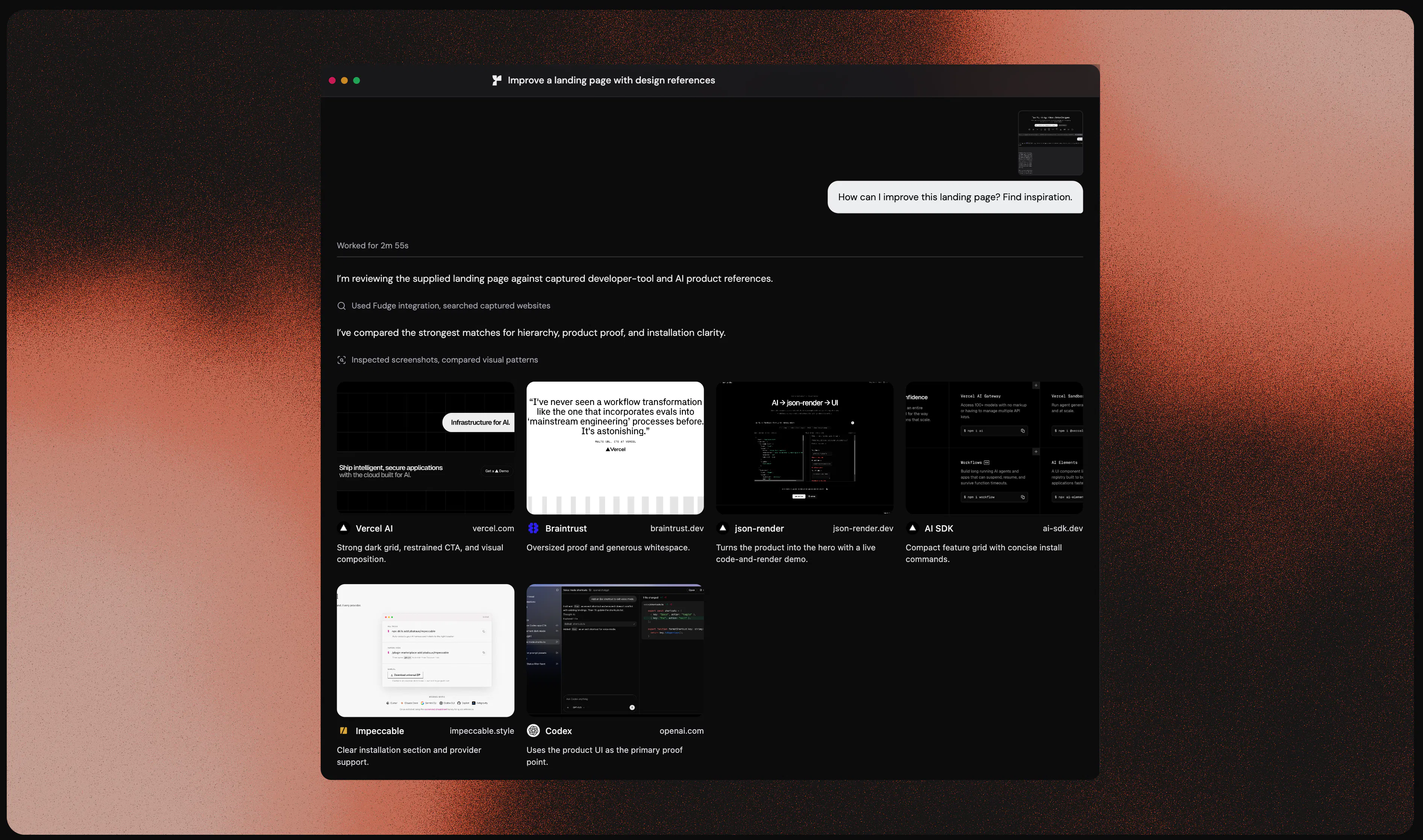
Meet Fudge: a design reference engine for AI agents. Instead of asking AI to make another “modern, premium” interface from scratch, let it search nearly 10,000 real websites by fonts, colors, components, layouts, page types, and visual similarity. Fudge combines measured design evidence with screenshots, runs locally through MCP, and remembers references you save with its Chrome extension. Give your coding agent better taste and not more adjectives.
AI Analysis
Fudge MCP is a design reference engine for AI agents. It enables searching nearly 10,000 real websites by fonts, colors, components, layouts, page types, and visual similarity, combining measured design data with screenshots. It runs locally via MCP and uses a Chrome extension to save user-preferred references. It solves the key pain point of AI agents producing generic 'modern and premium' interfaces due to vague prompts, instead providing concrete real-world design taste. The value proposition is empowering coding agents with sophisticated, evidence-based design capabilities for higher quality UI generation.
The timing is favorable in 2025-2026 as AI coding agents and autonomous AI tools are seeing explosive growth with maturing multimodal capabilities and increasing demand for higher quality outputs beyond generic designs. User frustration with bland AI-generated UIs is rising while web design data is abundant and searchable. Economic push for AI productivity tools supports adoption. Excellent Timing.
Technical difficulty is medium: building accurate design attribute extraction and similarity search over 10k sites is challenging but evidently solved. Local execution via MCP lowers operational costs and compliance risks (no heavy cloud dependency). Scalability is high once the database and extension are built. Overall High feasibility with manageable costs for a focused team.
Primary users: AI engineers, prompt engineers, indie developers and web designers using AI coding agents (e.g. Claude, Cursor). Industries: AI tooling, software development, digital design. Mainly English-speaking tech professionals in US/Europe. TAM is the multi-billion AI developer tools market; SAM is AI-assisted design software (hundreds of millions); SOM is niche agent reference tools. Core pain: ineffective vague prompts for UI. High willingness to pay for productivity gains.
Low. Direct competitors: 1. Mobbin (mobbin.com) - design pattern library; 2. PageFlows (pageflows.com) - user flow references; 3. UI8.net - UI kits and resources; 4. Galileo AI (galileo.ai) - text-to-UI generation. Advantages: uniquely tailored for AI agents with semantic search across real sites, local MCP operation, and persistent memory via extension. Disadvantages: newer entrant with potentially smaller initial database compared to established libraries; requires user to adopt Chrome extension and MCP.
Upgrade Pro to unlock full AI analysis
Similar Products

Cohere Parse 5
Turn complex docs, tables & images into AI-ready data
▲ 158 votes

Opaline
PostHog for team Claude Code and Codex sessions.
▲ 141 votes

Adapt
The company brain that gets work done
▲ 124 votes

Tapfree for Chrome
Voice dictation that adapts to what’s on your screen
▲ 122 votes

CodeBurn
See where your AI coding spend actually goes
▲ 101 votes

WikiFix for Confluence
Find and fix issues in your knowledge base
▲ 86 votes