
GateOS
The all-in-one workspace for serious exam aspirants.
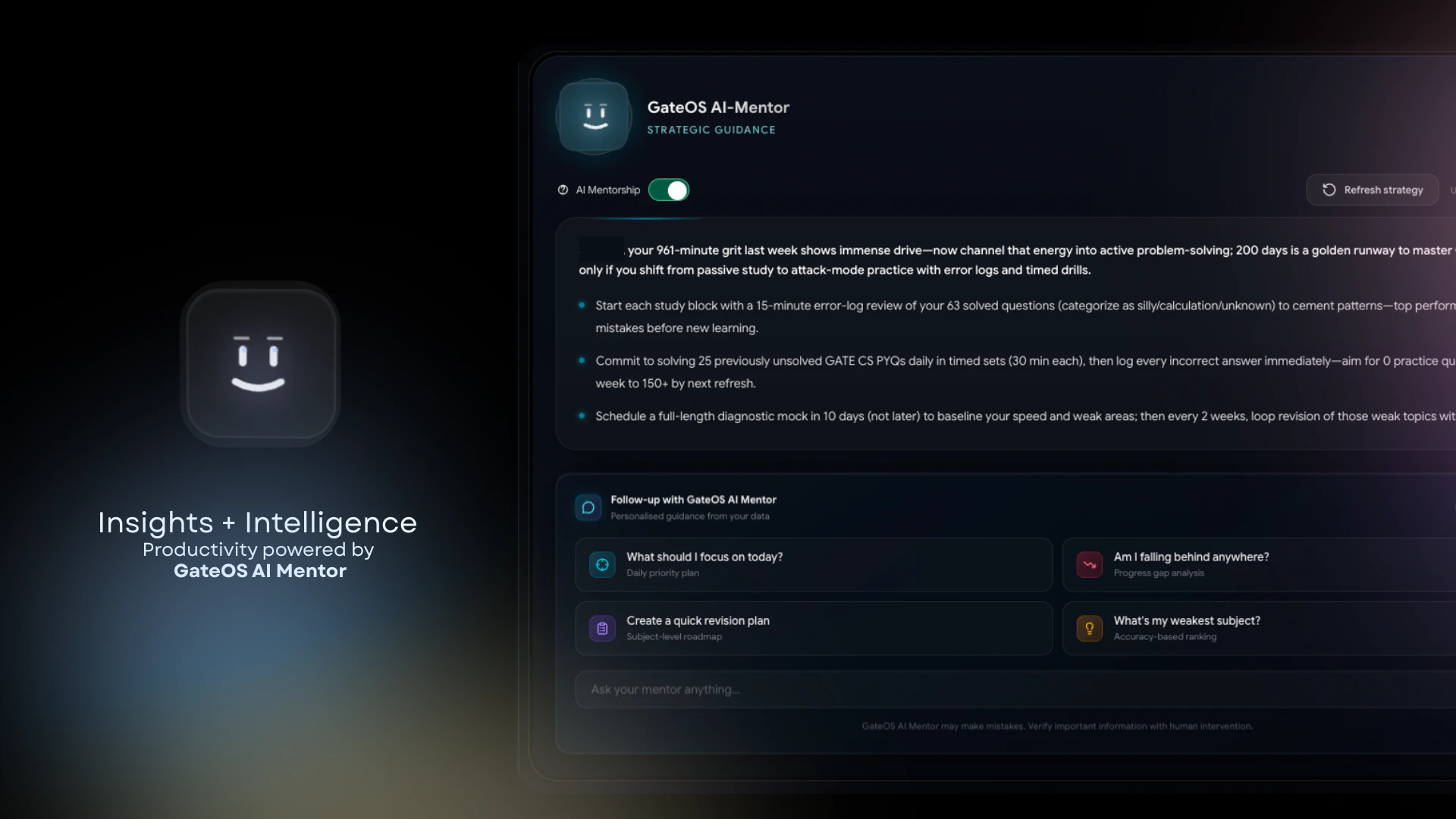
GateOS is an AI-powered learning workspace built for competitive exam aspirants, students and researchers. It brings planning, notes, AI tutoring, performance analytics, mistake tracking, mock-test insights, and revision workflows into a single platform. Instead of switching between multiple apps, students can manage their entire preparation journey in one place, helping them stay organized, focused, and continuously improve.
AI Analysis
GateOS is an AI-powered all-in-one workspace for competitive exam aspirants, students, and researchers. It integrates study planning, note-taking, AI tutoring, performance analytics, mistake tracking, mock-test insights, and revision workflows into a single platform. The core USP is eliminating the need to switch between multiple apps, solving key pain points like disorganization, fragmented preparation, lack of personalized guidance, and inefficient progress tracking. Its value proposition is to help users stay organized, maintain focus, and achieve continuous improvement through intelligent, data-driven tools tailored for serious exam preparation.
The market timing is favorable for 2025-2026. AI technology has matured with accessible LLMs enabling sophisticated tutoring and analytics. Education trends emphasize personalized, self-paced learning amid rising costs of traditional coaching. In exam-heavy regions, demand for integrated digital tools is surging due to post-pandemic shifts and policy support for edtech. Economic pressures make efficient all-in-one platforms attractive. Overall: Excellent Timing.
Feasibility is high. Technical difficulty is manageable by leveraging existing AI APIs, Vercel deployment, and standard web tech for notes/analytics. Development and operation costs are moderate for SaaS with potential AI inference expenses scalable via usage tiers. Low supply chain risk; main concerns are data privacy compliance (e.g., GDPR for student data). Strong scalability as cloud-based platform with good team fit for AI/productivity tools. Key risks are ensuring AI accuracy in education contexts.
Primary users: 18-28 year old competitive exam aspirants (e.g., GATE, JEE, NEET, UPSC in India), university students, and academic researchers. Demographics skew male/female in STEM fields, tech-savvy, motivated self-learners. Geographic focus: India (majority), South Asia, with expansion to global exam-prep markets. TAM for global edtech ~$250B+, India edtech TAM ~$10B with test prep SAM ~$3B; SOM for AI workspaces likely $200-500M. Core pains: fragmented tools and ineffective revision. High willingness to pay for premium features ($5-20/month subscriptions common in sector).
Competition level: Medium. Direct competitors: 1. Embibe (embibe.com) - AI test prep with analytics. 2. Unacademy (unacademy.com) - Online courses and mock tests for Indian exams. 3. Physics Wallah (pw.live) - Affordable prep with performance tracking. 4. Khanmigo (khanacademy.org/khanmigo) - AI-powered tutoring. 5. Notion AI (notion.so) - Flexible workspace for notes/planning. Advantages: tighter integration of mistake tracking, revision workflows and exam-specific insights in one dedicated space; focused on 'serious aspirants'. Disadvantages: newer brand with less content library or live classes than incumbents; may require user onboarding to replace existing tool stacks.
Upgrade Pro to unlock full AI analysis
Similar Products

Cohere Parse 5
Turn complex docs, tables & images into AI-ready data
▲ 158 votes

Adapt
The company brain that gets work done
▲ 124 votes

Tapfree for Chrome
Voice dictation that adapts to what’s on your screen
▲ 122 votes

CodeBurn
See where your AI coding spend actually goes
▲ 101 votes

Kosshi
Simple, fast outliner for Mac and iPhone.
▲ 90 votes

Thoughts for Mac
Capture notes from your menubar using text, images or voice
▲ 90 votes