
Genpire
Make Real Products with AI, literally.
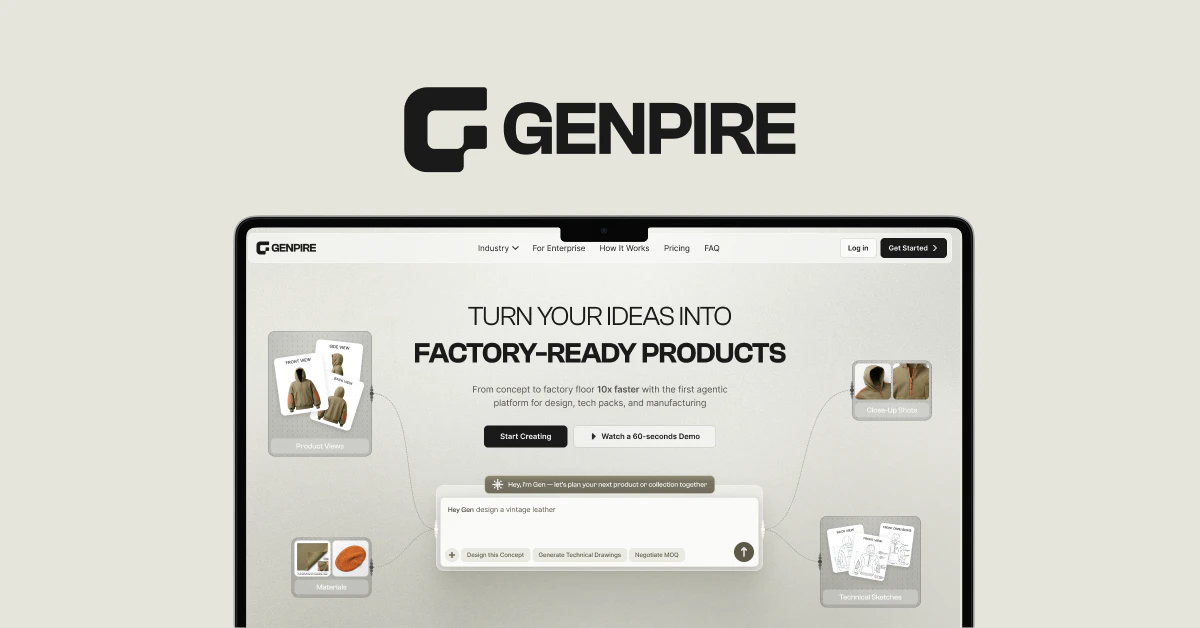
Most AI stops at the idea. Genpire takes it to the factory. Think Lovable, but for consumer goods manufacturing - an agentic platform that turns prompts and sketches into products, collections, and factory-ready specs, then lets you work with your own factory or tap into a vetted network for instant quotation, sampling, and bulk production. One workflow, all the way from an idea to the factory floor. Genpire makes building physical products faster, simpler, and finally accessible to anyone.
AI Analysis
Genpire is an agentic AI platform that turns prompts and sketches into physical consumer products, generating collections, factory-ready specs, and enabling instant quotations, sampling, and bulk production via personal or vetted factory networks. It solves major pain points including complex manufacturing processes, lack of technical expertise, long timelines, and high barriers for non-experts. Its USP is the seamless end-to-end workflow from idea to factory floor, making physical product development fast, simple, and accessible like AI has done for software (e.g. Lovable). Overall value: democratizes consumer goods manufacturing for makers and entrepreneurs.
Favorable in 2025-2026 due to maturing agentic and multimodal AI technologies, surging demand for rapid customization and small-batch production driven by e-commerce and direct-to-consumer brands, supply chain reshoring trends, and supportive AI innovation policies. AI has proven effective in digital domains and is now extending reliably into physical design/manufacturing. Excellent Timing.
Medium feasibility. Technical difficulty is notable in creating accurate, production-ready specs from vague prompts, requiring robust manufacturing knowledge integration. Development and operation costs are high for maintaining a vetted factory network, quality assurance, and compliance (IP, trade regulations). Supply chain risks exist but scalability is strong with AI leverage. Team needs expertise in both AI and physical manufacturing.
Primary segments: indie makers, product designers, entrepreneurs, and small DTC brands in consumer goods (fashion, accessories, electronics, home products). Demographics: tech-savvy individuals aged 25-45, mainly in US, Europe, and global creative hubs. Estimated market size: broad on-demand manufacturing TAM exceeds $400B with AI-enabled portion (SAM) in tens of billions; platform SOM in low billions. Core pains: barriers in design-to-production translation and high costs/timelines. Strong willingness to pay for speed and simplicity via usage or subscription models.
Medium. Direct competitors: 1. Xometry (xometry.com) - instant quoting manufacturing marketplace; 2. Shapeways (shapeways.com) - on-demand 3D printing and production; 3. Protolabs (protolabs.com) - rapid prototyping to production; 4. Autodesk generative design tools (autodesk.com); 5. Emerging AI platforms like Vizcom (vizcom.ai) for design. Advantages: unique agentic AI for full idea-to-factory automation and collections, beyond mere matching or design. Disadvantages: newer player may face challenges in AI accuracy validation and building trusted factory relationships compared to established manufacturing networks.
Upgrade Pro to unlock full AI analysis
Similar Products

Auriko
Trading desk for LLM calls
▲ 332 votes

Cohere Parse 5
Turn complex docs, tables & images into AI-ready data
▲ 158 votes

Opaline
PostHog for team Claude Code and Codex sessions.
▲ 141 votes

Adapt
The company brain that gets work done
▲ 124 votes

Tapfree for Chrome
Voice dictation that adapts to what’s on your screen
▲ 122 votes

CodeBurn
See where your AI coding spend actually goes
▲ 101 votes