
Ghostifier
Companies have your data. Ghostifier gets them to delete it.
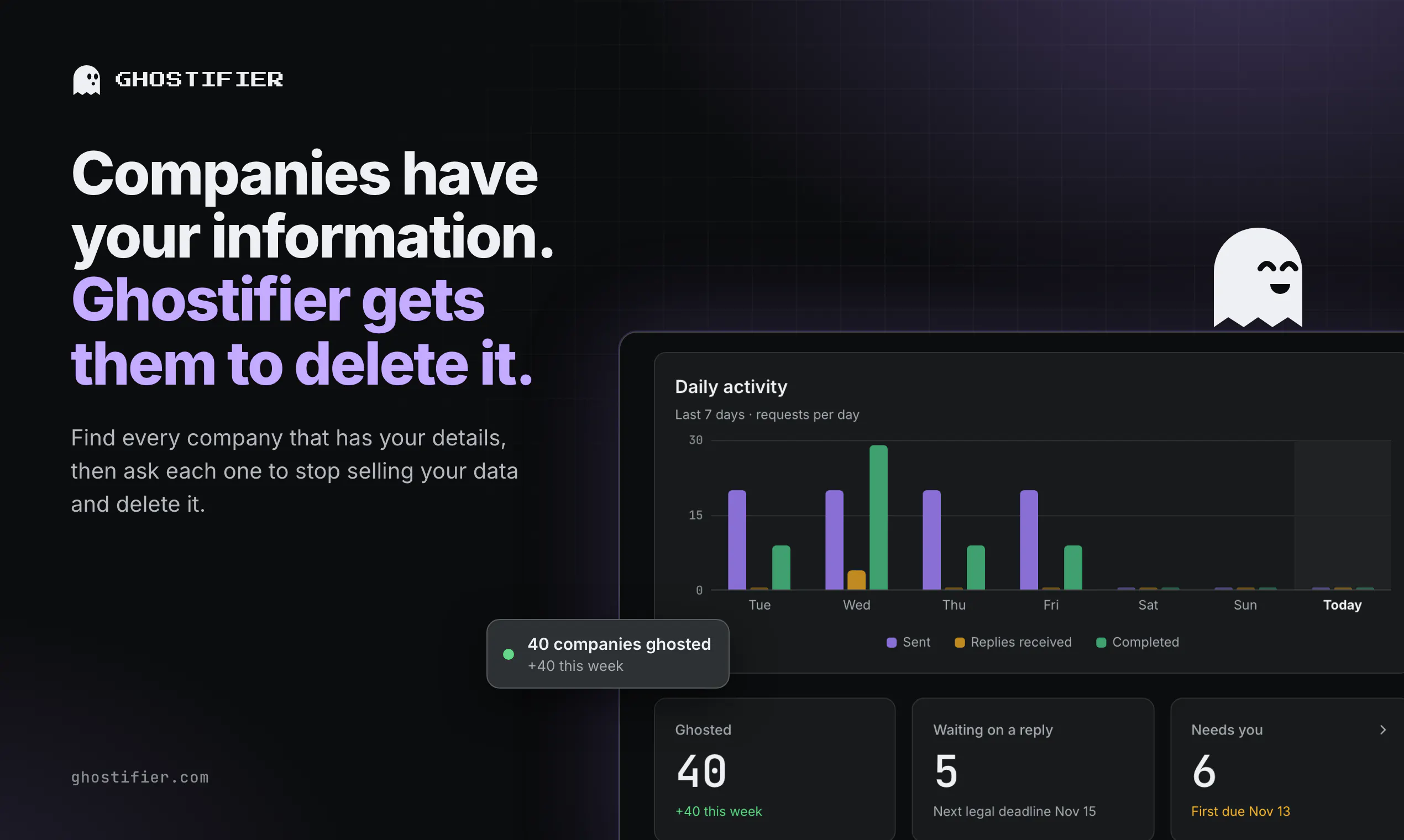
Instead of one form per company, Ghostifier starts from your inbox. It finds who holds your data, unsubscribes you and opts you out of sale and sharing on day one, waits out the return window, then sends deletion requests and tracks every reply. Banks, insurers and your employer are left alone. It also asks data brokers to delete you. Gmail access is headers only, so it never reads your email bodies, and there is no AI: every decision follows fixed rules.
AI Analysis
Ghostifier automates data privacy management by scanning Gmail inbox headers (without reading email bodies) to identify companies holding user data. It unsubscribes, opts out of data sale/sharing immediately, waits out return periods, then sends and tracks deletion requests per fixed rules. It skips banks, insurers, and employers while also targeting data brokers. This solves the pain of tedious, repetitive manual opt-outs and unenforced deletion requests across services. USP is its inbox-first, rule-based, privacy-first approach with no AI, ensuring compliance and tracking without compromising email content. Value proposition: effortless, thorough personal data cleanup restoring user control.
In 2025-2026, favorable trends include stricter global privacy laws (CCPA expansions, GDPR enforcement), heightened consumer awareness due to AI data scraping and breaches, and demand for automated tools amid digital fatigue. Policy environment supports data subject rights, making automated deletion services timely. No major economic barriers for SaaS privacy tools. Excellent Timing.
High. Technical implementation is straightforward using email APIs for headers only and rule-based automation, with moderate dev/operation costs. Main risks are legal/compliance around impersonating requests and data privacy (mitigated by no body reading). Strong scalability as SaaS. No supply chain issues; team fit good for privacy-focused developers. Key challenge is maintaining accurate rules across changing company policies.
Primary users: privacy-conscious individuals, professionals aged 25-45 concerned about spam, data brokers, and identity risks. Industries: tech, finance-adjacent consumers. Geographic: mainly US and EU where data rights laws (CCPA/GDPR) empower deletions. TAM for consumer privacy software is large and growing (multi-billion USD), SAM for automated deletion tools hundreds of millions, SOM depending on acquisition. Core pains: time sink of manual requests and low company response rates. Moderate to high willingness to pay for effective subscription service.
Medium. Direct competitors: 1. Incogni (incogni.com) - focuses on data broker opt-outs. 2. DeleteMe (abine.com/deleteme) - manual + automated removal from brokers/people search. 3. OneRep (onerep.com) - scans and removes personal data. 4. Optery (optery.com) - data broker deletion service. 5. PrivacyBee (privacybee.com). Advantages: unique inbox-driven automation with sequential unsubscribe/opt-out/deletion + reply tracking, selective exclusion of sensitive accounts, strict no-AI and headers-only privacy. Disadvantages: Gmail-only access may limit appeal, potentially higher complexity in tracking vs. broker-only tools; pricing unknown but must compete with ~$5-15/mo rivals.
Upgrade Pro to unlock full AI analysis
Similar Products

Oasis Browser for Mac
A privacy-first AI browser you can train anonymously
▲ 211 votes

Town
The assistant that learns how you work, then gets to work.
▲ 115 votes

Replay QA Security Scan
Automated Penetration Testing for AI-Built Apps
▲ 102 votes

FileFlan
Instant private universal file sharing
▲ 100 votes

Whiteout
Auto-redact sensitive info from Mac screenshots
▲ 83 votes

SolonGate
Zero-trust security gateway for AI agents
▲ 70 votes