
Glasp for Firefox
Highlight and summarize any page, PDF, or video in Firefox
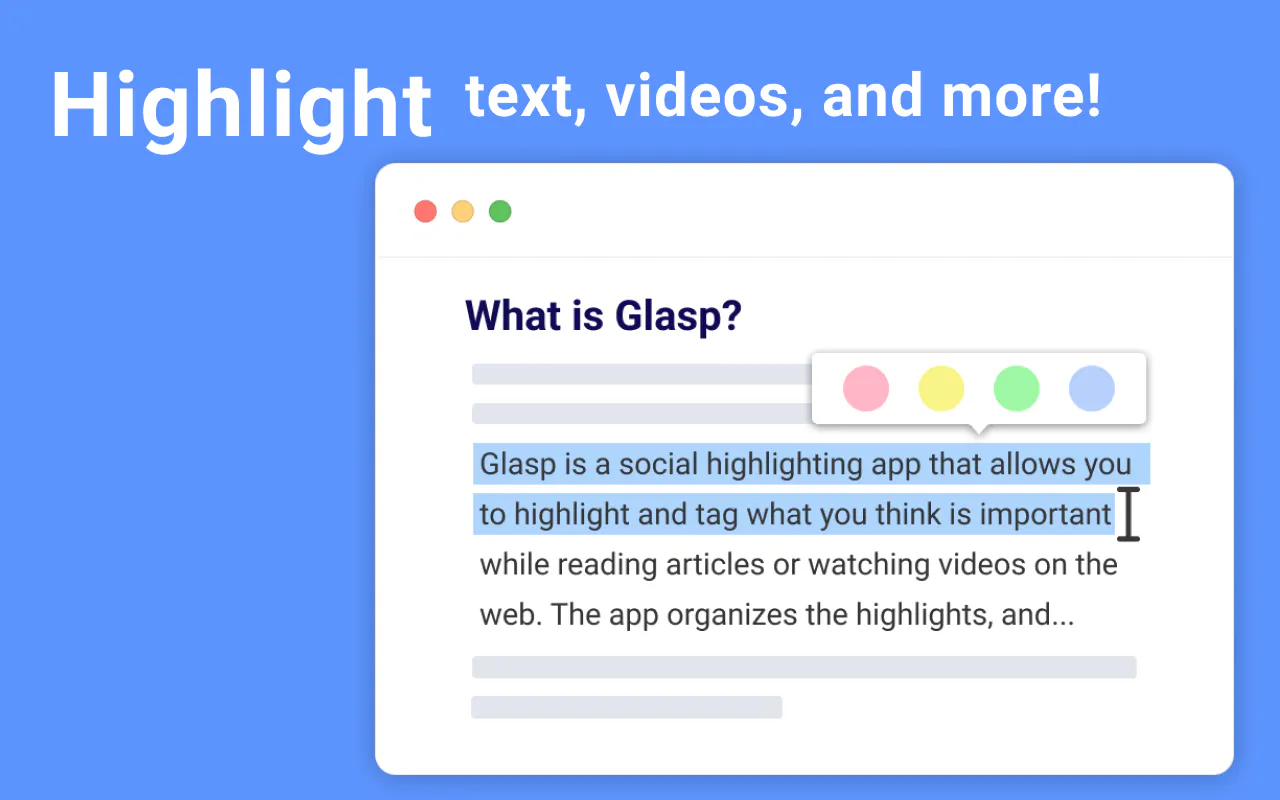
Glasp is now on Firefox. Highlight web articles, PDFs, and YouTube transcripts in four colors, add notes and tags, and summarize any page or video with ChatGPT, Claude, or Gemini. Everything lands in one searchable library and exports to Notion, Obsidian, or Markdown. Sign in on any browser or on the mobile apps and your highlights follow you. Free, and nothing to migrate.
AI Analysis
Glasp for Firefox is a browser extension allowing users to highlight web articles, PDFs, and YouTube transcripts in four colors, add notes and tags. It integrates AI (ChatGPT, Claude, Gemini) to summarize pages or videos, storing everything in a searchable library that exports to Notion, Obsidian, or Markdown. Highlights sync across browsers and mobile apps. It solves pain points like fragmented digital knowledge capture, inefficient note-taking from web/video/PDF content, and lack of unified organization. The value proposition is a free, seamless, AI-powered personal knowledge management tool that follows users everywhere without migration hassles.
The market timing is favorable for 2025-2026 due to maturing AI technologies (LLMs like Claude/Gemini), rising demand for AI-assisted productivity tools amid information overload from web/videos/PDFs, and continued remote/hybrid work trends. Browser extension ecosystems are stable, with growing user adoption of multi-AI integrations. Economic pressures favor efficient, free tools. No major negative policy impacts foreseen. This is Excellent Timing as AI becomes embedded in daily knowledge workflows.
High feasibility. Technical difficulty is low as the extension leverages mature browser APIs, existing LLM integrations, and proven highlighting tech already deployed on other browsers. Dev/operation costs are moderate (API usage fees for AI summaries can be optimized). Minimal supply chain risks; main concerns are browser store compliance and data privacy, which are standard. Strong scalability via cloud-synced libraries. Team fit assumed good given existing product. Overall low barriers for expansion.
Primary users: students, researchers, knowledge workers, content creators (ages 18-45, tech-savvy). Industries: education, academia, consulting, digital media. Geographic: global, strong in North America, Europe, East Asia. TAM for AI productivity/knowledge tools approx. $20B+, SAM for web annotation extensions ~$2B, SOM for Firefox/Chrome users ~$200M. Core pain points: disorganized web learning, hard-to-search video insights, poor cross-device knowledge access. Willingness to pay: moderate; core is free but users likely pay for advanced AI quotas or premium sync.
Medium. Direct competitors: 1. LINER (getliner.com), 2. Hypothesis (hypothes.is), 3. Readwise Reader (readwise.io), 4. Mem (getmem.com), 5. Notion Web Clipper with AI. Advantages: native Firefox support, multi-AI choice (ChatGPT/Claude/Gemini), strong YouTube/PDF/video transcript handling, free with easy exports to Obsidian/Notion, unified searchable library with cross-device sync. Disadvantages: potentially less collaborative features than Hypothesis, smaller brand than Notion, reliance on third-party AI APIs may affect consistency. Good differentiation via all-in-one free highlighting + AI summarization.
Upgrade Pro to unlock full AI analysis
Similar Products

Cohere Parse 5
Turn complex docs, tables & images into AI-ready data
▲ 158 votes

Opaline
PostHog for team Claude Code and Codex sessions.
▲ 141 votes

Adapt
The company brain that gets work done
▲ 124 votes

Kosshi
Simple, fast outliner for Mac and iPhone.
▲ 90 votes

WikiFix for Confluence
Find and fix issues in your knowledge base
▲ 83 votes

Refoid
Automate App Store refund responses and track every outcome
▲ 68 votes