
GoModel
Open-source OpenRouter
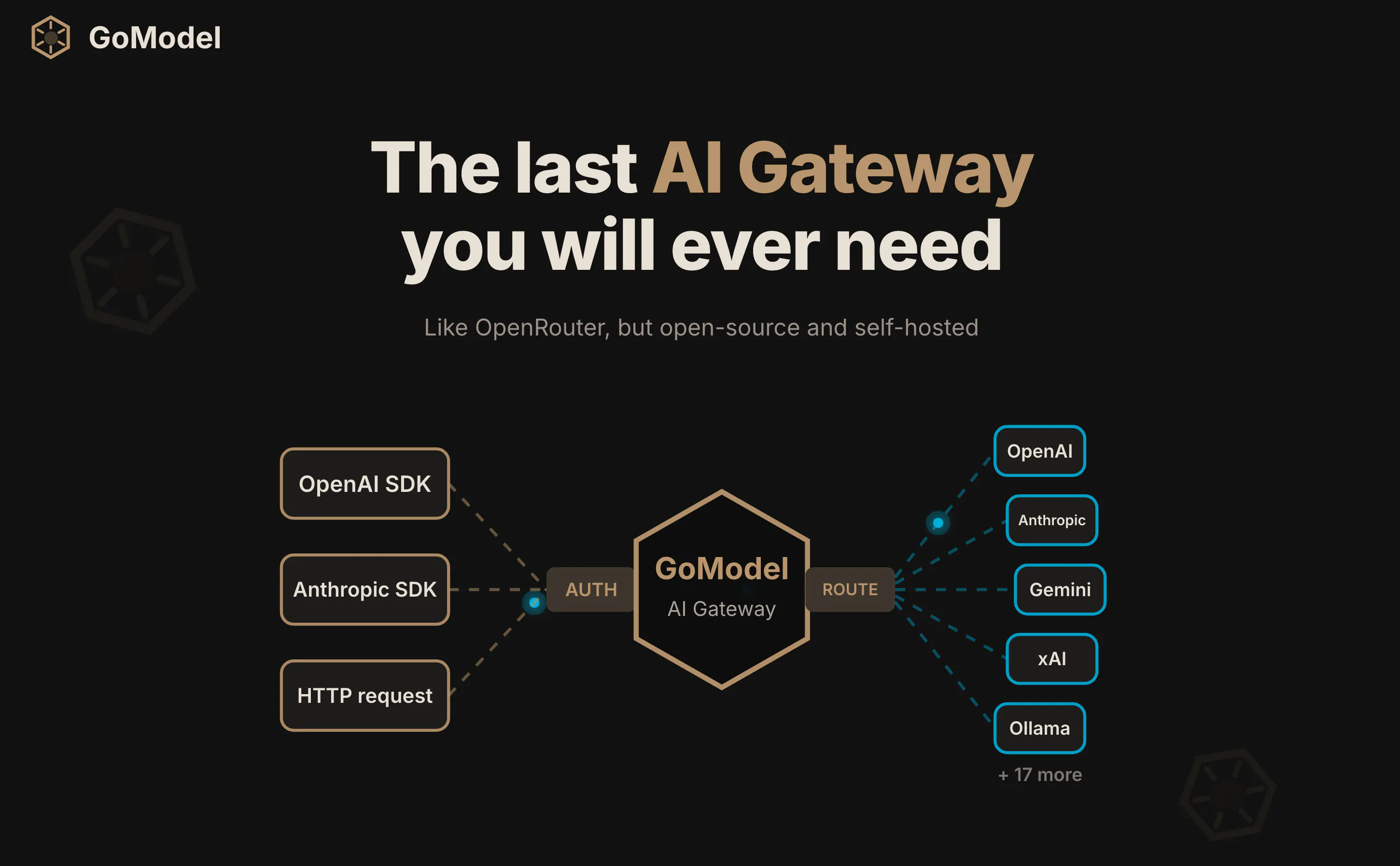
Open-source AI gateway in Go. One OpenAI-compatible API for every provider, with budgets, caching, guardrails, load balancing, and failover. Single binary, ~20MB docker image MIT, bring your own keys. A self-hosted alternative to OpenRouter and LiteLLM.
AI Analysis
GoModel is an open-source AI gateway written in Go, offering a single OpenAI-compatible API for all providers. Core features include budgets, caching, guardrails, load balancing, and failover. Delivered as a single ~20MB binary or Docker image under MIT license with bring-your-own-keys model. It solves key pain points like managing multiple LLM providers, cost overruns, API fragmentation, reliability issues, and lack of control/privacy by serving as a lightweight self-hosted alternative to OpenRouter and LiteLLM. Value proposition: simple, efficient, flexible AI routing without vendor lock-in or heavy dependencies.
In 2025-2026, explosive growth in AI models/providers, rising LLM costs, and privacy concerns drive demand for unified, self-hosted gateways. Tech is mature with widespread OpenAI API adoption; economic pressures favor cost-control tools. Excellent Timing.
Low technical difficulty as a single Go binary already implemented. Minimal dev/operation costs due to tiny footprint and self-hosting. No supply chain risks (open-source, BYOK); high scalability potential. Overall High with strong team fit for open-source developers. Key reasons: lightweight design and MIT license reduce barriers.
Main segments: AI/ML engineers, backend developers, tech startups and SMEs building AI apps (demographics: 25-40yo tech professionals). Industries: software engineering, AI products. Geographic: global, concentrated in US/Europe/China. TAM for AI API management tools ~$5-10B, SAM ~$500M, SOM ~$50M. Core pains: fragmented APIs, cost unpredictability, downtime. High willingness to pay for premium support/enterprise features despite open-source core.
Medium. Direct competitors: 1. LiteLLM (github.com/BerriAI/litellm), 2. OpenRouter (openrouter.ai), 3. Portkey (portkey.ai), 4. Helicone (helicone.ai). Advantages: lighter (single 20MB binary vs heavier alternatives), Go-based performance, full feature parity with strong open-source MIT model. Disadvantages: smaller community than LiteLLM, lacks hosted SaaS option that competitors offer, newer entrant with potentially less battle-tested integrations.
Upgrade Pro to unlock full AI analysis
Similar Products

Opaline
PostHog for team Claude Code and Codex sessions.
▲ 141 votes

React UI Kit V7
All the chat components you need. None of the complexity
▲ 115 votes

Replay QA Security Scan
Automated Penetration Testing for AI-Built Apps
▲ 102 votes

CodeBurn
See where your AI coding spend actually goes
▲ 101 votes

Audryo
Customer email your agent can operate.
▲ 68 votes

Refoid
Automate App Store refund responses and track every outcome
▲ 68 votes