
GPS
Your coding agent finally remembers your repo
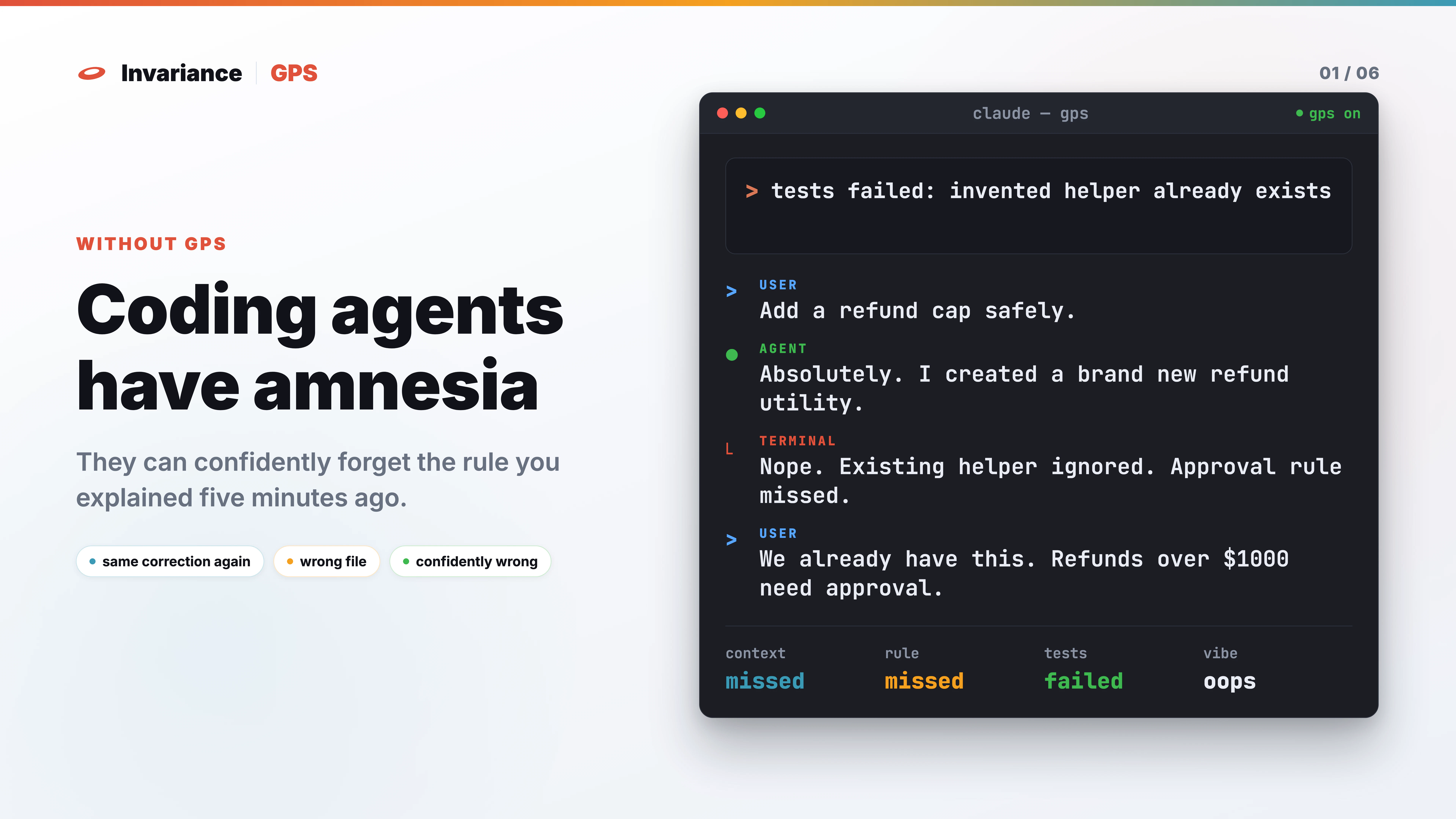
Your coding agent forgets everything the second a session ends. GPS fixes that. It learns your repo's rules, decisions, gotchas, and test commands, then surfaces exactly what's relevant before any edit. No more "don't log PII here" corrections twice. No more repeating yourself every run. Memory anchored to symbols and files, not dumped into a bloated CLAUDE.md. Agents track their own failures and get smarter over time. Local-first, CLI-first, built for Claude Code, Codex, Cursor, and MCP.
AI Analysis
GPS is a local-first, CLI-first memory layer for AI coding agents (Claude Code, Cursor, Codex, MCP). It solves the core pain of agents forgetting repo-specific rules, decisions, gotchas, and test commands after each session by learning from the codebase and anchoring memory directly to symbols and files. Relevant context is surfaced before edits, avoiding bloated files like CLAUDE.md. Agents can track their own failures and improve autonomously over time. USP is persistent, precise, non-polluting repo memory that makes AI coding more consistent, efficient, and self-improving without repetitive human corrections.
2025-2026 sees rapid maturation and adoption of agentic AI coding tools, with LLMs capable of handling complex, long-running tasks where persistent memory is critical. User demand is shifting from one-off completions to reliable, stateful agents. Economic push for dev productivity tools is strong and regulatory environment for local-first AI is favorable. Excellent Timing.
High. Technical foundation (embeddings, local vector stores, symbol parsing) is mature. CLI-first and local-first design keeps operation costs and compliance risks low. No complex supply chain. Scalability is strong as memory is repo-specific. Main challenge is seamless integration with evolving AI coding platforms, but overall highly feasible for a focused dev team.
Primary users: Professional software developers and engineering teams actively using AI coding agents (Cursor, Claude, etc.). Demographics: 25-45 years old, technical background. Industries: Software development, tech startups and enterprises. Geographic: Global with heavy concentration in US, Europe, China. TAM for AI developer productivity tools projected multi-billion by 2026; SAM for agent memory/context tools several hundred million; SOM niche but high-intent. Core pains are context loss and repetition. Strong willingness to pay via subscription for time savings.
Medium. Direct competitors: Letta (letta.ai) - persistent agent memory; Continue.dev (continue.dev) - open-source coding autopilot with context; Aider (aider.chat) - CLI LLM coding tool; Sourcegraph Cody (sourcegraph.com/cody); GitHub Copilot Workspace (github.com). GPS advantages: symbol/file-anchored memory, self-improving via failure tracking, explicit avoidance of repo pollution, tailored for Claude/Cursor/MCP. Disadvantages: newer product with potentially smaller ecosystem and fewer integrations than incumbents. Strong differentiation in targeted memory approach.
Upgrade Pro to unlock full AI analysis
Similar Products

Cohere Parse 5
Turn complex docs, tables & images into AI-ready data
▲ 158 votes

Adapt
The company brain that gets work done
▲ 124 votes

Coarena by Coasty
The arena where agents battle on real-world work
▲ 104 votes

WikiFix for Confluence
Find and fix issues in your knowledge base
▲ 86 votes

Audryo
Customer email your agent can operate.
▲ 68 votes

Refoid
Automate App Store refund responses and track every outcome
▲ 68 votes