
Gradio Workflow
connect nodes to build AI pipelines, powered by Hugging Face
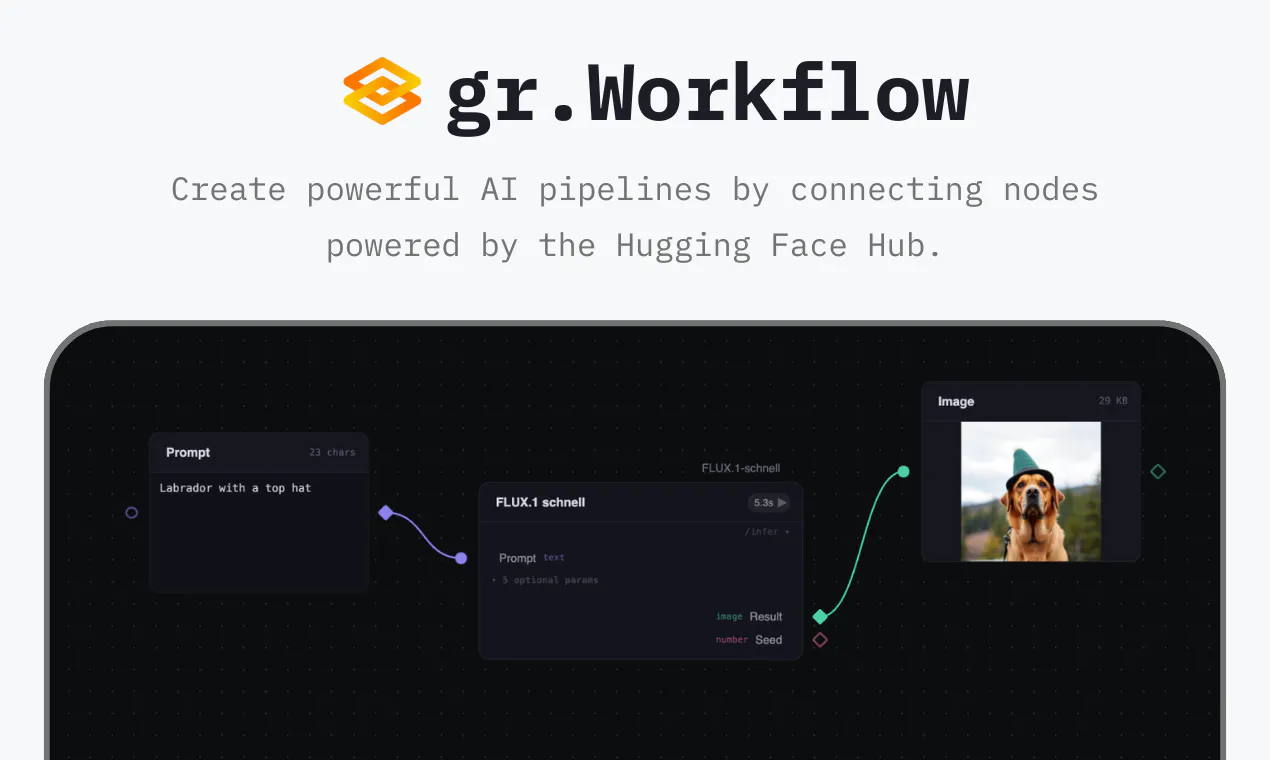
Create AI pipelines by connecting nodes. Bring together Hugging Face Spaces, models, datasets, and your own Python functions on a visual canvas - or let AI agents build workflows programmatically. Inspect intermediate inputs and outputs, and swap in better models without rebuilding your workflow. No downloads needed! Share with a URL or run via a REST API.
AI Analysis
Gradio Workflow enables users to create AI pipelines by visually connecting nodes on a canvas, integrating Hugging Face Spaces, models, datasets, and custom Python functions. It supports AI agents for programmatic workflow building, real-time inspection of inputs/outputs, and seamless model swapping without restarting. No installation required; deploy via shareable URLs or REST APIs. It solves pain points like complex coding for AI orchestration, slow iteration, and integration hurdles. USP is deep HF ecosystem integration in a no-download, collaborative environment. Value proposition: democratizes sophisticated AI pipeline development for faster prototyping and deployment.
In 2025-2026, with exploding growth in AI agents, multimodal AI, and demand for low-code orchestration tools amid maturing open-source ecosystems, timing is highly favorable. Hugging Face's dominance in accessible ML combined with enterprise push for productivity tools and relaxed AI regulations creates ideal conditions. User demand for visual, inspectable pipelines is rising as AI complexity increases. This is an Excellent Timing as it rides the wave of agentic AI and visual programming trends without major economic or policy headwinds.
High feasibility. Builds on mature Gradio and Hugging Face infrastructure, reducing technical difficulty for node-based UI and integrations. Development/operation costs are manageable via cloud hosting with strong scalability potential. Minimal supply chain or compliance risks as it's software-focused on open AI models. HF team expertise ensures good fit. Main challenges are ensuring robust real-time inspection at scale, but overall highly feasible with existing tech stack.
Main targets: AI/ML developers, data scientists, researchers, and indie hackers (tech professionals aged 25-45). Industries: AI startups, tech companies, academia. Geographic: Global with concentration in US, Europe, China. Core pain points: cumbersome pipeline coding, poor visibility into intermediates, slow model experimentation. Estimated market: AI dev tools TAM ~$15B (2025), SAM for workflow/orchestration ~$2B, SOM for visual HF-integrated tools ~$300M. High willingness to pay for premium features like advanced agents or private hosting.
Medium. Direct competitors: 1. Langflow (langflow.org), 2. FlowiseAI (flowiseai.com), 3. ComfyUI (github.com/comfyanonymous/ComfyUI), 4. n8n (n8n.io) for workflows. Advantages: Native deep integration with Hugging Face ecosystem (models/datasets/Spaces), AI agent co-creation, zero-install web-first approach, easy inspection/swapping. Disadvantages: Potentially less mature than ComfyUI in specialized domains (e.g. image gen), may have fewer enterprise connectors than n8n. Strong differentiation via HF brand and no-download accessibility reduces competition pressure.
Upgrade Pro to unlock full AI analysis
Similar Products

Cohere Parse 5
Turn complex docs, tables & images into AI-ready data
▲ 158 votes

Adapt
The company brain that gets work done
▲ 124 votes

Replay QA Security Scan
Automated Penetration Testing for AI-Built Apps
▲ 102 votes

Kosshi
Simple, fast outliner for Mac and iPhone.
▲ 90 votes

Thoughts for Mac
Capture notes from your menubar using text, images or voice
▲ 90 votes

Refoid
Automate App Store refund responses and track every outcome
▲ 0 votes