
Health in ChatGPT
Your personal health companion, powered by ChatGPT
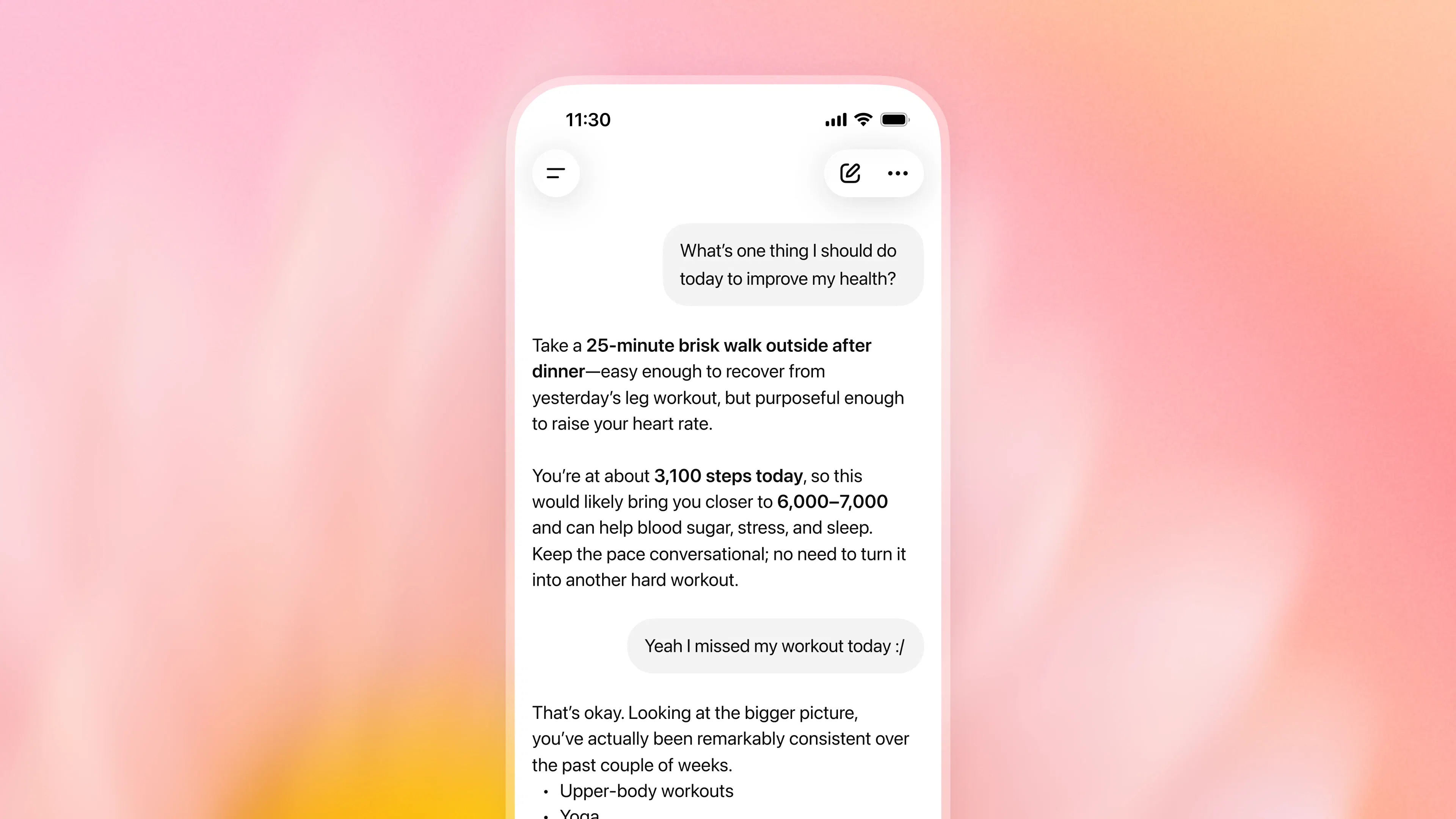
Health in ChatGPT helps you better understand and navigate your health by bringing your health information into one conversation. Connect your health data, medical records, and wellness apps to get more personalized insights, track changes over time, prepare for appointments, understand results, and build healthier routines — all while staying in control of what you share.
AI Analysis
Health in ChatGPT is a conversational AI health companion powered by ChatGPT. It integrates health data, medical records, and wellness apps into a single chat interface to deliver personalized insights, track health metrics over time, prepare users for medical appointments, explain test results, and support habit building. Key pain points solved include fragmented health information across apps and devices, difficulty interpreting complex medical data, and lack of personalized guidance. The USP is maintaining user control over data sharing while leveraging natural language conversations for proactive health navigation. The value proposition is an accessible, all-in-one AI tool that makes health understanding and management more intuitive and effective.
The timing is favorable for 2025-2026 as AI models like GPT continue to mature for domain-specific applications, wearable and health app adoption is surging, and consumers demand more personalized, proactive health tools amid rising healthcare costs and post-pandemic awareness. Improving data interoperability standards and AI healthcare policies further enable such integrations. Excellent Timing.
Overall feasibility is Medium. While leveraging existing ChatGPT APIs reduces core AI development difficulty, integrating diverse health APIs and medical records involves high technical complexity, substantial compliance risks (e.g. HIPAA, GDPR for health data), and notable operational costs for security and scalability. Scalability is promising but regulatory and privacy hurdles are significant challenges.
Main target segments: Tech-savvy health-conscious adults (25-55 years), patients with chronic conditions, and fitness/wellness enthusiasts, primarily in the US, Europe, and other developed markets with high digital adoption. TAM for AI-powered digital health tools exceeds $50B by 2026; SAM for consumer personal health assistants around $10B; SOM for conversational health integration likely $500M+. Core pain points are data silos and lack of actionable insights. Willingness to pay is moderate-to-high for premium personalization via subscriptions.
Medium. Direct competitors: 1. Ada Health (ada.com), 2. K Health (khealth.com), 3. Buoy Health (buoyhealth.com), 4. Infermedica (infermedica.com), 5. Flo Health (flo.health). Advantages: Seamless ChatGPT-powered natural conversations and unified data integration with strong user data control. Disadvantages: Relies on third-party AI (potential inaccuracies in medical advice), less specialized clinical validation than dedicated health AI platforms, and faces challenges in standing out in a crowded wellness AI space. Pricing not specified but likely faces pressure from freemium models.
Upgrade Pro to unlock full AI analysis
Similar Products

Cohere Parse 5
Turn complex docs, tables & images into AI-ready data
▲ 158 votes

Opaline
PostHog for team Claude Code and Codex sessions.
▲ 141 votes

Adapt
The company brain that gets work done
▲ 124 votes

Tapfree for Chrome
Voice dictation that adapts to what’s on your screen
▲ 122 votes

Cercle
The bat signal for your closest friends.
▲ 121 votes

WikiFix for Confluence
Find and fix issues in your knowledge base
▲ 86 votes