
Hosted Agents in Cluing
Collaborative agents who build, learn and publish in 1 place
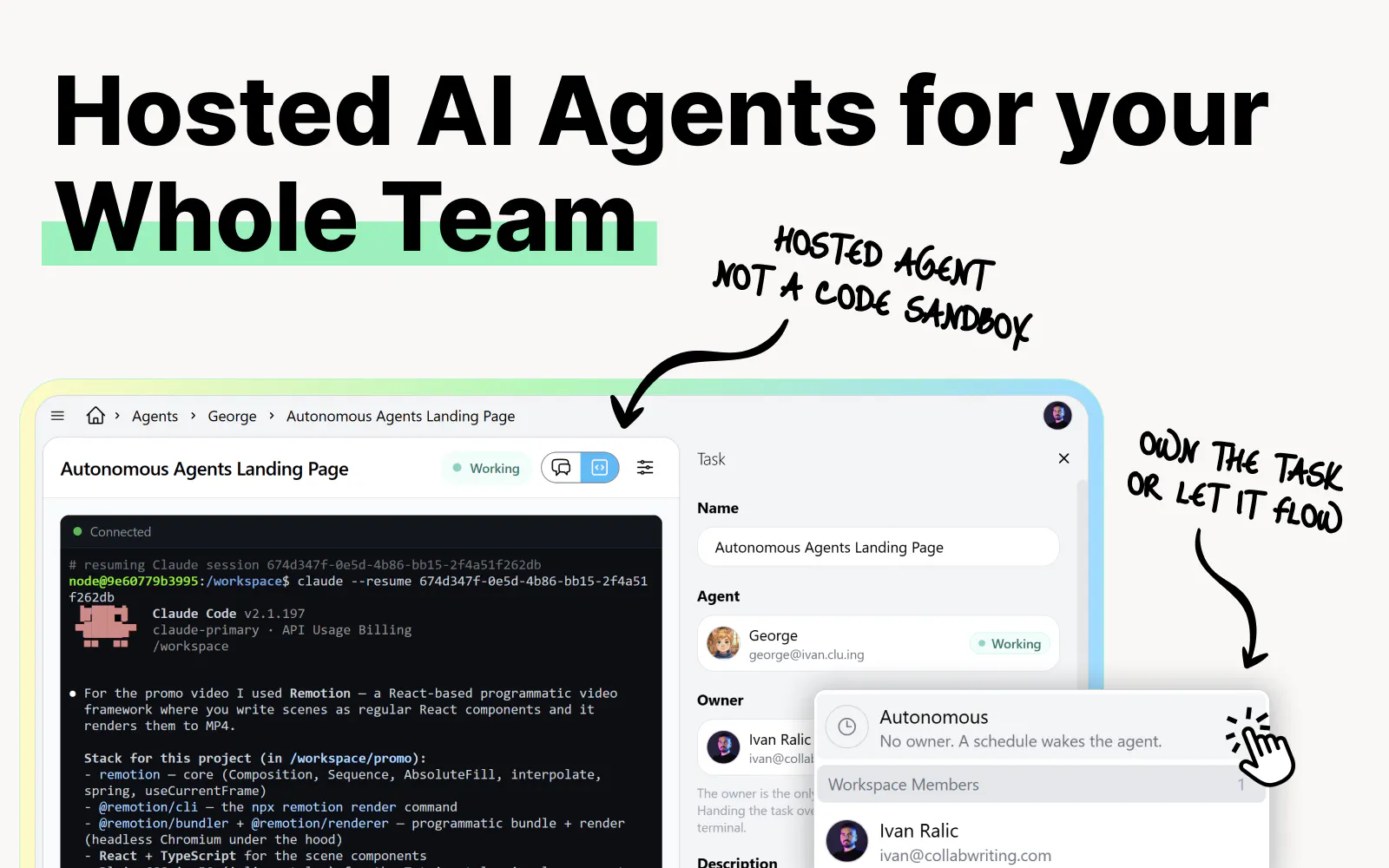
Cluing Hosted Agents take agents off one person’s laptop and into a collaborative workspace. Start work from your computer, continue on your phone, and hand it over to teammates without losing context. Evolving skills update as you collect new insights and agents become a team asset. Anyone can now assign tasks, publish their work, and connect to any external tool with an API or MCP with Cluing's custom connectors. Close the laptop - the work will keep going.
AI Analysis
Cluing Hosted Agents move AI agents from individual laptops into a collaborative, persistent workspace. Core features include starting work on computers and continuing on phones, seamless context-preserving handoffs to teammates, evolving agent skills from new insights, task assignment, publishing outputs, and integrations with any external tools via APIs or custom connectors. It addresses key pain points like isolated single-user agents, context loss during collaboration, and halted workflows when devices are offline. The value proposition is turning personal AI into shared team assets that operate continuously, learn collectively, and boost productivity across devices and users.
The 2025-2026 period is highly favorable as AI agent technologies mature rapidly with advanced LLMs, multi-agent systems, and rising enterprise adoption for automation. User demand is shifting strongly toward collaborative and persistent AI tools amid remote/hybrid work trends. Economic pressures for productivity gains and supportive AI policies create ideal conditions. This is Excellent Timing as the market moves from experimental frameworks to practical team platforms.
High. Technical difficulty is moderate by leveraging existing LLM APIs, cloud hosting, and connector frameworks, though robust multi-user context management and real-time collaboration require sophisticated engineering. Development and cloud operation costs are manageable for SaaS with usage-based scaling. Low supply chain risks and standard data compliance (e.g. GDPR) apply. Strong scalability potential as a cloud platform with good team fit for AI/productivity developers.
Primary segments: AI developers, productivity-focused knowledge workers, small-to-medium tech teams, and enterprises adopting AI automation. Demographics: 25-45yo professionals with technical aptitude. Industries: software/tech, consulting, digital marketing. Geographic: Global with concentration in US, Europe. Estimated TAM for AI productivity/agent platforms exceeds $20B by 2026; SAM for collaborative hosted agents ~$2-3B; SOM for early adopters ~$100-200M. Core pains: fragmented AI workflows and poor team sharing. High willingness to pay via subscriptions for time savings and team efficiency.
Medium. Direct competitors: 1. CrewAI (crewai.com), 2. AgentGPT (reworkd.ai), 3. Lindy (lindy.ai), 4. SmythOS (smythos.com), 5. MultiOn (multion.ai). Advantages: superior emphasis on true collaboration, cross-device persistence, agent evolution as team assets, and easy custom connectors vs. mostly single-user or dev-focused tools. Disadvantages: newer entrant so potentially less mature ecosystem and brand recognition; competitors may offer stronger open-source communities or specialized automation depth. Differentiation through workspace-like agent publishing and handover stands out.
Upgrade Pro to unlock full AI analysis
Similar Products

Cohere Parse 5
Turn complex docs, tables & images into AI-ready data
▲ 158 votes

Opaline
PostHog for team Claude Code and Codex sessions.
▲ 141 votes

Adapt
The company brain that gets work done
▲ 124 votes

Orus
Claude for investing in perpetuals
▲ 121 votes

Kosshi
Simple, fast outliner for Mac and iPhone.
▲ 90 votes
Refoid
Automate App Store refund responses and track every outcome
▲ 68 votes