
Hyperswitch Prism
Library to plug-n-switch payment processors
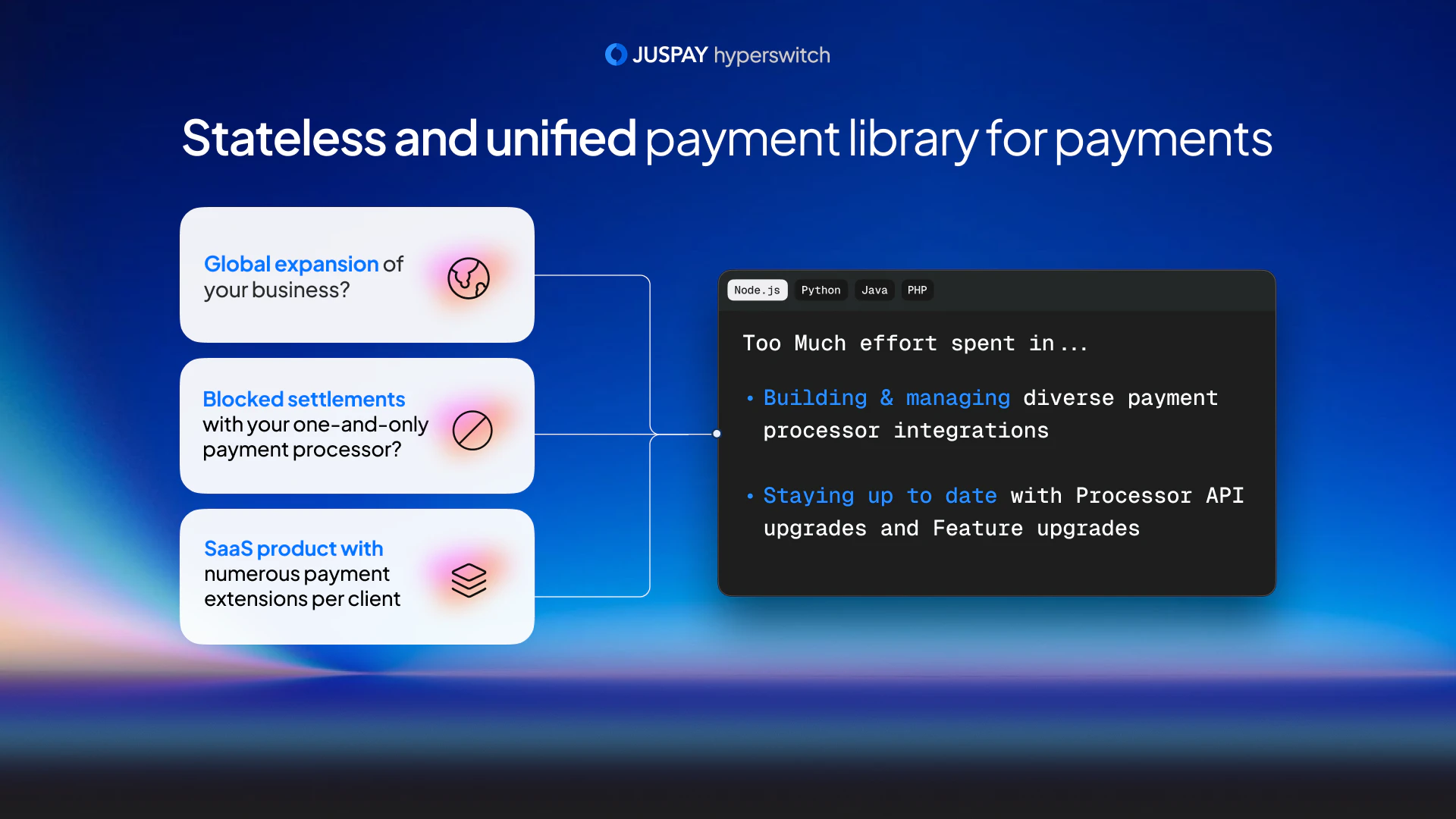
Prism is a stateless payments library that connects your app to multiple payment processors. You can integrate once and point to any payment processor; add fallbacks for redundancy, switch processors based on routing rules - all by swapping a few lines of code. No sign-up needed. No infra setup needed. Actively maintained within the Juspay Hyperswitch production environment. Apache-2.0 licensed, polyglot ready, with SDKs for Node, Python, Java and Rust.
AI Analysis
Hyperswitch Prism is an open-source, stateless payments library enabling developers to integrate once and switch between multiple payment processors via simple code changes. Core features include fallback redundancy, rule-based routing, no sign-up or infra requirements, and SDKs for Node, Python, Java, Rust. It solves key pain points like vendor lock-in, repetitive integrations, downtime risks, and maintenance overhead in payment systems. Actively used in Juspay's production environment under Apache-2.0 license. The value proposition is unmatched flexibility, reliability, and freedom for fintech and app developers to optimize payments without dependency on any single processor.
The market timing is favorable for 2025-2026 with booming digital payments, rising demand for orchestration to manage multiple processors amid increasing fees and reliability concerns. Open-source adoption in fintech is accelerating due to cost control, regulatory pushes for transparency, and mature API technologies. User demand for flexible, no-lock-in solutions is high in a competitive economic environment. Excellent Timing.
High - Stateless library design drastically cuts operational costs and infra needs with no setup required. Technical difficulty lies in maintaining compatibility and security across processors, but proven production use in Juspay environment demonstrates viability. Compliance risks in fintech exist but are lower as a client-side library. Strong scalability potential as it's polyglot and embeddable.
Primary segments: Developers, engineering teams, and fintech startups building e-commerce, SaaS, or digital apps (ages 25-40, tech professionals); concentrated in US, Europe, India, and Southeast Asia. TAM for global payment infrastructure ~$100B+, SAM for orchestration tools ~$10B by 2026, SOM for open-source libraries ~$500M. Core pains: integration complexity and processor dependency. Moderate-to-high willingness to pay for related enterprise support or hosted versions.
Medium. Direct competitors: 1. Stripe SDKs (stripe.com), 2. Adyen APIs (adyen.com), 3. Braintree SDK (braintreepayments.com), 4. Primer (primer.io), 5. Payrails (payrails.io). Advantages: Fully open-source, zero setup/infra costs, true plug-and-switch with routing/fallbacks, production-proven. Disadvantages: Requires more developer effort than fully managed SaaS platforms; limited built-in analytics or enterprise features compared to commercial orchestrators.
Upgrade Pro to unlock full AI analysis
Similar Products

Equitybee Benchmark
Compare your startup equity grant for free.
▲ 218 votes

Opaline
PostHog for team Claude Code and Codex sessions.
▲ 141 votes

Orus
Claude for investing in perpetuals
▲ 121 votes

React UI Kit V7
All the chat components you need. None of the complexity
▲ 115 votes

Replay QA Security Scan
Automated Penetration Testing for AI-Built Apps
▲ 102 votes

Refoid
Automate App Store refund responses and track every outcome
▲ 68 votes