
iMessage Hermes on a Raspberry Pi
An always-on AI agent that lives in your home
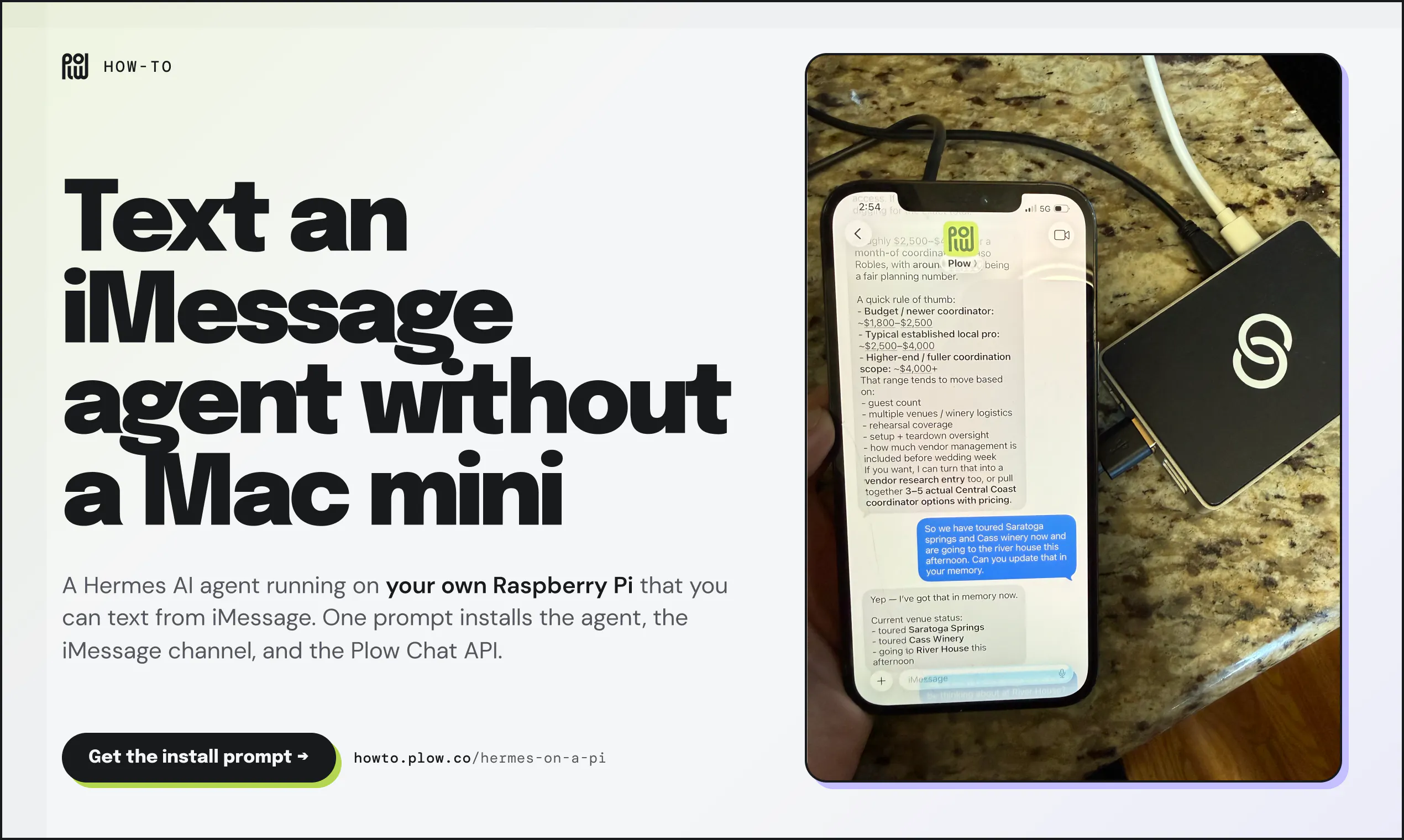
An always-on AI agent that lives on a cheap little Raspberry Pi in your home, with a real phone number you text over iMessage or SMS from anywhere. It runs Hermes, an open-source agent, and installs by handing the guide to a coding agent that works over SSH. Best of all, it's a foundation: build a family calendar on a kitchen screen, a recipe helper on the fridge, whatever you dream up. We build in public — join the Discord to see what others are making.
AI Analysis
iMessage Hermes on a Raspberry Pi is an always-on AI agent that resides in your home on affordable hardware. It offers a real phone number for interaction via iMessage or SMS from anywhere. Powered by open-source Hermes, it features AI-assisted installation over SSH. It acts as a foundation for custom smart home projects such as kitchen calendars or fridge recipe helpers. It solves pain points like complex AI setup, cloud dependency, privacy issues, and lack of personalization in home assistants. The value proposition is a private, low-cost, extensible AI companion fostering creativity and community-driven development in open source.
In 2025-2026, market timing is favorable with surging AI agent adoption, maturing edge computing on low-cost devices, rising privacy demands against big tech cloud services, and growing interest in open-source personalization. Technology for local LLMs is advancing rapidly while user needs shift toward always-available home AI amid economic interest in affordable DIY tech. Excellent Timing.
Overall feasibility is High. Technical barriers are reduced via open-source components and AI-driven SSH installation. Costs are low using cheap Raspberry Pi hardware with minimal ongoing operation expenses. Supply chain is stable for Pi devices and compliance risks are low for an open-source project. It offers strong scalability for home extensions and community builds, though Pi compute limits may require model optimizations. Well-suited for DIY and open-source oriented teams.
Main target segments: Tech-savvy hobbyists, AI and open-source enthusiasts, smart home makers, and families interested in custom home AI (primarily 25-45yo tech professionals). Geographic focus: Global with concentration in US/Europe. Estimated market: Niche within expanding home AI/IoT sector; SOM limited to early-adopter thousands in open-source communities. Core pain points: Difficult setup of private local AI, over-reliance on cloud, lack of extensible home agents. Potential willingness to pay: Moderate for Pi hardware and accessories, high for valued custom features or support.
Low. Direct competitors: 1. Home Assistant (home-assistant.io), 2. Mycroft AI (mycroft.ai), 3. Open Interpreter (openinterpreter.com), 4. Auto-GPT (github.com/Significant-Gravitas/Auto-GPT), 5. Rhasspy (for offline assistants). Advantages: Unique always-on local presence with real phone number for iMessage/SMS, AI self-install on cheap Pi, strong emphasis as extensible foundation with public community building. Disadvantages: Hardware setup required, potential performance constraints vs cloud rivals, narrower feature scope (text-focused), less user-friendly for non-technical users.
Upgrade Pro to unlock full AI analysis
Similar Products

Cohere Parse 5
Turn complex docs, tables & images into AI-ready data
▲ 158 votes

Opaline
PostHog for team Claude Code and Codex sessions.
▲ 141 votes

Adapt
The company brain that gets work done
▲ 124 votes

Tapfree for Chrome
Voice dictation that adapts to what’s on your screen
▲ 122 votes

CodeBurn
See where your AI coding spend actually goes
▲ 101 votes

WikiFix for Confluence
Find and fix issues in your knowledge base
▲ 86 votes