
iOrchestra AI Hardware Engineers
Prompt to production-ready Hardware designs for manufacture
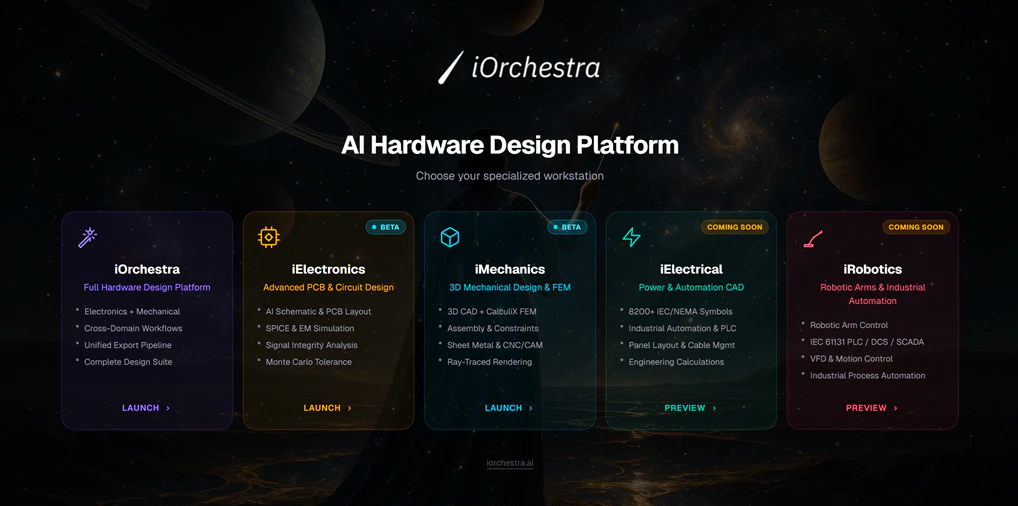
The platform that takes hardware engineers from a text prompt to a production-ready design in minutes not weeks Describe what you want. Our AI agents generate the PCB layout, schematic, mechanical design, and industrial design, across electrical, mechanical, thermal, and systems engineering disciplines. Then simulate it, iterate on it, auto-generate the Bill of Materials, and send it straight to manufacture The gap between idea and production hardware used to take months. We're making it minutes
AI Analysis
iOrchestra AI Hardware Engineers is a platform that converts text prompts into production-ready hardware designs in minutes. Core features include AI agents generating PCB layouts, schematics, mechanical and industrial designs across electrical, mechanical, thermal, and systems disciplines, plus simulation, iteration, auto-generated BOM, and direct manufacturing handoff. It solves key pain points of traditional hardware development taking months, high costs, and need for multidisciplinary expertise. Unique selling point is end-to-end AI orchestration accelerating the gap from idea to manufactured product. Overall value proposition: enabling rapid innovation for engineers and teams.
In 2025-2026, timing is highly favorable due to maturing generative AI and AI agent technologies capable of complex engineering tasks, surging demand for faster hardware cycles in IoT, AI devices, robotics and consumer electronics, plus economic pressures to reduce development time amid global manufacturing innovation policies. Traditional bottlenecks create strong pull for such tools. Excellent Timing.
High technical difficulty in achieving accurate multi-physics simulation, reliable cross-discipline generation and manufacturing-ready outputs with AI. Development and compute operation costs are likely substantial. Supply chain integration, regulatory compliance for hardware, and scalability of quality control present risks. Team with AI/hardware expertise would fit well. Overall rating: Medium.
Main target segments: hardware engineers, electrical/mechanical designers, YC startups, product teams in electronics, IoT, robotics and consumer hardware industries, concentrated in tech hubs across US, Europe and Asia. Market for AI-enhanced hardware design tools shows strong demand. Core pain points: months-long design timelines, multidisciplinary expertise gaps, slow iteration. High willingness to pay for solutions slashing time to minutes and streamlining to manufacture.
Medium. Direct competitors: 1. Flux (flux.ai) - AI-powered PCB and circuit design. 2. Celus (celus.io) - AI-driven electronics design automation. 3. Autodesk Fusion with generative design (autodesk.com). 4. Siemens Xpedition/EDA AI tools (eda.sw.siemens.com). 5. Cadence Cerebrus (cadence.com). Advantages: full prompt-to-manufacture pipeline with multi-discipline AI agents, simulation and BOM integration. Disadvantages: early-stage with unproven real-world accuracy at scale versus established CAD platforms with broader validation.
Upgrade Pro to unlock full AI analysis
Similar Products

Auriko
Trading desk for LLM calls
▲ 332 votes

Cohere Parse 5
Turn complex docs, tables & images into AI-ready data
▲ 158 votes

Opaline
PostHog for team Claude Code and Codex sessions.
▲ 141 votes

Adapt
The company brain that gets work done
▲ 124 votes

Tapfree for Chrome
Voice dictation that adapts to what’s on your screen
▲ 122 votes

CodeBurn
See where your AI coding spend actually goes
▲ 101 votes