
Kanwas
An open-source brain for your team
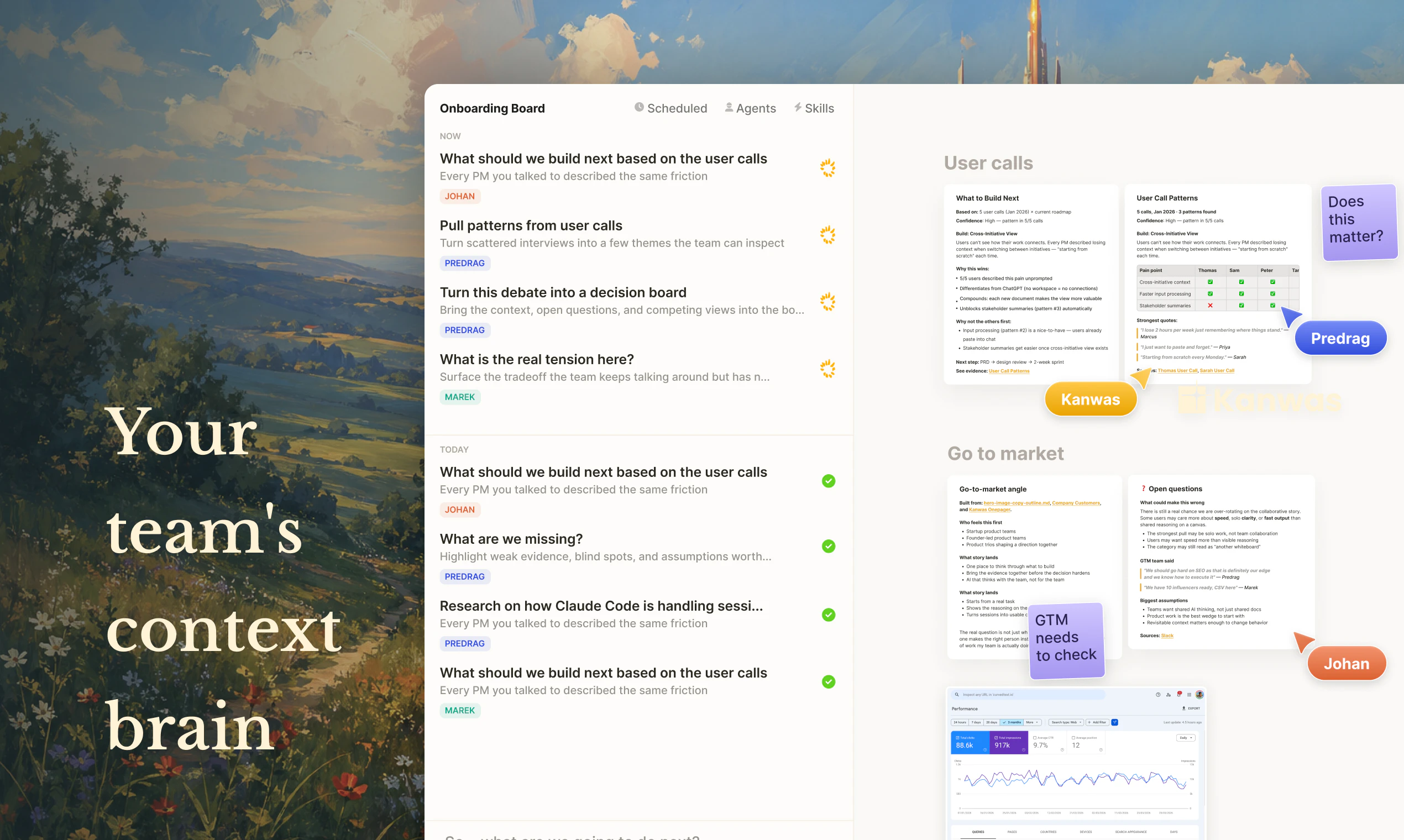
For you, your agent, your coworker and their agent. It holds the team's critical know-how, research, decisions and data. But it's not a dead storage. It's a workspace that makes the context workable for humans as well as agents.
AI Analysis
Kanwas is an open-source workspace serving as a living 'brain' for teams and AI agents. It centrally holds critical know-how, research, decisions, and data, transforming static storage into an interactive, workable context for both humans and agents. Core features focus on collaborative knowledge management and seamless AI integration. It solves key pain points like information silos, inaccessible knowledge for AI tools, and lack of actionable shared context. Unique selling points include its open-source nature and dual optimization for human-AI teamwork. The value proposition is enhanced team productivity through a dynamic knowledge ecosystem that empowers intelligent collaboration.
The current market timing is favorable for 2025-2026. With rapid maturation of AI agent technologies, growing demand for tools that provide reliable context to AI systems, and increasing adoption of hybrid human-AI workflows in productivity software, this aligns perfectly. Economic pressures for efficiency and supportive tech policies further boost it. It's a good time as shared knowledge infrastructure becomes essential for agentic AI. Rating: Excellent Timing.
Overall feasibility is high. Technical difficulty is moderate leveraging existing AI/LLM frameworks and open-source components. Development and operation costs are reduced via community contributions. Minimal supply chain risks as a pure software product; compliance focuses on standard data privacy. Strong scalability potential through self-hosting or cloud. Good fit for teams with AI expertise. Rating: High. Key reasons: open-source model accelerates development and adoption.
Main target user segments: Tech teams, AI developers, product and research groups in startups and mid-sized companies (demographics: 25-40 years old knowledge workers). Industries: Software, AI/ML, consulting. Geographic distribution: Global, with early traction in North America and Europe. Estimated market size: TAM $20B+ (AI productivity tools), SAM $2B (team knowledge platforms), SOM $300M (open-source AI knowledge). Core pain points: Fragmented team knowledge and poor context sharing with agents. Potential willingness to pay: Moderate to high for hosted/premium support despite open-source core.
Competition level: Medium. Direct competitors: 1. Notion (notion.so), 2. Obsidian (obsidian.md), 3. Mem (mem.ai), 4. Anytype (anytype.io), 5. Danswer (danswer.dev). This product's advantages: Deep agent integration and open-source focus for workable team context, strong differentiation for AI-human workflows. Disadvantages: Likely less polished UI and smaller user base than Notion/Mem, narrower feature set compared to established all-in-one tools, potential challenges in building ecosystem.
Upgrade Pro to unlock full AI analysis
Similar Products

Cohere Parse 5
Turn complex docs, tables & images into AI-ready data
▲ 158 votes

Opaline
PostHog for team Claude Code and Codex sessions.
▲ 141 votes

Adapt
The company brain that gets work done
▲ 124 votes

Kosshi
Simple, fast outliner for Mac and iPhone.
▲ 90 votes

Thoughts for Mac
Capture notes from your menubar using text, images or voice
▲ 90 votes
Refoid
Automate App Store refund responses and track every outcome
▲ 68 votes