Keel
An AI assistant whose memory belongs to you
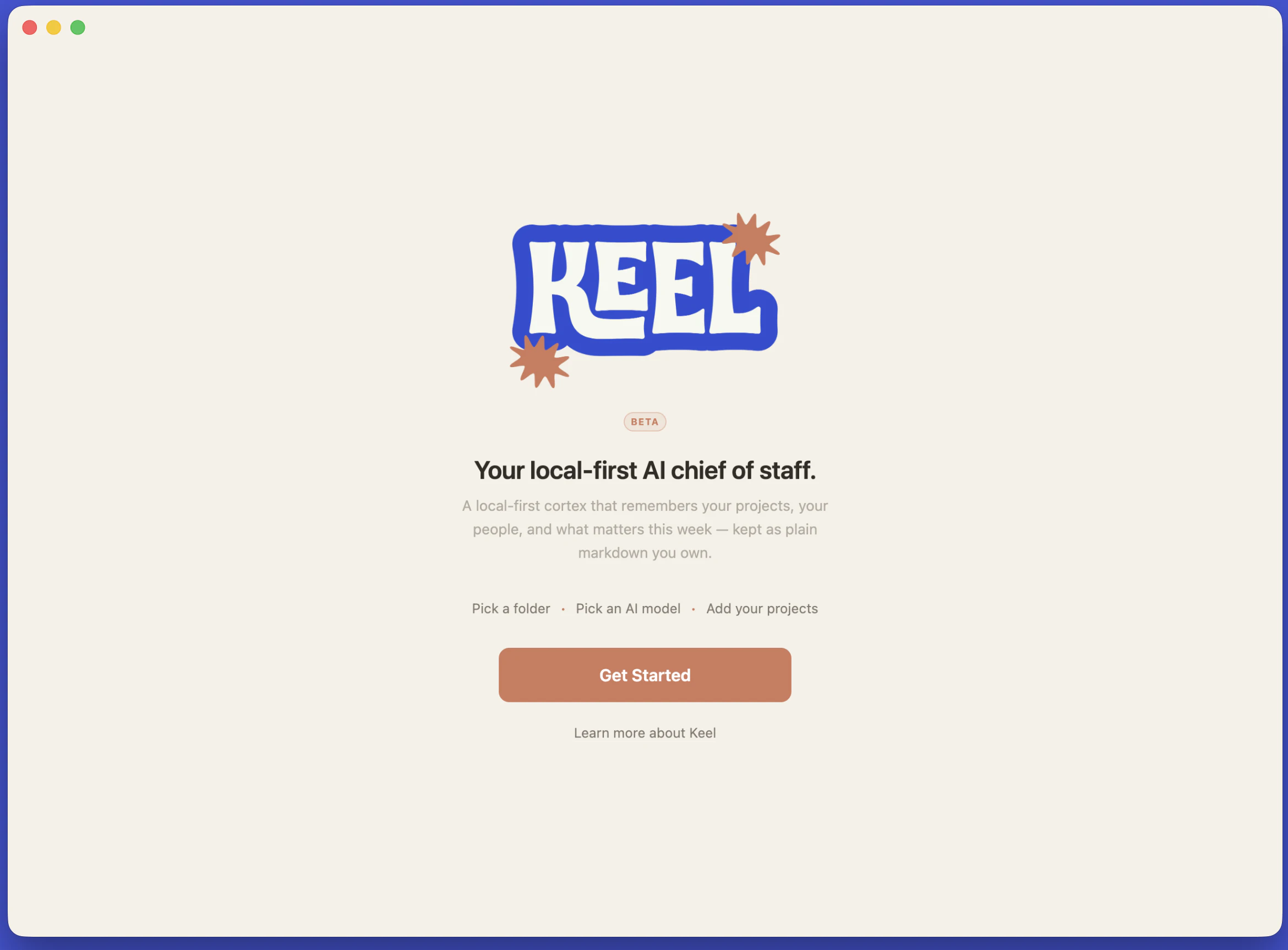
Keel is a local-first desktop app for macOS and Windows that captures what matters from your conversations into plain markdown files on your disk. Bring your own model - Claude, GPT, OpenRouter, or Ollama. Your context stays with you, not the vendor. Open source, MIT. https://keel-labs.github.io/
AI Analysis
Keel is a local-first desktop app for macOS and Windows that functions as a personal AI assistant. It automatically captures meaningful insights from conversations with AI models and saves them as plain Markdown files stored directly on the user's disk. It supports bring-your-own-model integration with Claude, GPT, OpenRouter, or Ollama. As an open-source project under the MIT license, its core USP is full user ownership of memory and context, avoiding vendor lock-in and privacy risks. It solves key pain points like fragmented conversation histories, lack of data portability, and dependency on cloud providers. The value proposition is a personal, controllable AI memory system that lives in simple, future-proof files users can edit, search, and own indefinitely.
In 2025-2026, with exploding AI adoption, maturing local LLMs (e.g. Ollama), growing privacy regulations, and rising demand for data ownership amid vendor lock-in concerns, timing is highly favorable. The local-first movement is gaining traction as users tire of cloud-only tools. Excellent Timing.
Technical difficulty is moderate using existing desktop frameworks and AI SDKs; no heavy backend or supply chain needed. Development and operation costs are low due to local-first design and open-source model. Minimal compliance risks for a privacy-focused tool. Strong scalability for personal use with potential community contributions. Overall rating: High. Key reasons: leverages mature technologies like Ollama and requires no servers.
Main segments: tech-savvy developers, AI enthusiasts, privacy-conscious knowledge workers and indie hackers (ages 25-45), concentrated in US, Europe, and tech hubs. Industries: software engineering, content creation, research. Estimated market: AI productivity tools TAM >$50B, local-first AI SAM ~$2B, SOM ~$50M for this niche. Core pains: loss of control over AI chat data and non-portable histories. Willingness to pay: moderate; open-source nature suggests freemium or donation model.
Medium. Direct competitors: 1. Mem (mem.ai) - cloud knowledge base; 2. Reflect (reflect.app) - networked notes with AI; 3. Limitless (limitless.ai) - AI wearable memory; 4. Obsidian + Copilot plugin (obsidian.md); 5. AnythingLLM (anythingllm.com) - local document AI. Advantages: fully local markdown files, true data ownership, open-source MIT, no subscription lock-in. Disadvantages: potentially less polished UI/UX than commercial tools, requires user to manage own models, desktop-only vs cross-platform cloud alternatives.
Upgrade Pro to unlock full AI analysis
Similar Products

Cohere Parse 5
Turn complex docs, tables & images into AI-ready data
▲ 158 votes

Opaline
PostHog for team Claude Code and Codex sessions.
▲ 141 votes

Adapt
The company brain that gets work done
▲ 124 votes

Tapfree for Chrome
Voice dictation that adapts to what’s on your screen
▲ 122 votes

React UI Kit V7
All the chat components you need. None of the complexity
▲ 115 votes

Coarena by Coasty
The arena where agents battle on real-world work
▲ 104 votes