
Khaos Brain
Local predictive memory for AI agents
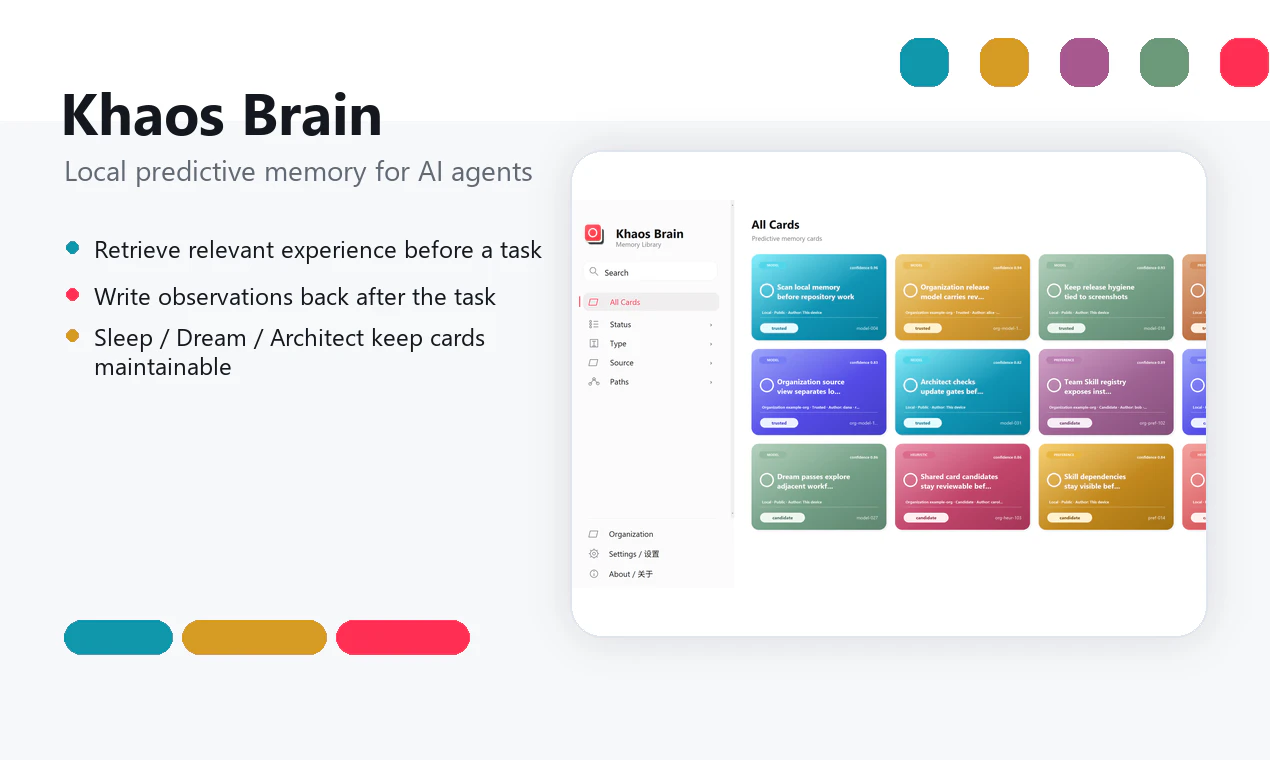
Khaos Brain is a local-first predictive memory system for AI agents. It turns task experience, preferences, workflow lessons, and skill-use evidence into visible Git-versioned cards. Agents retrieve relevant cards before work, write observations afterward, and Sleep/Dream/Architect maintenance keeps the library reviewable instead of becoming a black-box memory store.
AI Analysis
Khaos Brain is a local-first predictive memory system for AI agents. It converts task experiences, preferences, workflow lessons, and skill evidence into visible, Git-versioned cards. Core features include retrieving relevant cards before tasks, writing observations afterward, and Sleep/Dream/Architect modes for library maintenance to prevent black-box memory issues. It solves the pain of opaque, uninspectable agent memory stores by providing transparency, version control, and reviewability. USP is its predictive, human-visible approach that evolves with use while remaining fully local and open.
2025-2026 sees explosive growth in AI agents, local AI runtimes, and demand for transparent, debuggable systems amid regulatory pushes for AI explainability. Technology maturity in local LLMs and Git tooling makes this viable now. Changing demands for reliable autonomous agents favor predictive memory solutions. Excellent Timing.
Technical difficulty is moderate, leveraging mature Git and embedding tech but requiring tight AI agent integration. Low development costs as a dev tool; minimal supply chain or compliance risks (local-first). Strong scalability potential for open-source growth. High feasibility with good team fit for AI/Git engineers.
Primary users: AI developers, autonomous agent builders, open-source enthusiasts (developers/engineers, 25-40yo). Industries: AI/ML, software tooling. Geographic: Global, concentrated in US, Europe, China tech hubs. TAM for AI memory/tools ~$5-10B, SAM ~$800M, SOM ~$50M. Pain points: uninspectable agent memory hindering debugging/improvement. High willingness to pay for premium reliability features.
Medium. Direct competitors: 1. Mem0 (mem0.ai), 2. Zep (getzep.com), 3. Letta/MemGPT (letta.ai), 4. LangChain Memory modules, 5. Recall (recall.ai). Advantages: fully local, Git-versioned visible cards, unique Sleep/Dream/Architect maintenance for reviewability. Disadvantages: potentially narrower integrations and less enterprise cloud features vs competitors. Strong differentiation via transparency and predictive card system.
Upgrade Pro to unlock full AI analysis
Similar Products

Cohere Parse 5
Turn complex docs, tables & images into AI-ready data
▲ 158 votes

Opaline
PostHog for team Claude Code and Codex sessions.
▲ 141 votes

Adapt
The company brain that gets work done
▲ 124 votes

Tapfree for Chrome
Voice dictation that adapts to what’s on your screen
▲ 122 votes

Replay QA Security Scan
Automated Penetration Testing for AI-Built Apps
▲ 102 votes

Refoid
Automate App Store refund responses and track every outcome
▲ 68 votes