
KiHub
Hardware review platform for KiCad projects
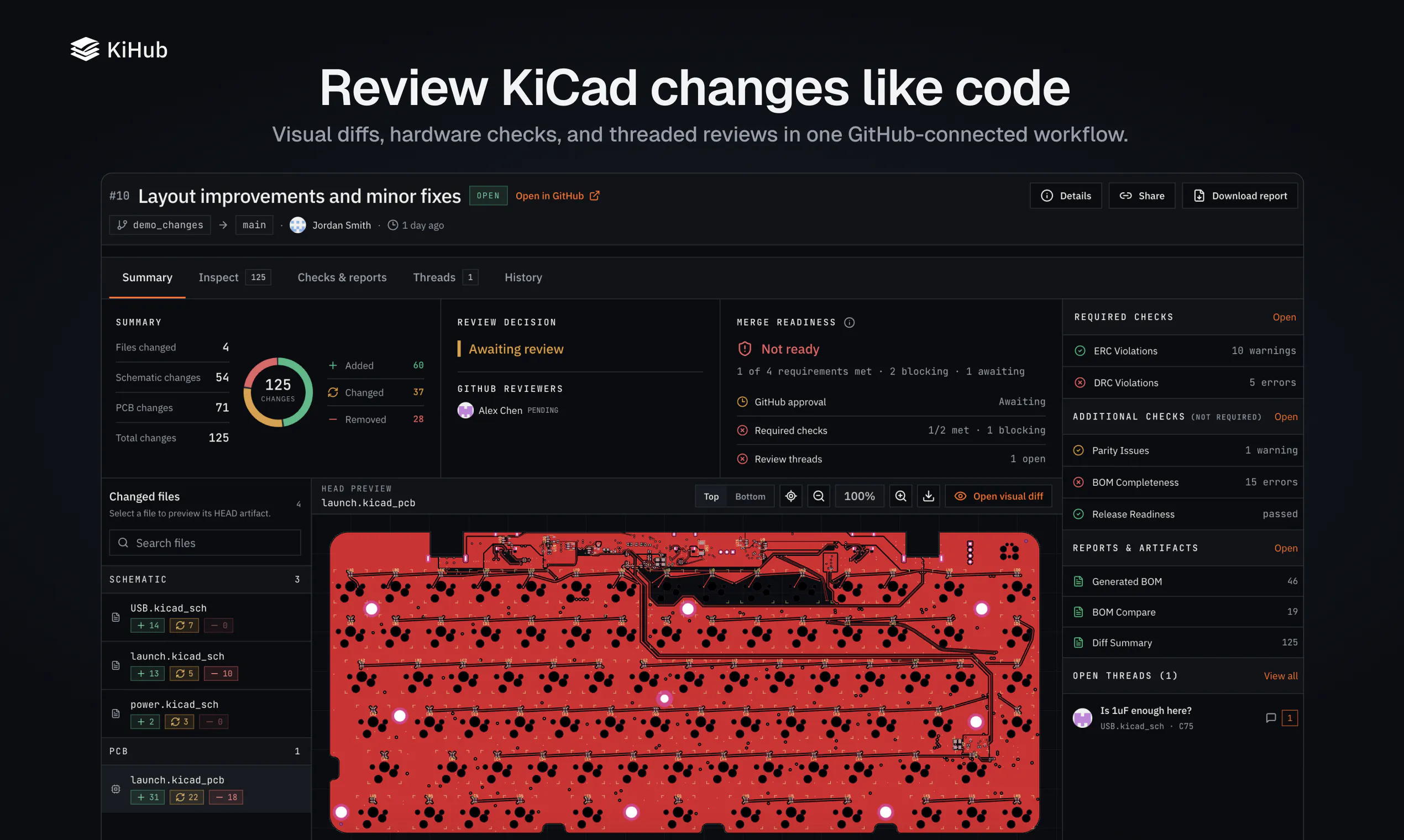
KiHub is a hardware review platform for KiCad projects. Compare schematic and PCB revisions, discuss changes with pinned comments, run automated checks, manage approvals, and keep a traceable review history — without changing your Git workflow.
AI Analysis
KiHub is a hardware review platform tailored for KiCad projects. Core features include side-by-side comparison of schematic and PCB revisions, pinned comments for targeted discussions, automated design rule checks, approval workflows, and full review history tracking. It integrates directly with existing Git and GitHub workflows. It solves major pain points like poor visibility into hardware design changes, scattered feedback via emails or meetings, lack of structured approvals, and difficulty maintaining audit trails. The value proposition is to adapt proven software code review best practices to hardware development, boosting collaboration, quality, and speed for electronics teams without workflow disruption.
Favorable for 2025-2026 due to surging adoption of KiCad as a mature open-source EDA alternative to costly proprietary tools, growth in open-source hardware and IoT/electronics startups, and increasing demand for remote collaborative tools post-pandemic. Web-based visualization tech is mature, and AI-assisted automated checks align with industry trends. Supportive economic push for faster innovation cycles in hardware. Excellent Timing.
Medium. Technical difficulty is notable for accurate KiCad file parsing, visual diffing of multi-layer PCBs/schematics, and reliable automated checks, though open-source parsers can help. Development and operation costs for a Git-integrated SaaS are moderate. Low supply chain risk but potential compliance needs for data security. Strong scalability via cloud, but requires specialized EDA/web expertise for team fit.
Primary segments: Professional hardware/electronics engineers, PCB designers, embedded systems developers, and open-source hardware contributors; mainly in hardware startups, IoT/consumer electronics firms. Global distribution with concentration in US, Europe, China. Estimated TAM/SAM/SOM: Niche within growing EDA collaboration space (KiCad user base in hundreds of thousands); core pain points are slow error-prone review cycles. Moderate-to-high willingness to pay for teams needing efficiency and traceability.
Low. Direct competitors: 1. Altium 365 (altium.com) - cloud collaboration but tied to Altium ecosystem. 2. Cadence OrCAD/Allegro collaboration tools (cadence.com) - enterprise-focused and expensive. 3. GitHub (github.com) - basic file diffs without hardware-specific visuals or checks. 4. OpenBOM (openbom.com) - focuses on BOM/plm rather than schematic/PCB reviews. Advantages: Deep KiCad integration, Git-native experience, pinned comments and approvals tailored for hardware. Disadvantages: Limited to KiCad users, newer player with less brand recognition and potentially higher learning curve.
Upgrade Pro to unlock full AI analysis
Similar Products

Opaline
PostHog for team Claude Code and Codex sessions.
▲ 141 votes

React UI Kit V7
All the chat components you need. None of the complexity
▲ 115 votes

Replay QA Security Scan
Automated Penetration Testing for AI-Built Apps
▲ 102 votes

CodeBurn
See where your AI coding spend actually goes
▲ 101 votes

Audryo
Customer email your agent can operate.
▲ 68 votes

Refoid
Automate App Store refund responses and track every outcome
▲ 68 votes