
Kim Personal Health Assistant
The intelligence layer for Apple Health
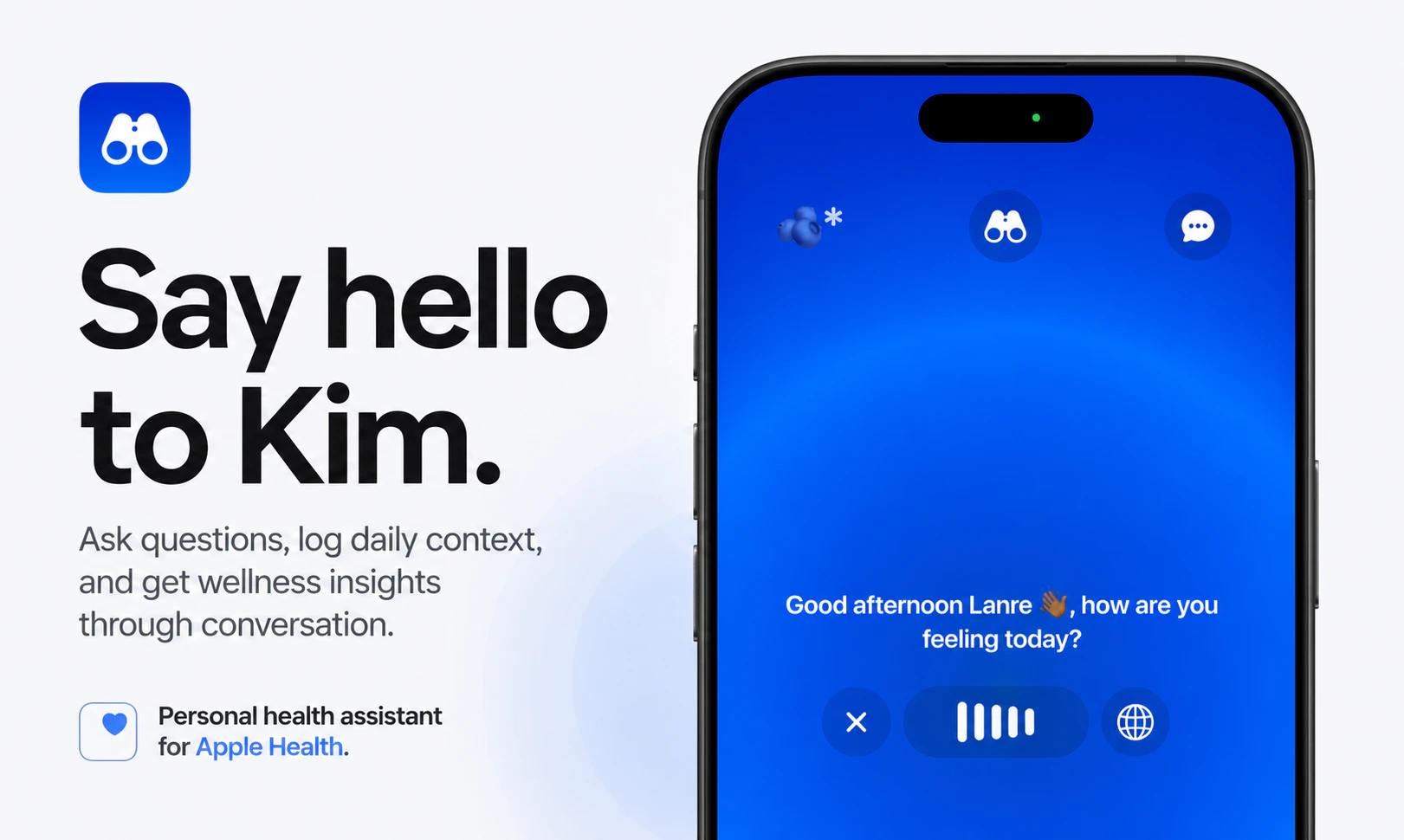
Meet Kim, a personal health assistant that turns your health data into simple conversations and personal experiments, helping you understand what actually works for your body. Kim becomes more personalized the more data you provide.
AI Analysis
Kim is an AI personal health assistant acting as the intelligence layer for Apple Health. It transforms complex health data into natural conversations, suggests personalized experiments (e.g., testing lifestyle impacts on metrics like sleep or energy), and improves with more user data. Core features include conversational insights and custom experiments. It solves the pain of overwhelming, uninterpretable health data from wearables by making it actionable without requiring expertise. USP: Deep personalization via experiments and dialogue. Value proposition: Helps users discover what uniquely works for their body to optimize health decisions.
Favorable in 2025-2026 with booming AI adoption (mature LLMs for conversation), surging demand for personalized preventive health post-pandemic, widespread Apple Watch/Health app usage, and wellness trends. Economic focus on health tech supports it, though privacy regs are stricter. Excellent Timing.
Technically feasible via Apple HealthKit API and LLM integration; moderate dev/ops costs as SaaS. Low supply chain risk (software-only). Risks include health compliance (must avoid medical advice, potential regulatory scrutiny) and data privacy. Strong scalability potential. Overall: Medium due to regulatory and accuracy challenges in health AI.
Tech-savvy iOS users aged 25-45, fitness/biohacking enthusiasts, Apple Watch owners in US/Europe seeking personalized insights. Core pains: Difficulty linking lifestyle to health outcomes from raw data. TAM for AI digital health ~$200B by 2026; SAM for conversational health AI ~$8B; SOM ~$500M with focused marketing. High willingness to pay for subscriptions if proven value.
Medium. Direct competitors: 1. Levels (levelshealth.com) - metabolic experiments via CGM. 2. Oura (ouraring.com) - AI recovery insights. 3. Whoop (whoop.com) - AI coaching tied to hardware. 4. Zoe (joinzoe.com) - personalized nutrition tests. 5. Lark Health (lark.com) - AI chronic care coach. Advantages: Broad Apple Health integration, conversational experiments without extra hardware. Disadvantages: Relies on user data quality, less established brand, potential higher AI usage costs vs hardware competitors.
Upgrade Pro to unlock full AI analysis
Similar Products

Cohere Parse 5
Turn complex docs, tables & images into AI-ready data
▲ 158 votes

Opaline
PostHog for team Claude Code and Codex sessions.
▲ 141 votes

Adapt
The company brain that gets work done
▲ 124 votes

Cercle
The bat signal for your closest friends.
▲ 121 votes

Coarena by Coasty
The arena where agents battle on real-world work
▲ 104 votes

WikiFix for Confluence
Find and fix issues in your knowledge base
▲ 86 votes