
Kimi Work
The AI desktop for knowledge work
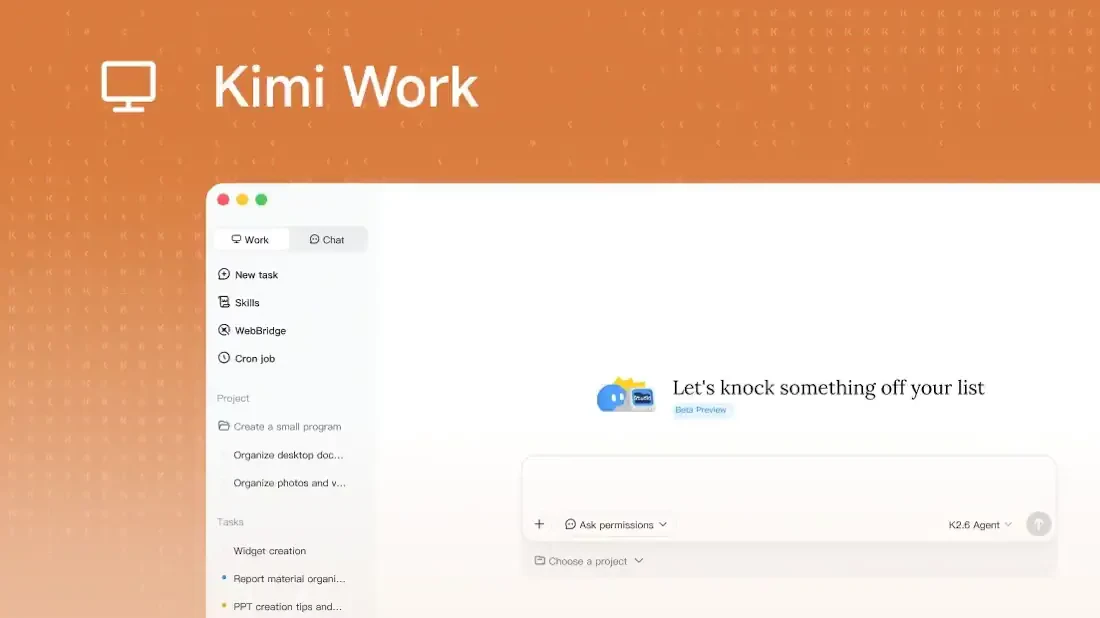
Kimi Work is a desktop agent for knowledge work. It connects to local files, uses WebBridge for browser automation, runs scheduled tasks, coordinates agent swarms, creates PPT/Excel/Word/PDF outputs, and includes native finance data tools.
AI Analysis
Kimi Work is a desktop AI agent for knowledge work that connects directly to local files, automates web tasks via WebBridge, runs scheduled automations, coordinates swarms of agents for complex projects, and natively generates PPT, Excel, Word, and PDF outputs. It includes specialized finance data tools for analysis and reporting. It addresses key pain points for knowledge workers such as fragmented workflows, manual data gathering across local and online sources, repetitive formatting tasks, and time lost switching between applications. The core value proposition is transforming the computer into an intelligent, autonomous workspace that executes end-to-end knowledge tasks, dramatically improving productivity and reducing cognitive load.
In 2025-2026, the explosion of LLM-powered agents, maturing multi-agent frameworks, rising demand for desktop automation beyond chat interfaces, and enterprise focus on AI-driven productivity create perfect conditions. Local computing capabilities and browser APIs have advanced sufficiently while economic pressure to cut knowledge work costs remains high. Policy support for AI innovation in key markets further helps. This is an ideal window before the space becomes saturated. Rating: Excellent Timing.
Technical difficulty is significant due to reliable local file system integration, stable cross-platform browser automation, multi-agent orchestration, and accurate document generation. Development and maintenance costs for a desktop application are high, with notable compliance risks around data privacy and financial data handling. However, leveraging existing LLM APIs, Electron framework, and established automation libraries improves feasibility. Scalability is strong via cloud-agent coordination. Overall rating: Medium, primarily limited by execution complexity and reliability requirements.
Primary users are knowledge workers (financial analysts, consultants, researchers, managers) aged 25-45 working in finance, consulting, technology, and research industries. Initial focus likely in China with global expansion. TAM for AI productivity tools exceeds $50B, SAM for desktop/web agents around $8B, SOM for early adopters approximately $300M. Core pain points include information overload, repetitive manual tasks, and inefficient report creation. Willingness to pay is strong (potential $20-60/month subscriptions) for solutions delivering measurable time savings.
Competition Level: Medium. Direct competitors: 1. Bardeen (bardeen.ai), 2. MultiOn (multion.ai), 3. Adept (adept.ai), 4. Anthropic Claude Computer Use (anthropic.com), 5. Microsoft Copilot (microsoft.com/copilot). Advantages vs competitors: deeper native local file access, built-in agent swarm coordination, specialized finance data tools, and direct generation of editable office documents within a unified desktop environment. Disadvantages: newer market entrant with potentially less brand trust, higher local computing demands, and less mature ecosystem integrations compared to Microsoft or Anthropic offerings. Strong differentiation as a dedicated 'AI desktop'.
Upgrade Pro to unlock full AI analysis
Similar Products

Cohere Parse 5
Turn complex docs, tables & images into AI-ready data
▲ 158 votes

Opaline
PostHog for team Claude Code and Codex sessions.
▲ 141 votes

Adapt
The company brain that gets work done
▲ 124 votes

Kosshi
Simple, fast outliner for Mac and iPhone.
▲ 90 votes

WikiFix for Confluence
Find and fix issues in your knowledge base
▲ 86 votes

Refoid
Automate App Store refund responses and track every outcome
▲ 68 votes