
Knowly 1.0
LLM Wiki + NotebookLM, in one closed-loop Proactive AI
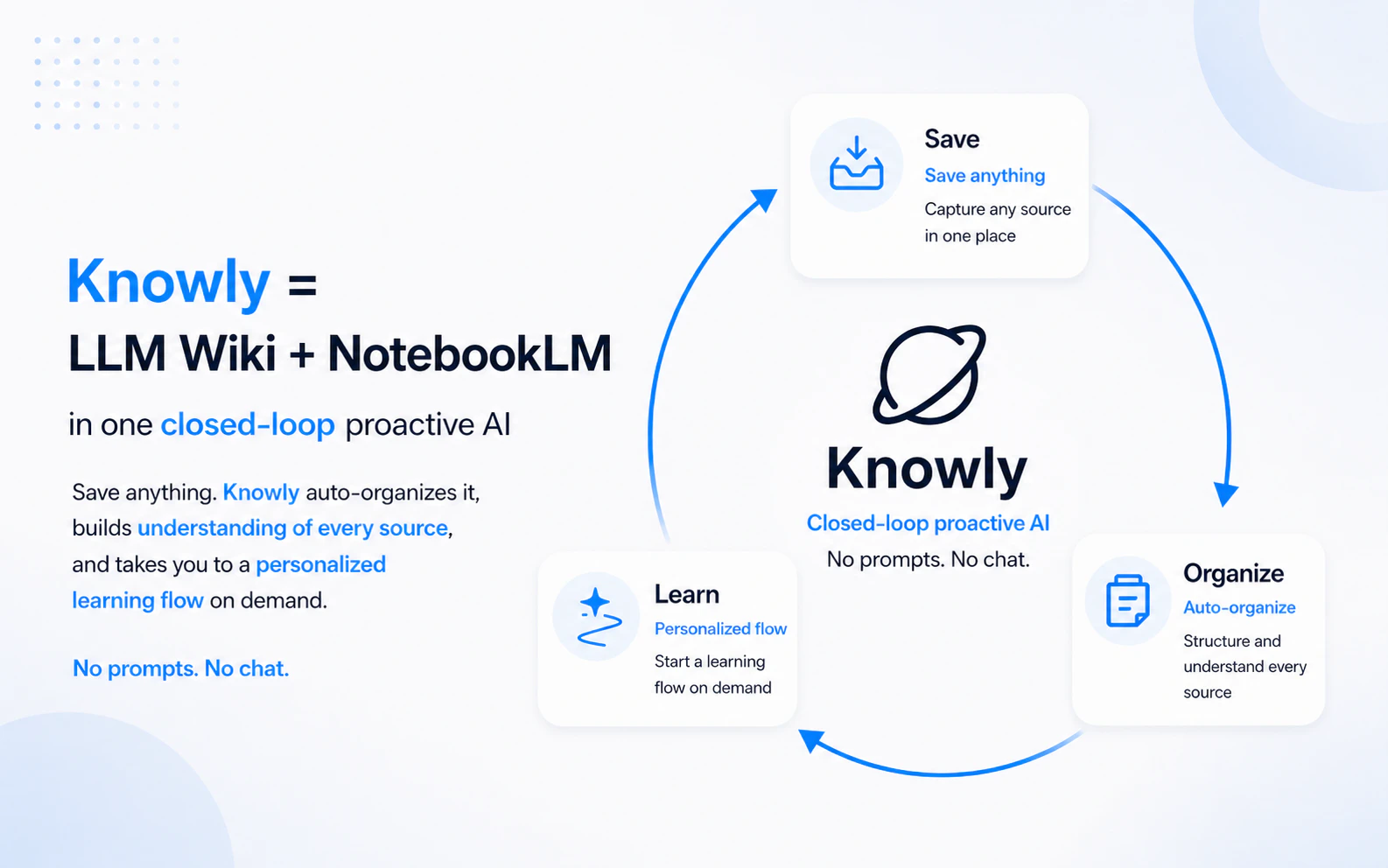
Knowly = Karpathy's LLM Wiki + NotebookLM in one closed-loop proactive AI for learning. Save anything → Knowly auto-organizes it, builds understanding of every source, and takes you to a personalized learning flow on demand.
AI Analysis
Knowly 1.0 combines Karpathy's LLM Wiki concept with NotebookLM into a closed-loop proactive AI for learning. Users save any content (notes, articles, etc.), and the system auto-organizes it, builds contextual understanding of every source, and generates personalized learning flows on demand. Core features include intelligent ingestion, automatic knowledge structuring, deep source comprehension, and adaptive proactive guidance. It solves key pain points like information disorganization, passive consumption without retention, and lack of personalized paths from saved materials. The value proposition is transforming scattered inputs into an intelligent, self-improving learning companion that delivers tailored educational experiences.
The timing is favorable for 2025-2026 as LLMs and multimodal AI reach maturity, enabling sophisticated personalization. Rising demand for efficient self-directed learning tools aligns with remote/hybrid education trends and AI integration in edtech. Economic focus on productivity AI and supportive policies for digital learning further boost adoption. Excellent Timing.
Technical difficulty is moderate by building on existing LLM APIs and vector databases for organization and personalization. Development costs include AI inference and data processing; operational costs may be high due to compute needs. Low supply chain risk but compliance with data privacy is essential. Strong scalability via cloud infrastructure. Overall rating: High, assuming an AI-experienced team.
Primary segments: tech-savvy lifelong learners, university students, researchers, and knowledge professionals aged 18-40. Industries: education, professional development, and self-improvement. Geographic focus: global with strong adoption in US, Europe, and East Asia. Estimated TAM for AI-powered online learning ~$50B+, SAM for personalized AI tutors ~$5-10B, SOM depending on capture ~$200-500M initially. Core pains: fragmented knowledge management and lack of structured guidance. High willingness to pay for subscription-based premium personalization.
Medium. Direct competitors: 1. NotebookLM (notebooklm.google.com), 2. Notion AI (notion.so/ai), 3. Mem (getmem.com), 4. Reflect (reflect.app), 5. Obsidian with AI plugins (obsidian.md). Advantages: seamless closed-loop proactive flows and automatic wiki-style organization from any saved content. Disadvantages: as a newer entrant, may have less brand recognition, fewer integrations, and unproven long-term accuracy compared to established tools like NotebookLM and Notion. Differentiation via 'proactive AI' learning paths provides strong positioning.
Upgrade Pro to unlock full AI analysis
Similar Products

Auriko
Trading desk for LLM calls
▲ 332 votes

Cohere Parse 5
Turn complex docs, tables & images into AI-ready data
▲ 158 votes

Opaline
PostHog for team Claude Code and Codex sessions.
▲ 141 votes

Adapt
The company brain that gets work done
▲ 124 votes

Tapfree for Chrome
Voice dictation that adapts to what’s on your screen
▲ 122 votes

CodeBurn
See where your AI coding spend actually goes
▲ 101 votes