
Krisp Voice Translation API
Real-time speech-to-speech translation built for accuracy
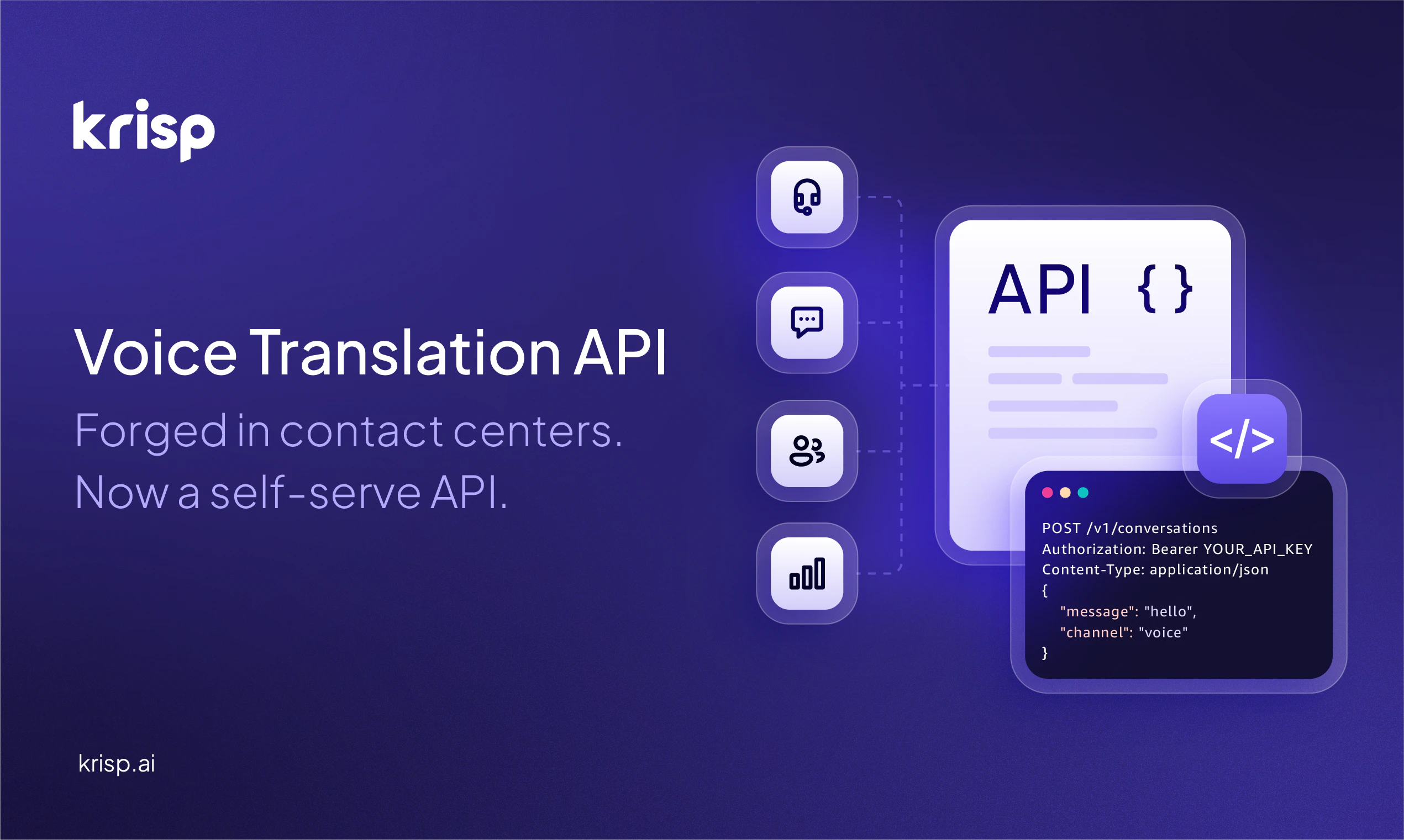
Most voice translation APIs work great in demos. Then real users show up with background noise, accents and verification code that gets garbled. We built our technology on a million live contact center calls where accuracy is non negotiable. 96% accuracy on real calls, zero patient safety incidents, 61+ languages with any to any pair. Translation API is now available self-serve with 60 mins free credit upon signup to dev dashboard.
AI Analysis
Krisp Voice Translation API delivers real-time speech-to-speech translation with 96% accuracy in challenging real-world conditions like background noise, accents, and garbled verification codes. Built using data from a million live contact center calls, it supports 61+ languages in any-to-any pairs and has recorded zero patient safety incidents. It addresses the core pain point that most voice translation APIs fail under actual user conditions despite performing well in demos. Unique selling points include its battle-tested reliability for high-stakes environments and self-serve availability with 60 minutes of free credit. The value proposition is providing dependable, accurate voice translation for mission-critical applications in customer service and healthcare.
In 2025-2026, market timing is favorable due to maturing AI speech technologies, exploding demand for real-time multilingual tools driven by global remote work, international customer support, and globalization trends. Economic pressures favor efficiency gains from accurate translation, while policy support for AI innovation and reduced language barriers in digital services align well. Krisp's focus on real-world accuracy addresses unmet needs as user expectations rise beyond demo-quality tools. Excellent Timing.
Feasibility is High. Technical difficulty is low as the solution is already proven on a million real calls with 96% accuracy. Development costs appear sunk; operation as a self-serve API enables scalability with usage-based pricing. Compute costs for real-time AI inference are a risk but manageable given existing infrastructure. Compliance risks are low for standard API usage outside regulated sectors like healthcare. Strong scalability potential via cloud delivery and established language coverage. High
Main target segments: Developers and engineering teams integrating voice AI (tech professionals aged 25-45), contact center operators, healthcare providers, and international businesses. Industries: BPO/customer service, telemedicine, global enterprise comms. Geographic distribution: Global with emphasis on US, Europe, and Asia-Pacific. Core pain points: Unreliable translations in noisy/accents-heavy real calls causing errors or safety issues. Estimated market: Growing voice AI translation sector with strong demand; high willingness to pay for accuracy in professional settings where failures have high costs.
Competition level: Medium. Direct competitors: 1. Google Cloud Translation API (cloud.google.com/translate), 2. Microsoft Azure Translator (azure.microsoft.com), 3. Amazon Translate (aws.amazon.com/translate), 4. IBM Watson Translator. This product differentiates with 96% real-call accuracy from contact-center training data, superior noise/accent handling, and zero-incident record versus generic cloud APIs that falter in production. Advantages: Any-to-any 61 languages optimized for live accuracy; self-serve onboarding. Disadvantages: Smaller ecosystem and brand recognition compared to hyperscalers; pricing transparency not detailed in source info.
Upgrade Pro to unlock full AI analysis
Similar Products

Cohere Parse 5
Turn complex docs, tables & images into AI-ready data
▲ 158 votes

Opaline
PostHog for team Claude Code and Codex sessions.
▲ 141 votes

Replay QA Security Scan
Automated Penetration Testing for AI-Built Apps
▲ 102 votes

Audryo
Customer email your agent can operate.
▲ 68 votes

Refoid
Automate App Store refund responses and track every outcome
▲ 68 votes

Patchcord
Studio sound for your mic in every Mac meeting with EQ
▲ 64 votes