
layernote
Visual feedback on websites, Figma files, PDFs and images
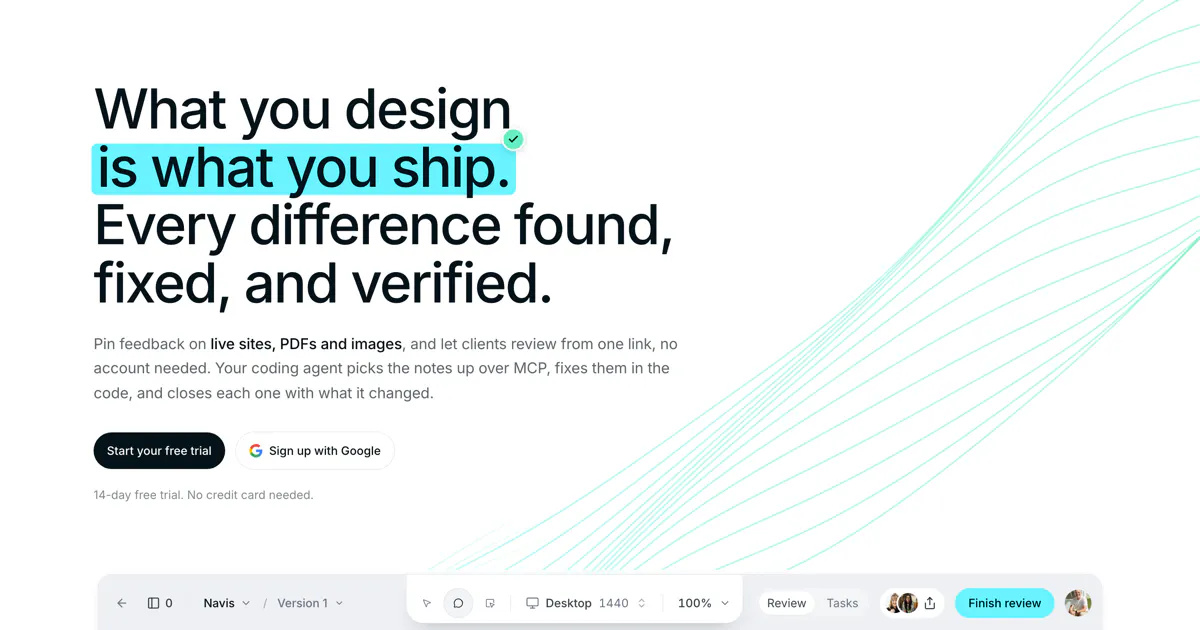
Collect visual feedback on live websites, PDFs and images. Clients pin comments through a share link, no account needed. Keep discussions and tasks in one place, and work through changes yourself or with your team. For website fixes, you can also hand feedback to your coding agent via MCP.
AI Analysis
LayerNote is a visual feedback platform for collecting pinned comments on live websites, Figma files, PDFs, and images via simple share links. Clients can participate without accounts. It centralizes discussions, tasks, and iterations in one place for individuals or teams. Unique integration allows handing website feedback directly to coding agents via MCP. It solves fragmented feedback loops across email, disparate tools, and miscommunication that slow design and development cycles. Value proposition: streamlined collaboration that accelerates revisions and bridges design-to-code workflows efficiently.
Favorable in 2025-2026 due to AI agent proliferation (e.g. coding agents), maturing no-code/low-code tools, and sustained demand for remote asynchronous collaboration. Post-pandemic work patterns and focus on faster product iteration align well. Economic pressures favor productivity SaaS that reduce meetings and email overhead. The MCP integration for AI handoff is particularly timely. Excellent Timing.
High. Technical implementation for multi-format annotation (web, Figma, PDF, images) is established though requires solid frontend and backend engineering. Development and cloud operation costs are moderate for SaaS. Minimal supply chain risk; main compliance considerations are data privacy (GDPR). Good scalability via cloud infrastructure. Strong potential if team has relevant web/dev tool experience. High
Primary segments: UI/UX designers, frontend developers, digital agencies, product teams in tech and creative industries. Demographics: professionals aged 25-45. Geographic: global with concentration in US, Europe, and Asia tech hubs. TAM for design collaboration software approx $4-6B; SAM for visual feedback tools ~$800M; SOM for this niche ~$50M initially. Core pains: scattered client feedback and slow iteration cycles. Moderate-to-high willingness to pay for time-saving tools ($15-49/mo typical).
Medium. Direct competitors: 1. Usersnap (usersnap.com), 2. BugHerd (bugherd.com), 3. Marker.io (marker.io), 4. Filestage (filestage.io). Advantages: broad format support (live sites + PDFs + Figma), zero-account client access, unique MCP coding-agent integration for direct fixes. Disadvantages: newer entrant with likely lower brand recognition, potentially fewer enterprise features or integrations compared to established players; pricing not specified but must compete on value. Medium
Upgrade Pro to unlock full AI analysis
Similar Products

Adapt
The company brain that gets work done
▲ 124 votes

Tapfree for Chrome
Voice dictation that adapts to what’s on your screen
▲ 122 votes

Kosshi
Simple, fast outliner for Mac and iPhone.
▲ 90 votes

Thoughts for Mac
Capture notes from your menubar using text, images or voice
▲ 90 votes

Polygram
AI-native design and coding app to build mobile & web apps
▲ 81 votes

Refoid
Automate App Store refund responses and track every outcome
▲ 68 votes