Lenz
Independent, multi-model fact-checking API for AI workflows
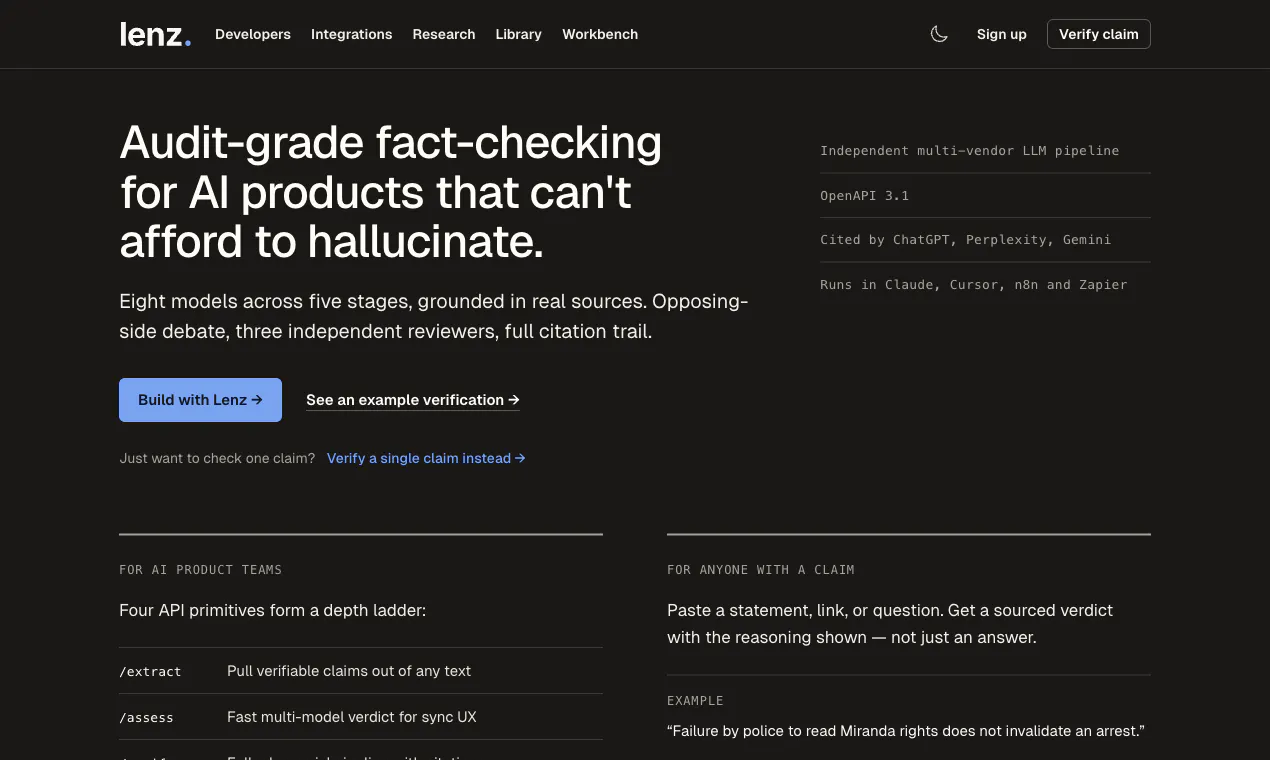
Lenz is an AI fact-checking API for products that cannot afford to hallucinate. It extracts verifiable claims from any text, then checks each one: searching independent sources, running multi-model debate, and routing through a review panel — returning a scored verdict with every source, argument, and step visible. Most AI tools give you one model's best guess from memory. Lenz ensures no single model's blind spots drive the conclusion. Available as API and MCP. Try it free at lenz.io/ph
AI Analysis
Lenz is an independent, multi-model fact-checking API for AI workflows. It extracts verifiable claims from any text, then verifies each by searching independent sources, running multi-model debates, and routing through a review panel. It returns a scored verdict with full visibility into sources, arguments, and steps. Unlike single-model outputs prone to hallucinations, Lenz avoids individual model blind spots. USP: transparent, rigorous verification process available via API and MCP. It solves the critical pain point of unreliable AI outputs in applications where accuracy is essential, delivering trustworthy results with free trial at lenz.io.
In 2025-2026, AI adoption is accelerating across industries while regulatory focus on AI trustworthiness, transparency, and reducing hallucinations is intensifying (e.g., EU AI Act implications). User demands are shifting from generative capability to verifiable reliability amid high-profile hallucination failures. Technology for multi-LLM orchestration and real-time search is mature enough. This makes it an optimal window for fact-checking solutions. Excellent Timing.
Technical difficulty is high due to integrating search engines, multiple LLMs for debate, claim extraction, and review logic, but feasible leveraging existing APIs and frameworks. Development and operation costs are significant from LLM inference and web queries, with scalability challenges for high volume. Compliance risks around data sourcing and privacy exist. Given it is already launched with API/MCP, scalability potential is strong for a skilled AI team. Overall rating: High.
Primary segments: AI/ML engineers and product teams building LLM-powered apps, particularly in high-stakes industries like legal, finance, healthcare, and enterprise SaaS. Demographics: tech professionals aged 25-45. Geographic focus: US, Europe, with global API access. Estimated TAM for AI safety/verification tools ~$10B by 2026, SAM for fact-checking APIs ~$1B, SOM ~$50M. Core pain: hallucinations causing errors, reputational damage, or liability. High willingness to pay for API reliability in production environments.
Medium. Direct competitors: 1. Patronus AI (patronus.ai) - enterprise LLM guardrails. 2. Vectara (vectara.com) - hallucination detection in RAG. 3. Galileo (rungalileo.io) - LLM evaluation platform. 4. Lakera (lakera.ai) - AI security and input/output guardrails. Advantages: unique independent multi-model debate + review panel with full source transparency vs. mostly single-pass or classifier approaches; strong differentiation for complex workflows. Disadvantages: potentially higher computational cost/latency; less established brand compared to earlier entrants.
Upgrade Pro to unlock full AI analysis
Similar Products

Cohere Parse 5
Turn complex docs, tables & images into AI-ready data
▲ 158 votes

Opaline
PostHog for team Claude Code and Codex sessions.
▲ 141 votes

Adapt
The company brain that gets work done
▲ 124 votes

Tapfree for Chrome
Voice dictation that adapts to what’s on your screen
▲ 122 votes

CodeBurn
See where your AI coding spend actually goes
▲ 101 votes

WikiFix for Confluence
Find and fix issues in your knowledge base
▲ 86 votes