
Liminary
Ground your AI in saved knowledge as you work
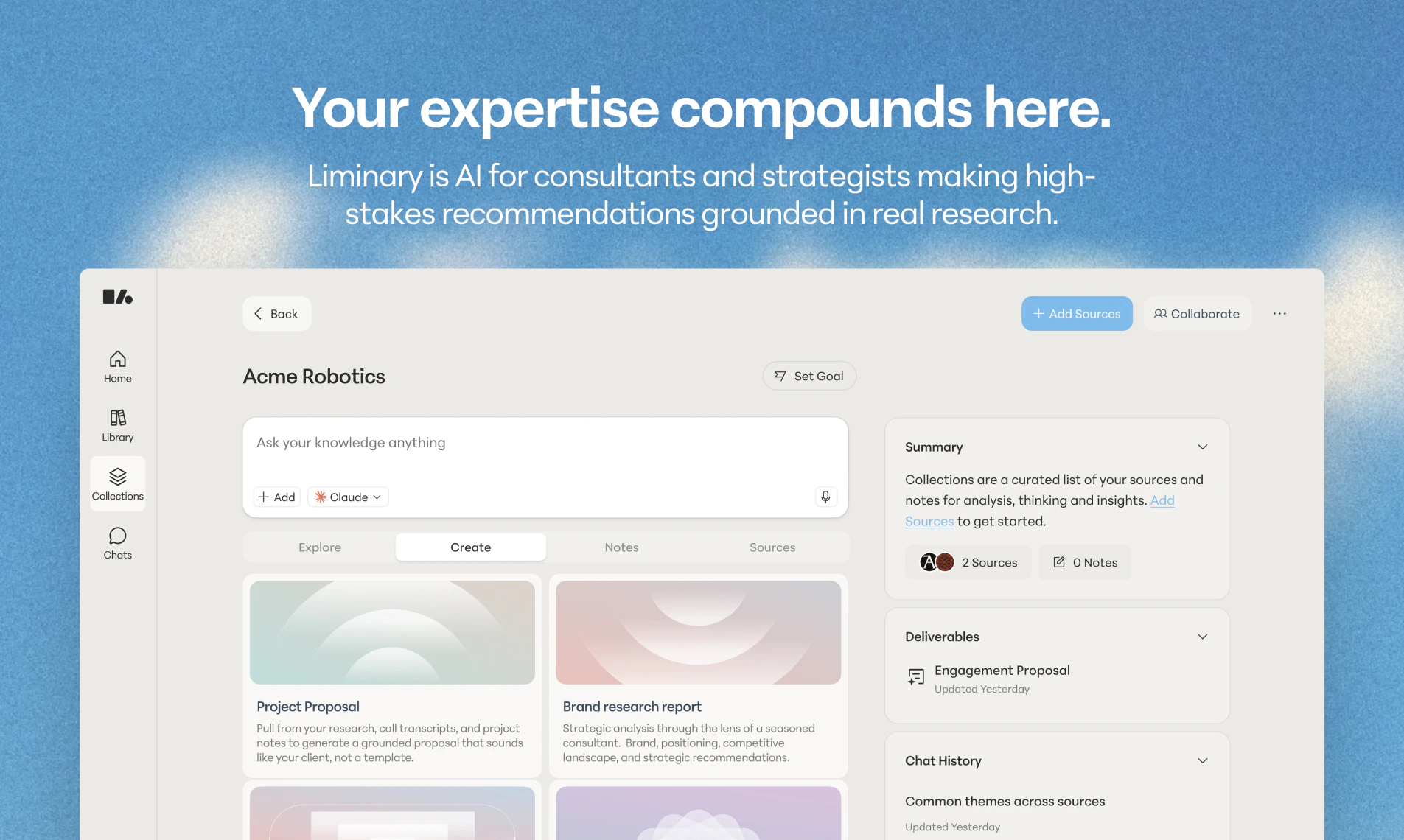
Liminary turns everything you’ve saved into working memory for AI. Unlike chatbots, meeting tools, or project-based notebooks, it gives your knowledge one shared memory across writing, meetings, and research. It surfaces relevant context automatically as you work, helping expert knowledge workers reuse their best thinking, avoid starting from scratch, and produce source-grounded work with traceable citations.
AI Analysis
Liminary transforms everything users have saved into working memory for AI. It creates one shared memory across writing, meetings, and research, automatically surfacing relevant context as you work. Unlike chatbots, meeting tools or project notebooks, it helps expert knowledge workers reuse their best thinking, avoid starting from scratch, and produce source-grounded outputs with traceable citations. It solves key pain points of fragmented knowledge, lack of context in AI interactions, and repetitive starting over. The value proposition is seamless, grounded AI assistance that boosts productivity and work quality for knowledge professionals.
In 2025-2026, market timing is highly favorable due to maturing LLM technologies, rising demand for context-aware AI to reduce hallucinations, and growing adoption of AI in daily productivity workflows. Users increasingly seek personalized tools grounded in their own knowledge rather than generic responses. Economic pressures for efficiency and innovation in knowledge work further support adoption. Excellent Timing.
Overall feasibility is High. Technical challenges in building cross-app context retrieval and RAG systems are manageable with current embedding and AI technologies. Development and LLM operational costs exist but are scalable. Privacy/compliance risks are present for a knowledge tool but addressable with standard practices. Strong scalability as a cloud service. Requires AI-savvy team but fits well for productivity SaaS. Rating: High.
Primary users are expert knowledge workers (researchers, consultants, analysts, writers) in industries like technology, consulting, academia, and professional services, concentrated in North America and Europe. TAM for AI productivity and knowledge tools is very large (hundreds of billions globally); SAM/SOM significant for personal/enterprise knowledge management segments. Core pain points include knowledge fragmentation, inefficient reuse of past work, and ungrounded AI outputs. High willingness to pay for time savings and quality gains via subscription.
Medium. Direct competitors: 1. Mem (mem.ai), 2. Notion AI (notion.so), 3. Reflect (reflect.app), 4. Capacities (capacities.io), 5. Tana (tana.inc). Advantages vs competitors: proactive automatic context surfacing during work (not just search), unified cross-tool shared memory, strong emphasis on traceable citations. Disadvantages: newer player with potentially less mature feature set or integrations than Notion; relies on users actively saving content first. Solid differentiation in positioning as 'working memory' reduces some pressure.
Upgrade Pro to unlock full AI analysis
Similar Products

Cohere Parse 5
Turn complex docs, tables & images into AI-ready data
▲ 158 votes

Opaline
PostHog for team Claude Code and Codex sessions.
▲ 141 votes

Adapt
The company brain that gets work done
▲ 124 votes

Kosshi
Simple, fast outliner for Mac and iPhone.
▲ 90 votes

Thoughts for Mac
Capture notes from your menubar using text, images or voice
▲ 90 votes
Refoid
Automate App Store refund responses and track every outcome
▲ 68 votes